Written by: Igor
Published: December 2025
Choosing between staff augmentation vs managed services comes down to a simple trade-off: control versus outcome. Staff augmentation gives you direct control by adding skilled people to your existing team. Managed services lets you hand off responsibility for a specific result to an outside provider. The right choice depends entirely on whether you need to fill a temporary skills gap or outsource an entire function.
For founders, making the wrong call can bleed your budget, delay timelines, and force you to give up control over strategic AI projects. This guide cuts through the generic comparisons to give you a clear framework for deciding. You'll learn how to evaluate each model based on cost, control, speed, and risk, so you can scale your AI from a promising concept into a core business asset.
Key takeaways
- Staff augmentation adds individual experts to your team, giving you high control and flexibility. It’s ideal for short-term projects and filling niche skill gaps.
- Managed services outsources an entire function to a provider, focusing on delivering a specific outcome based on a service level agreement (SLA). It’s best for stable, long-term operational needs.
- The choice impacts your budget, speed to market, and operational risk. Staff augmentation is a variable cost, while managed services offer a fixed, predictable expense.
- A hybrid approach often works best: use staff augmentation for core, innovative AI development and managed services for stable, non-core functions like infrastructure management.
What is the difference between staff augmentation and managed services?
Most AI pilots never make it to production. The bottleneck isn't usually the technology-it's having the right team to execute. This is where you face a critical decision between two popular outsourcing models.
The global IT staff augmentation and managed services market hit USD 150 billion in 2023 and is climbing at an 8.5% CAGR, according to Statista. This growth shows just how vital external talent has become for scaling technical teams. Let's break down the core differences.

Staff augmentation: Adding experts to your team
Staff augmentation is about adding capacity. You "rent" experts who plug directly into your in-house team. You manage their daily work, set their priorities, and steer the project's direction.
- What you get: Individual talent or a small team.
- Who manages: Your internal leadership.
- Best for: Filling skill gaps, project sprints, and maintaining direct control.
This model gives you maximum control over the process and the people, which is critical when developing proprietary AI or when project requirements are still fluid. This comprehensive staff augmentation services playbook offers a practical guide on integrating external talent smoothly.
Managed services: Outsourcing outcomes
Managed services is about outsourcing responsibility. You hand off an entire function to a provider who promises to deliver a specific result, governed by a service level agreement (SLA). They handle the team, the process, and the tech stack.
- What you get: A complete, outcome-based service.
- Who manages: The external service provider.
- Best for: Outsourcing entire, stable functions like cybersecurity or infrastructure management.
This model is ideal when the outcome is more important than the process. You define the "what," and the provider handles the "how."
Comparing control, cost, and commitment
The staff augmentation vs managed services debate really boils down to whether you need more control over your team or more certainty in your outcomes. Each model offers a different way to build your AI capabilities. Understanding the core differences is the first step to making the right call.
To make this less abstract, let’s break down the two models across a few key business dimensions.
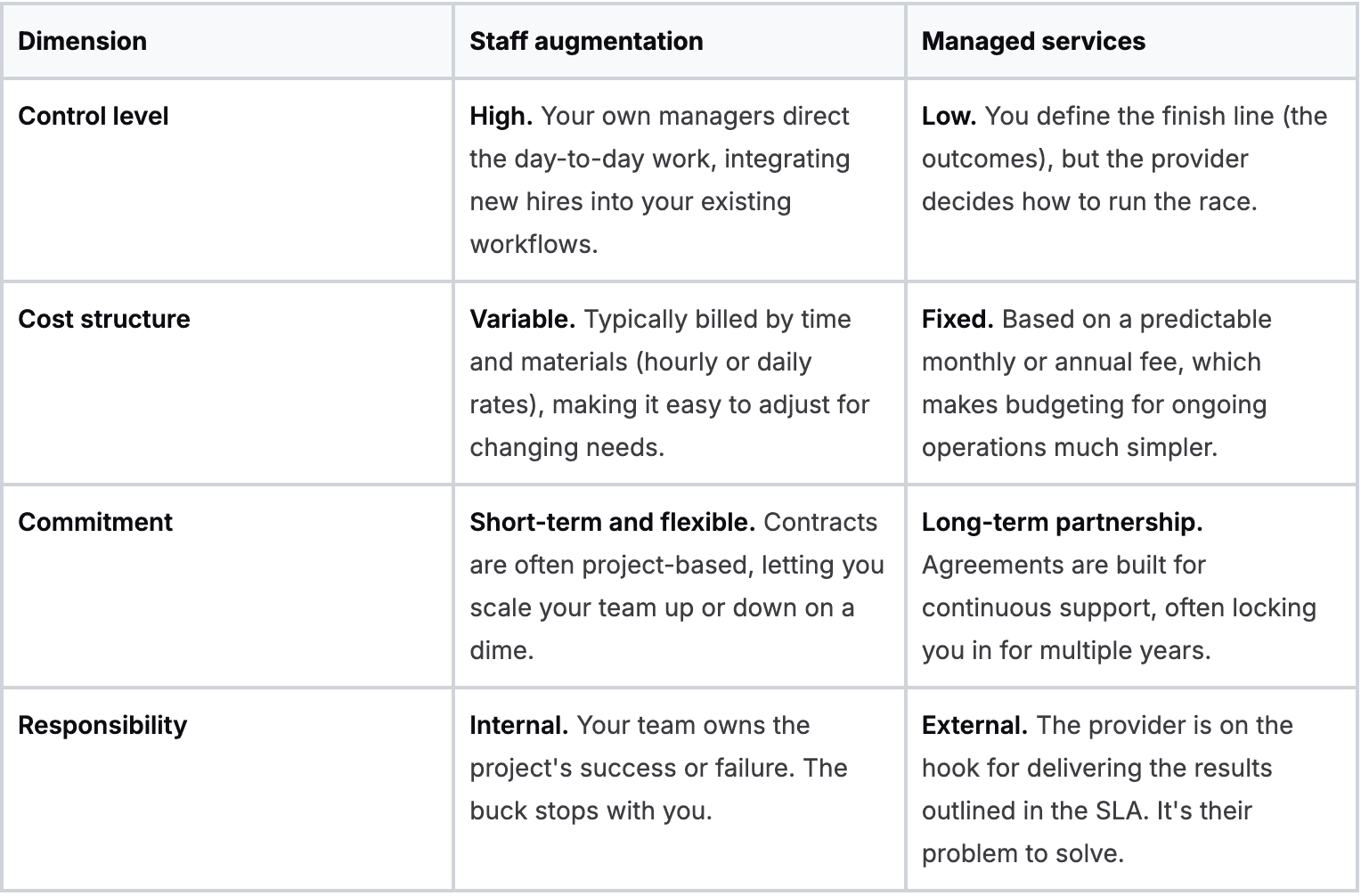
Staff augmentation gives you tactical flexibility, while managed services provides strategic predictability. For a deeper look at the kind of specialized talent available, it's worth exploring different machine learning consulting services to see how experts can slot into either model.
Analyzing the financial trade-offs
When you're weighing staff augmentation against managed services, you have to look past the initial price tag. Each model hits your books differently, and what seems "cheaper" upfront often isn't once you factor in the total cost.
Staff augmentation runs on a variable, pay-per-resource model. You’re paying an hourly or daily rate for specific talent, treating it as an operating expense. This is perfect for startups watching their burn rate or for short-term projects where you need to plug a skills gap.
On the other hand, managed services offer predictable, fixed costs. You'll typically pay a flat monthly or annual fee tied to an SLA. This model is a favorite for companies that need budget certainty for ongoing work, like 24/7 infrastructure monitoring.
Uncovering the hidden costs
A simple rate-to-rate comparison will lead you astray. Both models come with hidden costs that can blow up your budget.
With staff augmentation, the biggest hidden cost is internal management overhead. Your team leads will spend significant time directing, mentoring, and reviewing the work of your augmented staff. This is a real cost that pulls your key people away from strategic work.
For managed services, the number one financial risk is scope creep. If your project needs to pivot or expand beyond what you initially agreed to, you could be looking at serious charges for out-of-scope work. It's critical to nail down a tight contract from the start.
Drilling into the numbers, staff augmentation's variable model can deliver savings up to 25% lower than managed services' fixed contracts for short sprints, according to a Deloitte report. Data shows that 60% of product leaders lean on augmentation for 3-6 month AI roadmaps to dodge hidden fees that can add an extra 15-30%. You can find more insights on how these pricing models compare from industry analysis.
Evaluating speed, flexibility, and scale
Time-to-market is everything when you're pushing new AI features. Your choice between staff augmentation and managed services will directly impact your project's velocity and adaptability.
Staff augmentation is built for speed. When you need a niche skill-say, a senior machine learning engineer-you can often find and onboard that person in just a few weeks. This agility is a game-changer for projects that need to iterate fast. You keep direct control, which lets you pivot without complex contract negotiations.
Managed services trades that initial speed for long-term scalability. The setup process is slower, involving detailed scoping, legal reviews, and hammering out clear SLAs. But once in place, the provider takes full responsibility for scaling resources to meet demand. This is perfect for stable, predictable workloads but can be a bottleneck if your project’s direction suddenly changes.
A simple workflow for deciding
Use this checklist to quickly assess which model fits your current project:
- Define the project scope: Is it a core, innovative feature (e.g., a new AI algorithm) or a stable, operational task (e.g., IT support)?
- Assess control needs: Do you need daily, hands-on management to guide development and protect IP?
- Evaluate timeline: Is this a short-term sprint (3-6 months) or a long-term, ongoing function (12+ months)?
- Analyze budget: Do you need a flexible, variable cost structure or a predictable, fixed expense?
- Review internal capacity: Do you have the internal leadership to manage additional team members?
Staff augmentation excels in flexibility, enabling teams to scale with pinpoint skill matching in just 2-4 weeks and boosting project velocity by 30-40% for short-term needs, as reported by Gartner. You can discover more about these performance metrics on Multidots.com. For complex projects, knowing the best MLOps platforms can also help you figure out which specific skills you need to source quickly.
A framework for choosing the right model
Let's move beyond definitions and lay out a clear, use-case-driven framework to help you decide between staff augmentation and managed services for your next AI initiative.
The core of your decision boils down to a simple question: are you building a core competitive advantage, or are you outsourcing a stable, non-core function?
Use case driven recommendations
When you apply this framework to real-world AI projects, the right choice becomes much clearer.
Developing a proprietary AI algorithm
- Best fit: Staff augmentation
- Why: This is your core intellectual property (IP). You need direct, hands-on control. Staff augmentation lets you bring in specialized machine learning engineers who operate as a seamless extension of your team, protecting your IP and ensuring the final model is exactly what you envisioned.
Managing 24/7 cybersecurity monitoring
- Best fit: Managed services
- Why: This is a mission-critical function, but it's an operational burden, not a market differentiator. A managed service provider delivers a guaranteed outcome based on a strict SLA. They handle the round-the-clock monitoring, so you don't have to build and manage an internal security operations center.
You can dig deeper into these market dynamics in this report from Global Growth Insights.
The power of a hybrid approach
You don’t have to lock yourself into just one model. A hybrid strategy often delivers the best of both worlds.
For example, you could use a managed service provider to handle the stable work of managing your cloud infrastructure while deploying an augmented team of data scientists to build innovative models on top of it. This gives you stability where you need it and agile innovation where it counts.
Your next step to production-ready AI
Making the call between staff augmentation vs managed services is a strategic decision that shapes your return on AI investment.
Staff augmentation offers the speed and oversight needed for dynamic, core projects. Managed services delivers the predictability and accountability required for stable, non-core functions. Your immediate next step is to analyze your current AI initiative: is it a fast-moving innovation project demanding tight control, or a well-defined process ready for outsourcing? Answering that one question will point you to the right model.
For a structured way to figure this out, our production readiness checklist can help you clarify your needs and build a solid roadmap.
We at N² labs can conduct an independent AI readiness assessment to give you a clear, actionable plan for moving your AI projects from pilot to full production.
FAQ
The main difference is control versus responsibility. With staff augmentation, you add experts to your team and manage them directly, maintaining full control. With managed services, you outsource an entire function to a provider who takes full responsibility for delivering a specific outcome based on a service level agreement (SLA).
For most fast-growing startups, staff augmentation is the better fit. It provides the agility to bring in specialized skills for critical product sprints without the commitment of a long-term contract. This keeps founders in direct control of product development, allowing them to pivot quickly as the market evolves.
Initially, staff augmentation can appear cheaper because you pay an hourly rate without the overhead included in a managed services fee. However, you must factor in the "hidden cost" of your internal management time. For short-term projects (3-6 months), staff augmentation is often more cost-effective. For long-term, stable functions, the fixed cost of a managed service can provide better budget predictability and value.
Yes, a hybrid approach is a smart strategy. You can use staff augmentation for core, innovative AI projects where you need direct oversight. Simultaneously, you can use a managed services provider for stable, non-core functions like cloud infrastructure management or 24/7 application support. This approach optimizes for both flexibility and stability.