Written by: Igor
Published: December 2025
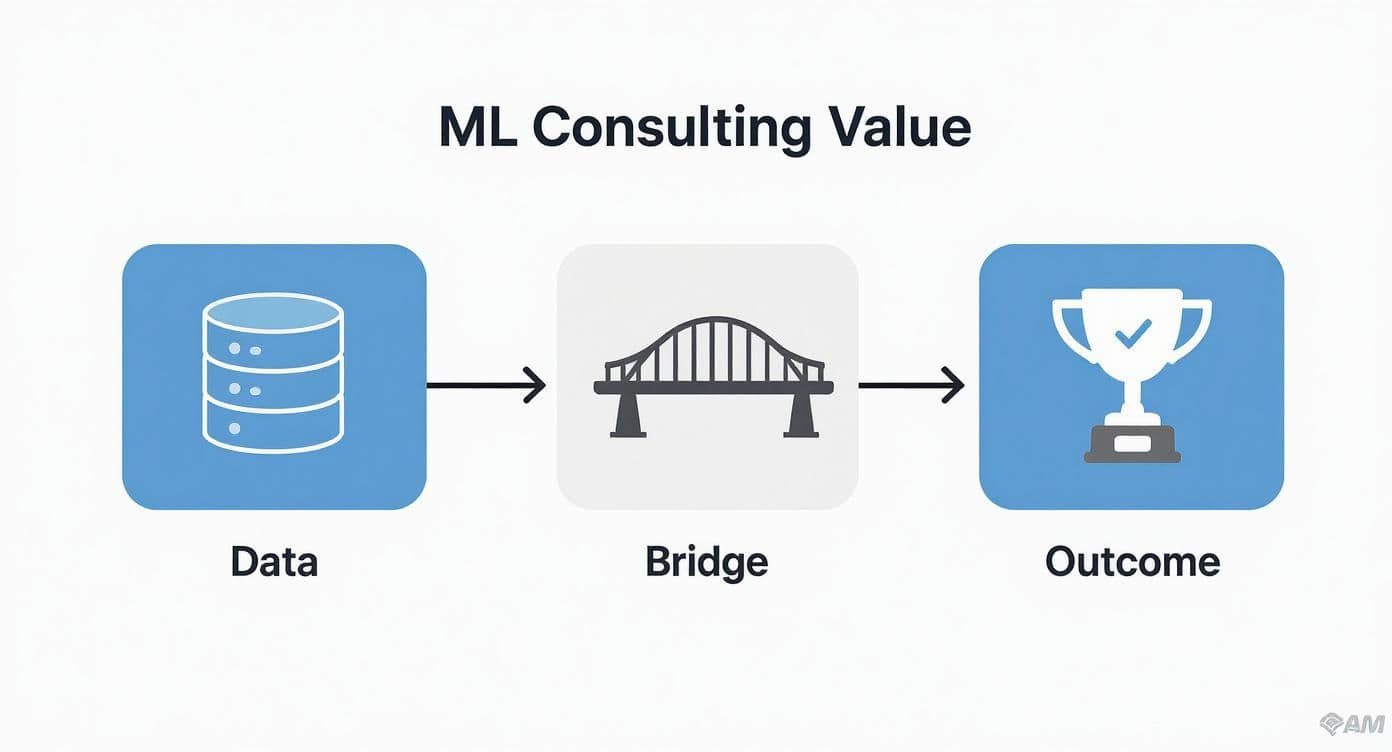
What are machine learning consulting services? Think of them as the bridge between your company’s raw data and actual, measurable business outcomes. It’s hiring a specialist to build a custom engine for growth, using your data as the fuel. These partnerships help you move past theoretical AI projects and into production-grade systems that increase revenue, boost efficiency, and create a sustainable competitive advantage. This guide will show you how.
Snapshot: your key takeaways
- Avoid pilot purgatory: Good consulting helps you design projects with a production-first mindset, avoiding the common trap where 85% of AI projects fail to deliver value.
- Focus on business outcomes: The right partner connects technical work to business KPIs, like reducing customer churn by 15% or increasing equipment uptime by 30%.
- Follow a structured process: Engagements should follow a clear path: readiness assessment, strategic roadmap, proof of concept, and production pipeline development.
- Choose a strategic partner, not just a technician: Vet partners on their business acumen and production experience, not just their favorite algorithms.
Why founders turn to machine learning consulting
Staring at a mountain of data and wondering how to turn it into a competitive edge? You're not alone. Many founders have brilliant ideas for using AI-like predicting customer churn or automating marketing tasks-but get stuck turning those ideas into reality. The path from a cool concept to a working, value-generating AI system is littered with technical landmines.
This is where expert guidance becomes a strategic investment, not just an expense. A machine learning consultant is an architect for your data. They don't just build a model. They ensure it's built on a solid foundation and solves a real-world business problem.
Avoid the dreaded 'pilot purgatory'
One of the biggest killers of any AI initiative is "pilot purgatory." This is where a promising proof-of-concept looks great in a slideshow but never makes it into production where it can do some good.
It's a shockingly common problem. According to Gartner, an estimated 85% of AI projects fail to deliver on their intended promises to the business. This happens for many reasons: the model isn't scalable, it's too slow for real-time decisions, or it's impossible to integrate into existing workflows.
Bringing in ML consultants from the start helps you sidestep this trap. A good partner designs every project with a production-first mindset, ensuring the final system is built for the chaos of the real world. They focus on creating robust, automated pipelines that deliver consistent value.
Mitigate risk and get to market faster
Hiring a full-time, in-house machine learning team is a massive commitment. Finding, vetting, and onboarding senior talent can take months, delaying your project. With the average salary for a machine learning engineer now topping $150,000 per year (source: Glassdoor), a mis-hire is an incredibly expensive mistake.
Consulting offers a more direct and less risky path. You get immediate access to a team of seasoned experts with experience across dozens of projects and industries. This lets you:
- De-risk your investment: Validate your AI strategy with a smaller, focused engagement before committing to long-term hires.
- Accelerate development: Go from idea to a working solution in weeks, not quarters. We built an AI readiness assessment process to speed this up.
- Access specialized skills on demand: Get deep expertise in niche areas like Natural Language Processing (NLP) without hiring for every specialty.
The right partner closes the gap between raw data and real results. They bring the strategic roadmap and technical firepower to turn your AI ambitions into a powerful engine for growth.
What a typical ML consulting engagement looks like
Working with a machine learning consulting partner isn't a black box where you toss data over a wall and hope for the best. It’s a structured, collaborative journey designed to kill risks early and squeeze every drop of business value out of the project.
A solid engagement follows a clear, phased approach that takes an idea from a business goal to a fully functioning system. This keeps everyone aligned and makes sure the project stays focused on real-world results.
Phase 1: the readiness assessment
Before a single line of code is written, a great partner starts with a deep dive into where you are today. The goal of a readiness assessment is to answer one simple question: are we set up for success? This is about more than just data-it’s about understanding your business goals, your tech stack, and your team's readiness.
During this phase, consultants will dig into:
- Data quality and availability: Do you have the right data? Is it clean, accessible, and is there enough to train a model?
- Business goals: What specific problem are we trying to solve? How will we know if we've won? (e.g., cut customer churn by 15%, bump up average order value by 10%).
- Technical infrastructure: Can your current systems handle a production-grade ML model without grinding to a halt?
The key deliverable is a straightforward scorecard. It flags quick wins, shines a light on potential roadblocks, and gives you an honest picture of your company's AI maturity.
Phase 2: building the strategic ML roadmap
Once we know where you stand, the next step is to build a strategic ML roadmap. This isn't a list of every cool AI project you could do. It’s a prioritized plan focused on the few initiatives with the highest potential return on investment (ROI) and a realistic shot at making it to production.
This part is highly collaborative. The consulting team works alongside your leadership to map potential projects against business impact and technical difficulty. The final output is often a simple one-page plan detailing the first project, including clear goals and a realistic timeline.
The demand for this kind of strategic guidance is exploding. The global AI consulting market is projected to hit $90.99 billion by 2035, growing at a compound annual rate of 26.2%. This surge is all about companies looking for expert partners to help them avoid expensive project failures. You can read the full research about AI consulting growth drivers.
Phase 3: the proof of concept
With a high-impact project identified, the work shifts to a proof of concept (PoC). The goal here is simple: prove the idea works, quickly and cheaply. A PoC means building a small-scale, functional model to confirm that the approach is technically solid and can deliver the desired results.
Think of it as a critical de-risking step. Instead of sinking six months into building a massive system, you can get an initial "yes, this works" or "no, back to the drawing board" in just a few weeks. This agile approach lets you learn and pivot fast.
Phase 4: production pipeline development
After a successful PoC, the final phase is building the production pipeline. This is where the validated model gets turned into a robust, scalable, and automated system that plugs into your daily operations. It includes everything from data ingestion and processing to monitoring and guardrails that ensure reliable performance.
The deliverable is a fully deployed ML system that’s actively generating value.
Here's a quick summary of the engagement phases.
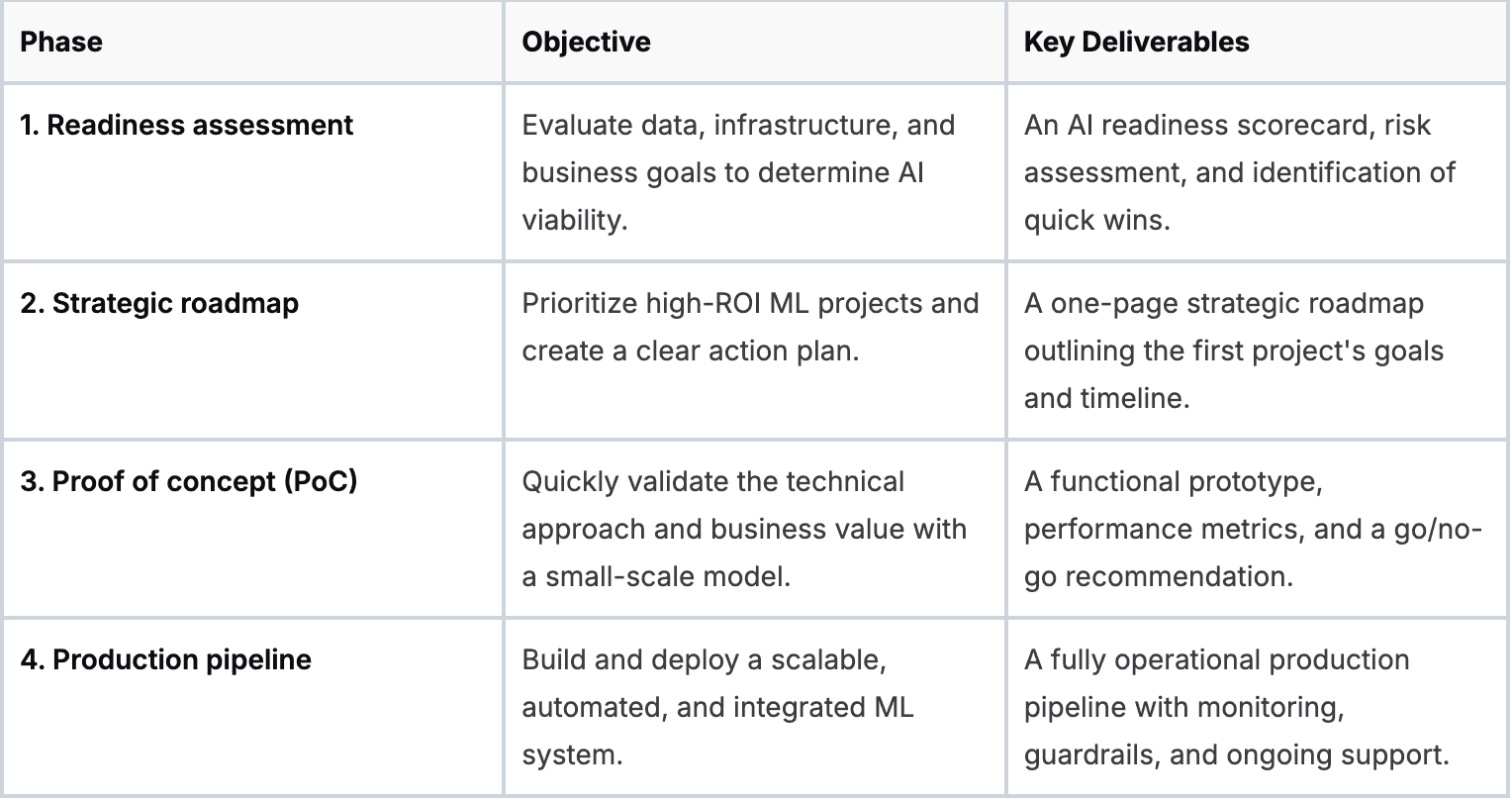
This structured approach moves methodically from idea to impact.
How to choose the right ML consulting partner
Picking the right machine learning consulting partner is the single most important decision in your AI journey. It's the difference between building a business asset and another expensive, failed pilot. The best firms don't just act like vendors; they become an extension of your team.
The demand for this expertise is exploding. The machine learning market is projected to hit $1.88 trillion by 2035. Read the full research about the machine learning market to understand its rapid expansion. This massive growth means more players are jumping in, making it critical to vet your options carefully. Your mission is to find a partner who gets that a successful model works reliably in production, not just in a slide deck.
Technical experts vs. strategic partners
First, you need to know whether you’re looking for a technical expert or a true strategic partner. A freelance ML engineer is perfect for a specific, well-defined task. Think of them as a specialist you hire to execute a plan you've already created.
A strategic partner, on the other hand, helps you build the plan. They start with your business problem, not a technical request. They work with you to define success, build a practical roadmap, and then execute with an eye on long-term value. For a founder trying to build a real competitive advantage, a strategic partner is non-negotiable.
A practical vetting checklist
When interviewing potential machine learning consulting services, don't just ask about algorithms. Dig into their process, business instincts, and track record.
Use this checklist to guide your conversations:
- Production experience: Ask them to walk you through a project that went from concept to a live system. How did they handle scalability, monitoring, and integration?
- Business acumen: Do they ask more questions about your business goals or their favorite tech stack? A great partner will be obsessed with your KPIs.
- Defining success: How do they suggest you measure success? Their answer should be in business terms (like "reduce customer churn by 12%") not technical metrics ("achieve 95% model accuracy").
- Data security: How will they handle your sensitive data? Ask for specifics on access controls, encryption, and compliance.
You're looking for a team that can translate code into measurable business impact.
Critical red flags to watch out for
Knowing what to look for is only half the battle. Be wary of any firm that:
- Guarantees a specific outcome: Machine learning deals in probabilities, not certainties. They should talk about expected ranges and the methodology to get there.
- Lacks industry context: If they can't speak your industry's language, they'll struggle to build a solution that works for you.
- Pushes a one-size-fits-all solution: Run from partners who recommend a specific tool before they've done a deep dive into your goals.
- Can't explain their process: If their methods feel like a "black box," it’s a huge red flag. A real partner is transparent, from the initial AI readiness assessment to deployment.
Take the time to find a firm that aligns with your strategic goals.
Real-world use cases and business impact
Theory is great, but machine learning projects only prove their worth when they translate into tangible business results. The best ML projects aren't science experiments. They are strategic initiatives designed to move a specific business metric. The key is to connect the technical work to a measurable financial outcome.
Boosting revenue and customer loyalty
One of the most powerful applications of machine learning is in understanding and influencing customer behavior. By analyzing past actions, ML models can predict future ones with remarkable accuracy.
Here are a few high-impact examples:
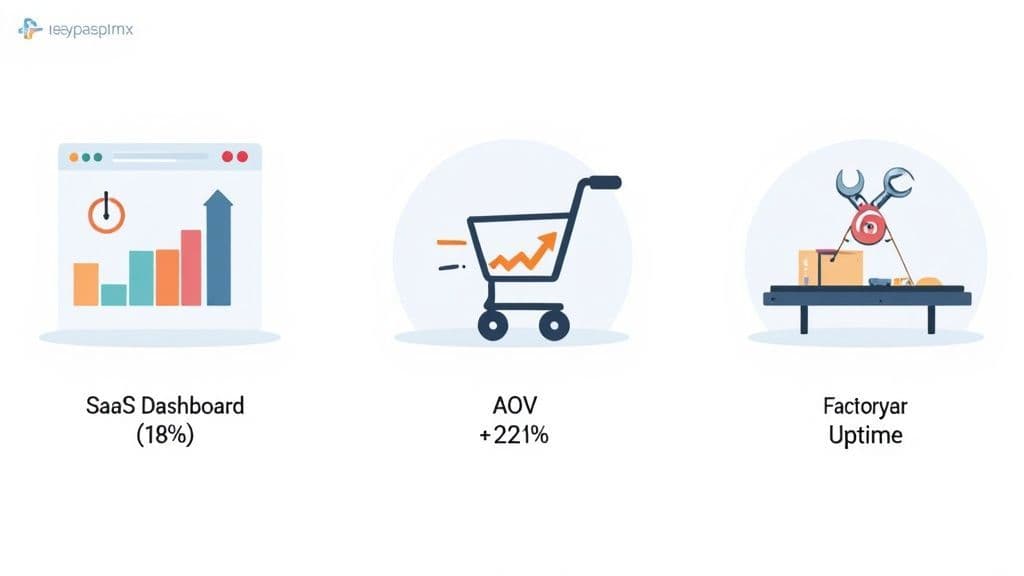
- SaaS churn prediction: A subscription software company was losing customers. By building a model that analyzed user engagement data, they could identify at-risk customers. This let their success team intervene, reducing customer churn by 18% within two quarters.
- E-commerce recommendation engines: An online retailer developed a personalized recommendation engine based on browsing history and past purchases. This simple change boosted the average order value (AOV) by 22%.
Driving operational efficiency
Beyond customer-facing applications, machine learning is a powerhouse for streamlining internal operations and cutting costs.
Consider these scenarios:
- Manufacturing predictive maintenance: A factory was losing money to unplanned equipment downtime. An ML model was trained on sensor data to predict machine failures before they happened. This allowed proactive maintenance, increasing equipment uptime by 30%.
- Finance automated reporting: A finance department spent over 50 hours each month manually compiling reports. An ML-powered workflow automated the process, saving time and reducing errors. Learn more in our guide on how AI transforms finance teams through automated reporting.
The adoption of these solutions is fueling massive market growth. According to a McKinsey report, AI could deliver between $2.6 trillion and $4.4 trillion in annual value across global industries. You can discover more insights about the machine learning market's growth.
The goal of engaging machine learning consulting services is to create a direct link between an AI investment and a key business outcome.
Understanding pricing models and project timelines
Let's tackle the two questions every leader has: "How much will this cost?" and "How long will it take?" Getting clear answers is non-negotiable for budgeting and managing expectations. While no two projects are alike, ML consulting follows a few predictable pricing structures and timelines.
Common pricing models
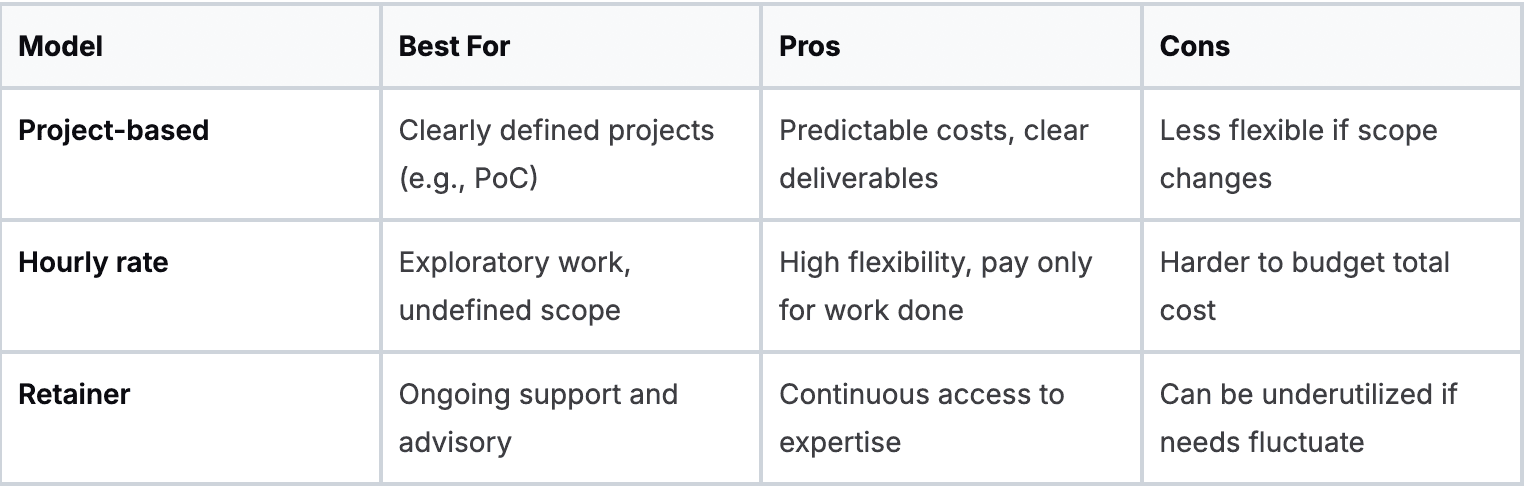
Consulting firms usually lean on a few core pricing models. The right one for you depends on your project's scope and flexibility.
- Project-based fees: This is the go-to for well-defined projects. You agree on a fixed price for a specific set of deliverables, like a three-month proof of concept. This gives you cost predictability.
- Hourly rates: Best for exploratory work where the scope is fuzzy. You pay for the exact time spent, which is perfect for an initial readiness assessment or advisory work.
- Retainers: If you need continuous access to ML expertise, a monthly retainer is your best bet. This secures a dedicated block of time for ongoing model monitoring, iteration, and strategic guidance.
Mapping out a realistic project timeline
Time is as crucial as your budget. Project length is influenced by data quality, tech stack complexity, and the business problem. A project isn't one block of time; it's a sequence of distinct phases.
Here’s a look at a typical engagement timeline:
- AI readiness assessment (2 - 4 weeks): This is the initial deep dive into your data, systems, and goals.
- Strategic roadmap & PoC (4 - 12 weeks): The team builds a small-scale proof of concept to prove an idea can work. A PoC for a fraud detection model might take 8 weeks and cost between $40,000 - $75,000.
- Production deployment (3 - 9 months): This is where the timeline can vary. Turning a validated PoC into a scalable, integrated production system is a serious undertaking.
These are practical ranges. A project with clean, accessible data will always move faster.
Moving your AI project from pilot to production
The true test of any AI project is getting a promising model out of the lab and into the real world. This is the final step where an estimated 85% of AI projects fail, according to Gartner. A model performs beautifully on clean, historical data but crumbles under the chaos of live operations.
Successfully making this leap separates a business asset from an expensive science project. It means shifting focus from model accuracy to engineering operational excellence. The goal is an AI system that performs consistently, scales without breaking, and adapts over time.

Building a bulletproof production system
Getting to production is less about the algorithm and more about the infrastructure around it. A good partner providing machine learning consulting services will engineer a sustainable system.
A production-ready system needs these core components:
- Robust MLOps pipelines: Machine Learning Operations (MLOps) creates an automated assembly line for AI. It handles data ingestion, model training, validation, and deployment.
- Resilient data infrastructure: Production data is messy. The data pipelines feeding your model must handle missing values and format changes without breaking.
- Continuous monitoring and guardrails: A model’s performance naturally degrades over time, a known issue called "model drift." An active system needs automated monitoring to track predictions and alert you when they go off track.
Example workflow: from pilot to production
Here’s a simple checklist for deploying a demand forecasting model:
- [ ] Automate data ingestion: Build a pipeline that automatically pulls in new sales figures, inventory levels, and external data daily.
- [ ] Establish model retraining: Set up an MLOps pipeline to automatically retrain the model weekly with the latest data.
- [ ] Implement performance guardrails: Put alerts in place that trigger if the model's forecast error jumps above a set threshold (e.g., 15%).
This systematic approach turns a static pilot into a dynamic, self-maintaining asset. For a deeper dive into common roadblocks, check out our guide on overcoming AI implementation challenges.
Wrap-up
Successfully leveraging machine learning consulting services comes down to one thing: focusing on production from day one. Choosing the right partner-one who combines deep technical expertise with sharp business acumen-is the most critical step. They will guide you through a structured process, from assessing readiness to deploying a robust system that delivers real value. Your next step is to evaluate potential partners not on their technical jargon, but on their proven track record of turning AI pilots into profitable business assets.
We at N² labs can help you build and deploy production-ready AI systems that drive real business outcomes.
FAQ
While it varies, the returns are often significant. For example, a well-built demand forecasting model can cut inventory costs by 15-30%. A good consulting partner helps you identify high-impact use cases first, ensuring the business value is clear. Success metrics should tie model performance directly to a business KPI, like revenue growth or operational savings.
Yes, absolutely. "Perfect data" is a myth. A core part of any initial engagement is a data readiness assessment. Consultants will help you spot data gaps, map out a plan for collection and cleanup, and start building initial models with the data you already have. They are experts at wrangling imperfect data.
Any reputable machine learning consulting service will operate under a strict NDA and follow industry-standard security practices. Always ask a potential partner about their specific protocols, from data encryption to compliance with regulations like GDPR. Consultants can often work directly within your cloud environment, so your sensitive data never leaves your infrastructure.
You hire a freelance ML engineer for a specific task, like building one model. You partner with a consulting firm for a strategic, end-to-end solution. A firm brings business analysis, strategic roadmapping, MLOps, project management, and ongoing support. For founders who want to build a scalable, long-term AI capability, a firm offers a more complete partnership.