Written by: Igor
Published: December 2025
Technical debt is a business problem, not an engineering one. If you want to get serious about how to reduce technical debt, you need to quantify its impact on revenue and speed-metrics the C-suite actually cares about. This guide will show you how to assess your current debt, build a practical roadmap for paying it down, and implement the governance needed to stop it from coming back.
Key takeaways
- Frame debt in business terms: Connect technical issues to business impact like slower feature delivery, increased costs, and security risks.
- Create a scorecard: Audit your code, data, and infrastructure to quantify the problem and build a data-driven case for action.
- Prioritize ruthlessly: Separate quick wins from strategic refactors. Tackle issues that pose the biggest business risk or create the most friction for your team first.
- Automate governance: Use automated quality gates in your CI/CD pipeline to enforce standards and prevent new debt from accumulating.
- Start small: Begin with a one-hour meeting with your lead engineer to identify the top three sources of friction. This creates a manageable starting point and builds momentum.
Why your technical debt is a business problem
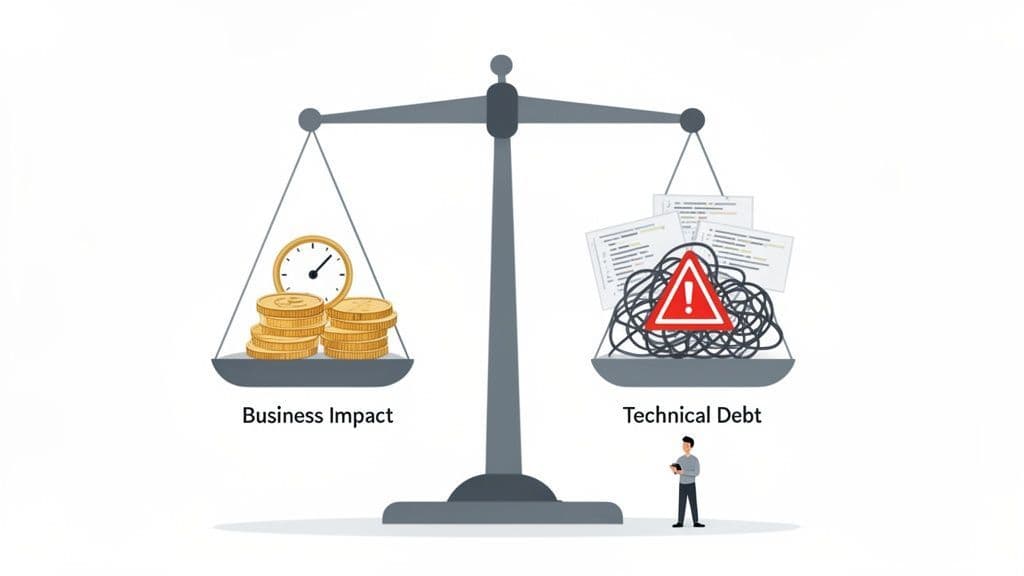
Technical debt is a hidden tax on your entire business. It quietly eats away at resources, grinds innovation to a halt, and leaves you vulnerable to competitors. For founders trying to move AI pilots into production, understanding this cost is critical.
Imagine trying to fund your next big AI push when 40% of your IT budget is tied up just keeping the lights on. According to a report from McKinsey, technical debt can consume up to 40% of IT balance sheets, diverting capital that should be fueling growth.
This is a common roadblock for startups. The same McKinsey report found that 30% of CIOs admit over 20% of their new product budget gets hijacked to fight fires in legacy systems. That's a massive drag on momentum when speed is everything.
Good debt vs. bad debt
Not all debt is created equal. You have to distinguish between a calculated shortcut and a plain mess. To get a handle on this, you need to understand what technical debt is at its core.
- Good debt (strategic): This is a deliberate shortcut to hit a critical market window or validate a new feature fast. You know you're incurring debt and have a plan to "repay" it by refactoring the code later. It’s a calculated risk for a clear business advantage.
- Bad debt (unintentional): This is the dangerous stuff. It piles up from sloppy work, a lack of standards, or not understanding the system's architecture. It creates unpredictable bugs, makes feature delivery a slog, and turns your platform into a house of cards.
The real cost to your business
Letting technical debt fester has real, tangible consequences. It's more than just "bad code"-it's a direct impediment to growth.
When this debt accumulates, you see:
- Slower feature delivery: Engineers spend more time wrestling with spaghetti code and fixing bugs than building features your customers want.
- Increased operational costs: Brittle systems demand constant maintenance, endless bug fixes, and manual workarounds, which bloats your engineering budget.
- Missed market opportunities: A competitor launches a game-changing feature, and you can't respond because your codebase is too rigid to adapt quickly.
- Higher business risk: Unmanaged debt is a breeding ground for hidden security flaws and stability issues. This becomes a massive liability when doing any kind of risk analysis for your software.
How to create a technical debt assessment scorecard
You can't fix what you can't see. Before you can figure out how to reduce technical debt, you need a clear, objective picture of where it lives and how much it’s costing you. This isn’t about a month-long audit. It’s about building a simple scorecard to quantify the problem in business terms.
A proper audit moves the conversation from vague developer complaints to a data-driven case for action. The goal is to create a snapshot of your system's health across code, data, and infrastructure.
Auditing your code debt
Code is usually the most obvious source of technical debt. It’s the slow development cycles, unpredictable bugs, and features everyone is terrified to modify. To assess it, you have to move past gut feelings and use tools that give you objective metrics.
Static analysis tools like SonarQube or CodeClimate are invaluable here. They scan your codebase and flag issues automatically, giving you hard numbers on:
- Cyclomatic complexity: A measure of how many different paths exist through your code. High complexity-over 15 per function is a common red flag-means the code is a nightmare to test and understand.
- Code smells: Patterns that hint at deeper problems, like duplicated code blocks, long methods, or classes doing too much.
- Vulnerability scans: Non-negotiable scans that pinpoint security weaknesses like outdated dependencies or insecure coding patterns.
The output from these tools is the raw data for your scorecard. You’re no longer just saying the code is "messy." You're saying, "we have 25 critical security vulnerabilities and our code duplication is at 18%, which adds an estimated 40 hours of rework to every sprint." That gets attention.
Assessing your data debt
In an AI-driven world, data debt is just as toxic as code debt. It’s the silent killer of AI projects, leading to unreliable models and flawed business insights. To find it, hunt for fragmentation, poor quality, and accessibility roadblocks.
Start by mapping your critical data sources. Ask your team:
- Where does our most important business data live? Are there multiple, conflicting "sources of truth"?
- How much time do we spend cleaning data before it can be used for analytics or AI models?
- Do we have clear data dictionaries and lineage tracking?
Fragmented data sources and inconsistent formats create immense drag. If your data science team spends 70% of its time on data prep instead of building models, that’s a massive, quantifiable cost. This inefficiency is a huge red flag that you need a more structured approach, much like what's detailed in an AI readiness assessment.
Evaluating your infrastructure debt
Infrastructure debt often hides in plain sight, disguised as manual processes. It’s the outdated server software, lack of automation, and brittle deployment pipelines that turn every release into a high-stress event.
Your infrastructure audit should focus on bottlenecks and manual toil. Key metrics include:
- Lead time for changes: How long does it take for a single line of code to get from a developer's machine into production? Elite teams do this in under an hour. Teams drowning in infrastructure debt can take weeks.
- Mean time to recovery (MTTR): When an outage happens, how long does it take to restore service? A high MTTR (hours instead of minutes) points to a lack of observability and automated rollbacks.
- Manual processes: Count how many steps in your deployment process require a human. Each one is a potential point of failure and a time sink.
Your scorecard template
Once you've audited these three areas, pull it all together in a simple scorecard. This is a tool to help you prioritize by focusing on business impact, not just how annoying a technical issue is.
Here's a template to get you started:
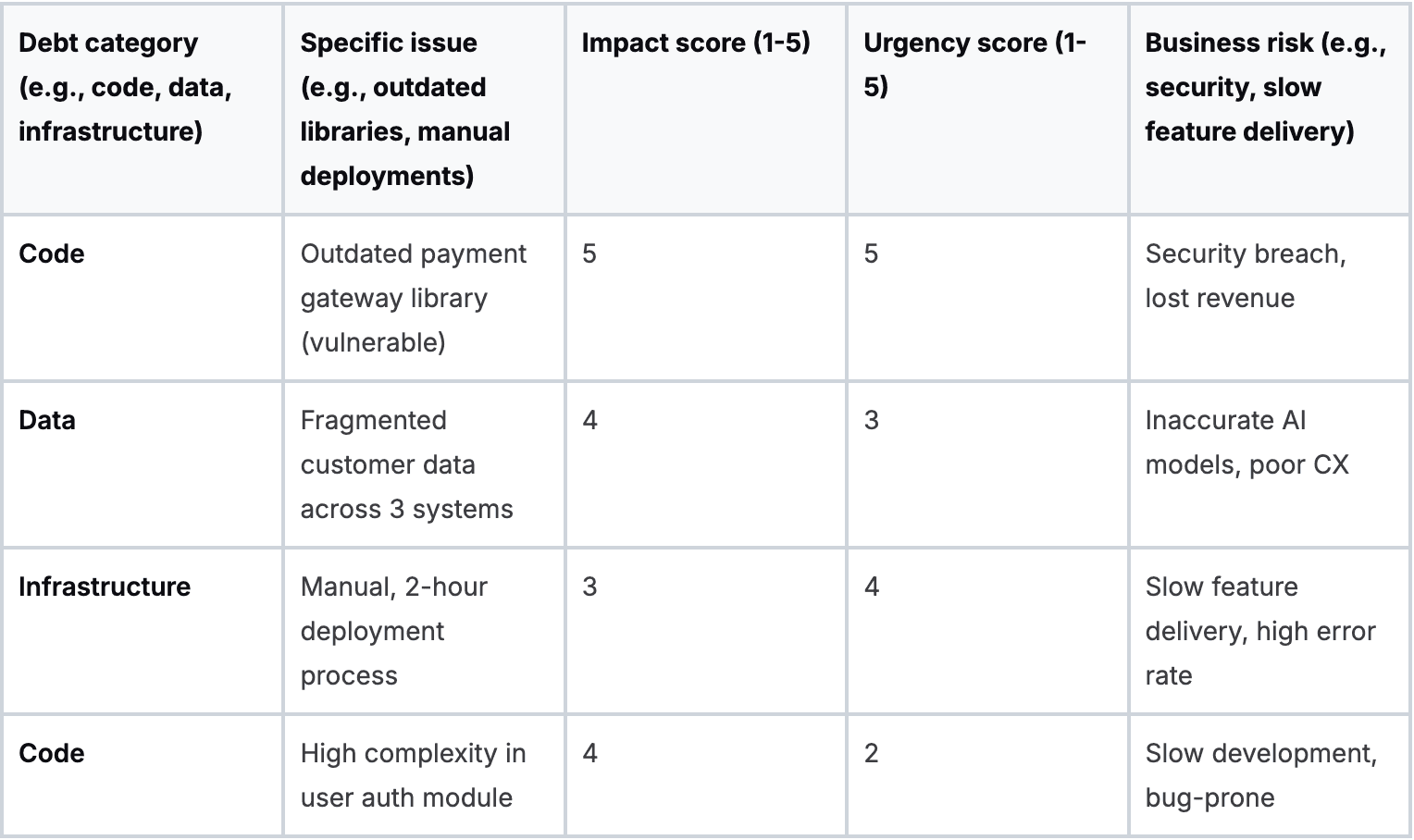
This scorecard translates technical jargon into a language the business understands: risk and speed. It becomes the foundation for your debt reduction roadmap.
How to build a prioritized debt reduction roadmap
An assessment is only useful if it leads to action. The goal is to build a practical, prioritized roadmap your team can execute without halting new feature development. This isn’t about fixing everything at once. It’s about making smart, sequential investments that deliver the biggest returns.
A successful roadmap balances immediate gains with long-term architectural health. The flowchart below outlines the core pillars to consider, which will form the foundation for your roadmap.
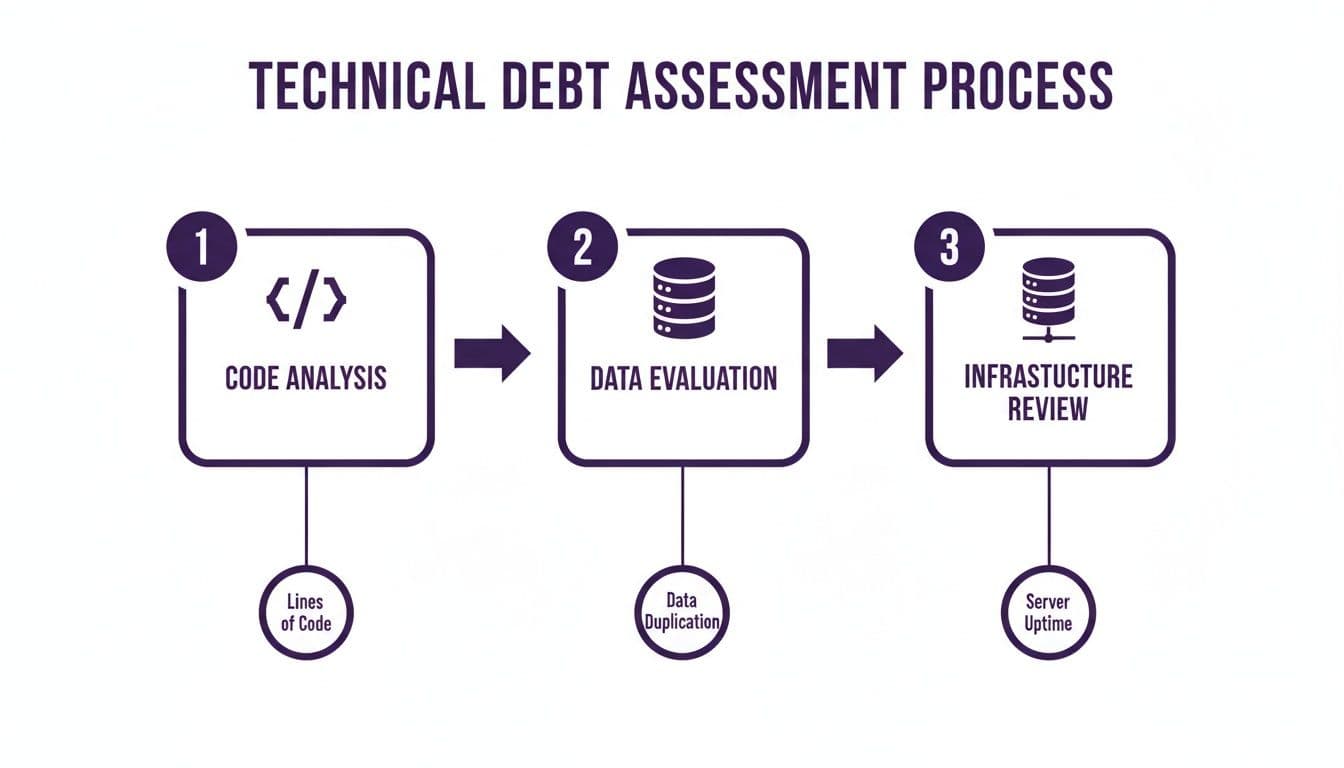
As you can see, a comprehensive plan must address debt across your entire tech stack-from code to data to infrastructure.
Separating quick wins from strategic refactors
Categorize every item from your assessment scorecard into one of two groups: quick wins or strategic refactors. This brings immediate clarity and helps you plan your team’s capacity.
- Quick wins: These are the high-impact, low-effort fixes you can knock out in a single two-week sprint. Upgrading a critical library with a known security flaw, automating a painful deployment step, or refactoring a single buggy module are perfect examples. These wins build momentum.
- Strategic refactors: These are the bigger initiatives that require dedicated planning. Migrating a monolithic application to microservices, redesigning your data architecture for AI, or overhauling your CI/CD pipeline fall into this category. These projects address the root causes of your debt.
This dual-bucket approach ensures you're constantly delivering value. While a small team focuses on a strategic refactor, the rest of the organization can chip away at quick wins.
Example workflow for prioritization
Not all debt is created equal. Use this simple workflow to decide what to tackle first.
- Identify business and security risk: Does this issue pose a direct threat? Vulnerabilities in open-source libraries or compliance gaps should always jump to the top of the list. These are immediate business liabilities.
- Measure impact on feature velocity: Which pieces of debt slow your team down the most? Ask your engineers where they feel the most friction. If a part of the codebase makes every feature take twice as long, fixing it delivers compounding returns.
- Assess customer-facing impact: Is the debt causing visible problems for users? Frequent outages, slow page loads, or persistent bugs directly impact customer satisfaction and revenue.
- Consider team morale: Don't underestimate the cost of developer frustration. Fixing a tool, process, or module that everyone hates working with can significantly boost morale and retention.
A strategic approach is key. This CEO playbook for prioritizing technical debt reframes the problem in terms that resonate with business leaders.
The fix is often allocating a consistent 15-20% of sprint capacity to refactoring. This ensures you prioritize scalability blockers while adopting CI/CD pipelines to catch issues early. A Gartner report shows that nearly 60% of tech leaders now tie debt reduction to 'value realization' programs, accelerating feature delivery by up to 40%.
How to implement governance to prevent new debt
Paying down existing debt is only half the battle. The real victory is stopping it from coming back. Without strong governance, your team will fall back into old habits, and the debt will creep right back in.
This is about building a sustainable system for keeping your tech stack healthy. It’s a move from reactive firefighting to a proactive state where quality is baked into the development lifecycle. The goal is to weave debt management into your team's DNA.
Establish clear guardrails and standards
First, define what "good" looks like for your team. This means establishing clear, documented standards that leave no room for ambiguity.
Start with the basics:
- Coding standards: Document your conventions for naming, formatting, and design patterns. Consistency makes the codebase easier for everyone to read and maintain.
- Code reviews: Make peer reviews mandatory for all new code. This is a powerful way to spread knowledge and break down information silos.
- Definition of done: Your "definition of done" can't just be "it works." It must include writing unit tests, updating documentation, and passing all quality checks.
These standards provide a shared framework that reduces accidental complexity and stops bad debt from piling up.
Automate quality gates in your CI/CD pipeline
Human oversight doesn't scale. If you're serious about enforcing standards, you have to automate them. Your continuous integration/continuous deployment (CI/CD) pipeline is the perfect place to build automated quality gates.
These gates are automated checkpoints that code must pass before it can be merged or deployed. If the code fails, the build stops. This forces developers to fix issues immediately when they are cheapest and easiest to fix.
Common automated gates include:
- Static analysis tools to scan for code smells, complexity, and security vulnerabilities.
- Unit test coverage thresholds to ensure new code is properly tested.
- Dependency scanners that check for outdated or vulnerable libraries.
Automation makes quality non-negotiable. It turns your standards from suggestions into hard requirements, a critical step in learning how to reduce technical debt for good. Many teams use different application development models to integrate these practices.
Document decisions and embrace the boy scout rule
Great governance is also about fostering a culture of ownership and continuous improvement. Two practices are incredibly effective here: architecture decision records and the "boy scout rule."
Architecture decision records (ADRs) are simple documents that capture important architectural choices, the context behind them, and their consequences. Why did we choose this database? What trade-offs did we consider for that API design? Documenting these decisions gives future developers invaluable context.
The boy scout rule is even simpler: always leave the code a little better than you found it.
This small, cultural commitment has a massive compounding effect. When every developer makes tiny improvements-like renaming a confusing variable or adding a missing comment-the overall health of the codebase continuously improves.
The one thing to do next to reduce technical debt
You have the framework. Now it's time to shift from thinking to doing. You don't need a massive initiative to get started. Small, targeted efforts are almost always more effective because they build momentum and show results quickly.
Your first move should be to book a one-hour meeting with your lead engineer. The only goal is to pinpoint the top three sources of friction in your development process.
To get the conversation flowing, ask questions that connect technical headaches to real business problems:
- Velocity blockers: Which part of the codebase do we all dread touching? The one that always takes twice as long as estimated?
- System fragility: What’s the one component that keeps breaking or causing production fires?
- Manual toil: What’s the most soul-crushing manual process in our deployment or testing cycle?
This approach reframes the discussion. It's no longer about "bad code" but about tangible business constraints. Instead of a vague complaint, you get a concrete problem: "Our manual testing process for the payments module adds 10 hours of work to every release." Now that is a problem you can solve.
By zeroing in on just three high-friction areas, you create a manageable starting point. This short list becomes the first draft of your plan on how to reduce technical debt and turn this liability into a strategic advantage.
We at N² labs can help you with an AI readiness assessment to identify and address the technical debt holding you back.
FAQ
Technical debt is the implied cost of rework caused by choosing an easy solution now instead of using a better approach that would take longer. Like financial debt, it accrues "interest" over time, making future development slower and more difficult. It's a key concept for any team looking to learn how to reduce technical debt effectively.
Explain it in business terms. Use analogies they understand, like building a house on a weak foundation. You can build quickly at first, but soon every new addition becomes slow, expensive, and risky. Frame the conversation around business outcomes: "If we invest two weeks in fixing this, we can launch new features 50% faster and reduce critical bugs by 30%."
No, and that shouldn't be the goal. Some technical debt is strategic-a deliberate tradeoff to get a product to market faster. The goal isn't to eliminate all debt but to manage it consciously. Continuously assess your debt, prioritize what to "repay" based on business impact, and avoid accumulating unintentional "bad" debt through poor practices.
Technical debt often arises from business pressure to meet tight deadlines, leading to shortcuts. Other common causes include a lack of clear coding standards, insufficient testing, poor documentation, and team members who lack experience with the system's architecture. Over time, evolving business requirements can also turn once-optimal design choices into debt.
A solid rule of thumb is to dedicate 15-20% of your development capacity to managing technical debt. You can do this with dedicated "fix-it" sprints or by earmarking a portion of every sprint for refactoring and cleanup. The key is consistency. A steady, predictable investment keeps debt from spiraling out of control.