Written by: Igor
Published: December 2025
Running a startup means making high-stakes decisions with incomplete information. To do it well, you need to understand your risks-not just avoid them, but turn them into a competitive edge. This is where software for risk analysis becomes a founder's best friend, moving risk management from a gut-feel exercise to a data-driven strategy. This guide will walk you through choosing the right tool, implementing it without the usual headaches, and measuring its real-world impact on your bottom line.
Key takeaways
- Risk software isn't just for defense: It helps you protect your runway, make sharper strategic decisions, and increase investor confidence.
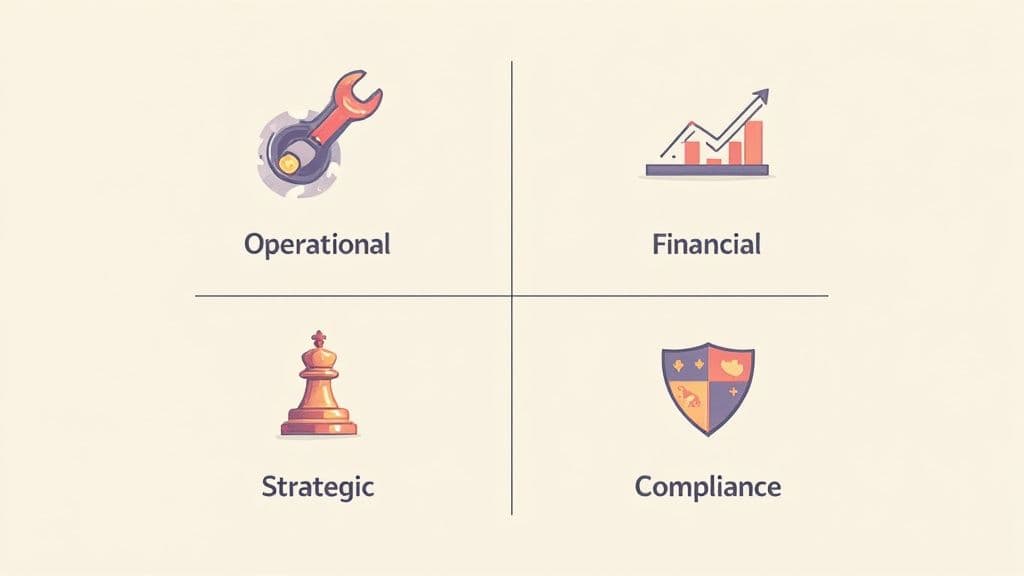
- Not all tools are the same: The best software depends on your biggest vulnerability-operational, financial, strategic, or compliance.
- Core features are non-negotiable: Look for customizable risk modeling, real-time dashboards, automated alerts, and seamless integrations with your existing tech stack.
- Implementation is everything: A phased rollout with a cross-functional team is critical for user adoption and getting a positive ROI.
Why every founder needs a risk analysis strategy now
Navigating uncertainty is a founder's daily reality, but doing it without the right tools is like driving through fog with no headlights. A structured approach to risk management, powered by dedicated software, isn't just for big corporations anymore-it's a critical tool for survival and growth.
Ignoring risk has real costs. An operational hiccup can snarl your supply chain. A financial miscalculation can burn through your runway. A strategic blind spot can hand competitors a massive advantage. According to a McKinsey report, companies with mature risk-management practices generate up to three times the level of EBITDA as those with less mature practices. These aren't distant "what-ifs"-they are daily realities.
Moving from defense to offense
Thinking about risk isn't just about preventing disasters. It’s about building a resilient business that can confidently jump on opportunities when they appear. When you truly understand your vulnerabilities, you can afford to make bolder bets.
A structured approach brings a few key advantages:
- Protected runway: By flagging financial and operational threats early, you can avoid costly mistakes that eat through your cash.
- Sharper decision-making: Data-driven risk insights replace gut feelings, leading to more sound strategic moves.
- Increased investor confidence: A clear risk management plan signals to investors that you're a responsible steward of their capital.
This process is a continuous cycle of identifying, analyzing, evaluating, and treating risks-exactly what modern software is built to automate and simplify.

The market is signaling a clear trend
The demand for these tools is exploding. The global risk analytics market is projected to reach $74.5 billion by 2028, growing at a compound annual growth rate (CAGR) of 13.7%, according to MarketsandMarkets. This surge isn't just noise; it’s a broad recognition that manual, spreadsheet-based methods just can't keep up.
Adopting technology to manage this process is quickly becoming standard practice. For founders looking to get ahead of the curve, figuring out how to implement AI in business provides a powerful framework for solving core operational challenges, including risk.
Ultimately, a strong risk analysis strategy isn’t just a safety net. It’s a core driver of sustainable growth and a powerful competitive advantage.
Decoding the different types of software for risk analysis
Not all risk is created equal, and neither is the software built to manage it. Choosing the right platform means first understanding your company's specific weak spots. The world of software for risk analysis isn't a one-size-fits-all market; it's a collection of specialized tools designed to tackle distinct challenges.
Getting these categories straight is the first step toward having an intelligent conversation with vendors and picking a solution that actually targets your most critical vulnerabilities. Let's break down the main players you'll come across.
Operational risk software
Think of operational risk software as the engine diagnostic tool for your company. It’s all about identifying, assessing, and shutting down risks that bubble up from your internal processes, people, and systems. These are the day-to-day gremlins that can cause major disruptions if you let them run wild.
Its main job is to spot the small cracks before they turn into catastrophic failures. This could be anything from a breakdown in your supply chain to human error on a spreadsheet or an unexpected system outage.
Here’s an example: A fast-growing e-commerce startup uses this software to map out its entire order fulfillment process. The tool flags a single point of failure: only one person knows how to operate a critical packaging machine. The software automatically assigns a task to the operations manager to cross-train two more team members, slashing the risk of a shipping bottleneck.
Financial risk software
This type of software is your company's financial weather forecaster. It zeroes in on risks that could lead to a loss of capital, helping you navigate market volatility, credit exposure, and liquidity crunches. If you're managing any significant investments, debt, or cash flow, this is non-negotiable.
These tools analyze market trends, score the creditworthiness of your customers, and run models on different economic scenarios to predict the impact on your bottom line. They’re absolutely vital for keeping the company financially stable and making smart investment decisions.
Here’s an example: A SaaS company with global customers uses financial risk software to monitor currency exchange rate swings. The system alerts the finance team the moment volatility in a key market crosses a preset threshold. This early warning gives them enough time to hedge their currency exposure, protecting profit margins.
Strategic risk software
Strategic risk software is like a GPS for your long-term business journey. It helps you see and manage the big-picture risks that could stop you from hitting your major goals. Unlike operational issues, these are usually external, high-level threats-think major market shifts, aggressive competitor moves, or changing customer tastes.
These platforms are designed to align risk management with the company’s long-term vision. They make "what-if" scenario planning a core part of the process, ensuring the company stays agile enough to pivot when its strategy is on the line.
Here’s an example: A B2B tech firm uses strategic risk software to track a disruptive new technology. The platform pulls in news, patent filings, and market analysis to score the threat level. This data prompts the leadership team to launch an R&D project to integrate the new tech, turning a potential threat into a competitive advantage.
Compliance risk software
Think of compliance risk software as your company's automated legal expert. Its whole purpose is to make sure your business is playing by the rules and adhering to all relevant laws, regulations, and industry standards. Mess this up, and you’re looking at hefty fines, legal battles, and a PR nightmare.
These tools track regulatory changes, manage internal policies, and automate the documentation needed for audits. For a holistic approach, many companies explore comprehensive Enterprise Risk Management Software Solutions, which often bundle in powerful compliance features.
Here’s an example: A fintech startup uses compliance software to handle its anti-money laundering (AML) obligations. The system automatically screens new customers against government watchlists and flags any suspicious transactions for human review. This doesn't just keep the company compliant; it also builds trust with regulators and banking partners.
Essential features your risk analysis software must have
Picking a software solution can feel overwhelming. To cut through the marketing fluff, you need to zero in on the core capabilities that actually deliver value. The right software for risk analysis is more than just a database of threats; it's an active system that helps you make smarter decisions, faster.
The global risk analytics market surpassed USD 39.64 billion in 2023, with software accounting for over two-thirds of that share, according to Grand View Research. This highlights a real, urgent business need for tools that can handle today’s interconnected risks. So, what separates a useful platform from a glorified spreadsheet?
Customizable risk modeling and scoring
Your business isn’t cookie-cutter, so your risk models shouldn't be either. The best tools let you define what risk means to your company. This goes beyond slapping on "high," "medium," or "low" labels. We're talking about building a scoring system that reflects your specific operational realities.
A solid platform has to let you:
- Define custom risk criteria based on what matters to you-financial impact, reputational damage, or a supply chain meltdown.
- Create weighted scoring systems that prioritize threats that could sink your core objectives.
- Blend qualitative and quantitative analysis, so you can start with expert judgment and layer in hard data as it becomes available.
A fintech startup will weigh compliance risk far more heavily than a retail business obsessed with its supply chain. Your software needs to be flexible enough to reflect that context.
Real-time data dashboards and visualization
Static reports are dead on arrival. In a world that moves this fast, you need a live view of your risk landscape. A non-negotiable feature is the ability to translate complex data into simple, intuitive dashboards.
Look for visualization tools that give you:
- Heat maps: Instantly show which risks are burning hottest in terms of probability and impact.
- Trend lines: Track how specific risks are evolving, so you can see if your mitigation strategies are working.
- Drill-down capabilities: Let you click on a high-level risk and immediately see the underlying data and contributing factors.
These visual aids turn abstract risk data into a clear story that your leadership team can grasp and act on in seconds.
Automated alerts and reporting
Manually keeping tabs on hundreds of potential threats is impossible. Automation is what separates a proactive risk management program from a reactive, firefighting one. Your software should be your company's watchdog, barking at the right people at the right time.
This feature isn't a nice-to-have; it's essential. You should be able to set up custom rules that trigger automatic notifications when a risk crosses a defined threshold. For instance, if a key supplier's on-time delivery metric drops by 10%, the system should ping the operations manager immediately.
This simple capability shifts your team from hunting for problems to solving them the moment they appear.
Seamless integrations with your existing tools
Risk isn't an island. The data you need is scattered across all the systems you already use. A powerful risk platform has to plug into those sources to pull data automatically. Without this, you’re sentencing your team to a life of manual data entry-a slow, error-prone, and unsustainable process.
Key integrations to demand include:
- CRM (like Salesforce): To monitor sales pipeline risks or customer concentration issues.
- ERP (like NetSuite): For real-time data on inventory, supply chain disruptions, and financial health.
- Project Management (like Jira): To track risks tied to project delays and budget overruns.
- Financial Platforms (like QuickBooks): To monitor cash flow, credit risk, and market swings.
Strong integrations ensure your risk analysis is always based on fresh, accurate information, making your entire program more credible and effective.
A practical framework for selecting and implementing your software
A great tool is only as good as the team using it. The next step is nailing the selection and rollout of your software for risk analysis. This framework takes you from the first demo to long-term monitoring, making sure you actually get your money's worth. A rushed or poorly planned rollout is a one-way ticket to low adoption and wasted money.
Step 1: Form your cross-functional selection team
Before you look at a vendor’s website, get the right people in the room. Risk isn't just an IT or finance problem; it’s a business-wide issue.
Your team should include a voice from:
- Operations: They know the daily processes where things can go wrong.
- Finance: They can connect risk to the bottom line and measure ROI.
- IT/Security: They’ll evaluate the technical architecture, security, and integrations.
- Legal/Compliance: They ensure the tool can handle regulatory demands.
- Executive Leadership: You need a C-suite sponsor to provide authority and alignment.
This group's first job is to agree on what you actually need. What specific problems are you trying to solve? This simple step keeps you from getting distracted by flashy features.
Step 2: Run a structured vendor evaluation
With your requirements list in hand, it's time to vet vendors.
- Create a shortlist: Based on research, pick 3-5 vendors that seem to check your main boxes.
- Request tailored demos: Insist that vendors show how their software solves your specific use cases.
- Conduct a proof-of-concept (POC): This is non-negotiable. Pick your top contender and give them a real dataset to see how the software behaves in your environment.
- Check references: Talk to their current customers-ideally, companies like yours. Ask about implementation, support, and the results they've seen.
Step 3: Design a phased implementation plan
You've picked your software. Now, resist the urge to roll it out to everyone at once. A phased implementation minimizes chaos and builds momentum. Before you start, an AI readiness assessment can uncover hidden data or infrastructure issues that could trip you up.
Start small. Pick one department or one specific type of risk. This pilot program lets you fine-tune your approach, train a core group of power users, and iron out the wrinkles before you go company-wide.
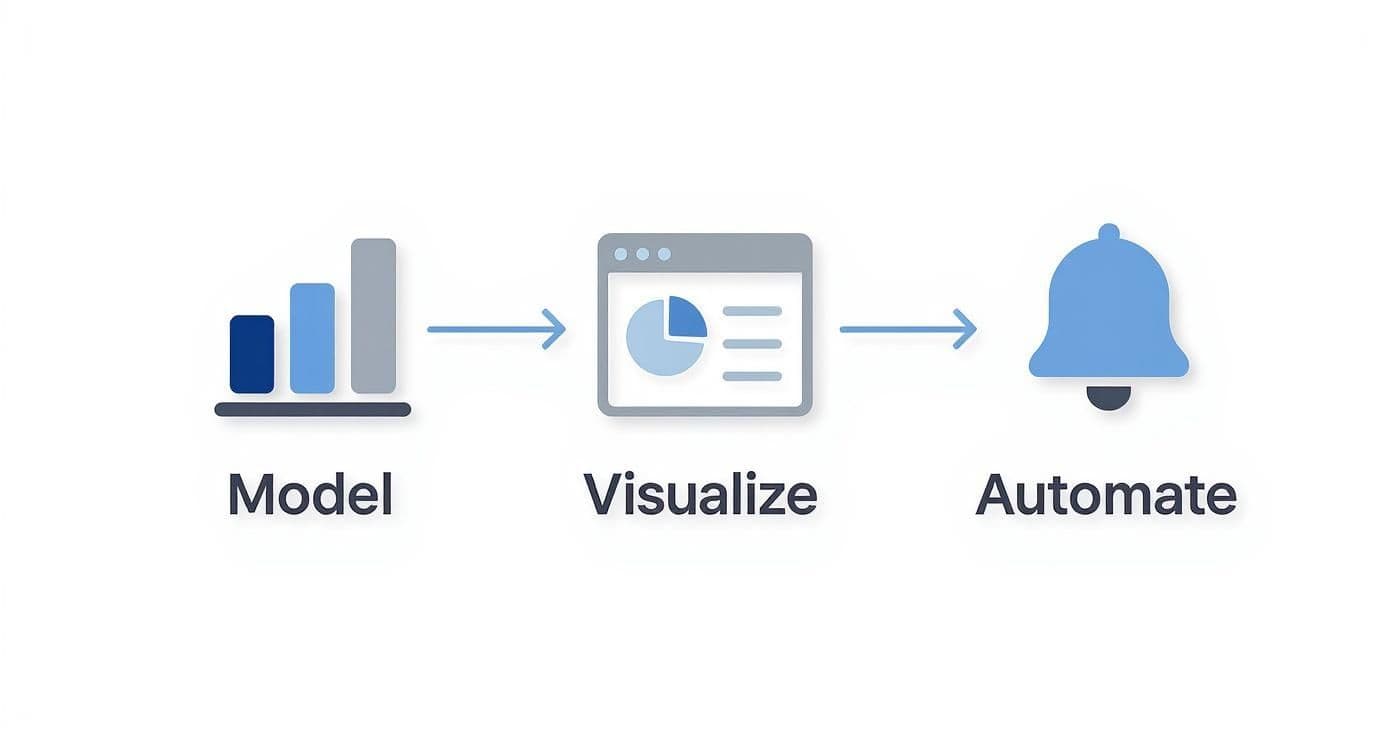
Phase 1 go-live checklist
This checklist ensures a smooth launch for your pilot program.
- Data migration: Historical risk data for the pilot team is imported and validated.
- User access: All pilot users are set up with the correct permissions.
- Core training: The pilot team has completed hands-on training for key tasks.
- Workflow configuration: Your first risk assessment and mitigation workflows are built and tested.
- Dashboard setup: Initial dashboards are live, tracking key risk indicators (KRIs) for the pilot group.
- Alerts activated: Automated alerts for high-priority risks are configured and tested.
- Feedback channel: A dedicated Slack channel is ready for user questions and feedback.
Measuring ROI and avoiding common pitfalls
How do you know if your new software for risk analysis is pulling its weight? You have to get past vague feelings of "being safer" and start tracking tangible metrics that tie directly back to the bottom line. Calculating your return on investment (ROI) isn't just about tallying up prevented disasters; it's also about new efficiencies and smarter decisions.
To learn more about the business case, the team at Reclaim Security has a great breakdown on Exposure Management: Business Case, ROI, and Automated Remediation.
Calculating the real return on your investment
Your ROI calculation needs to be a mix of hard dollar savings and softer strategic wins.
- Prevented losses: Calculate the potential financial hit from risks the software helped you identify and mitigate.
- Efficiency gains: Track the hours your team gets back by automating manual risk assessments, compliance checks, and reporting.
- Reduced insurance premiums: A well-documented, tech-backed risk management program can often lead to lower premiums.
- Improved audit scores: Better compliance scores mean less time and money spent fixing issues and avoiding potential fines.
Common pitfalls and how to avoid them
Even the best software will fail if rolled out poorly. Knowing these common traps is the first step to sidestepping them.
Mistake 1: Choosing an overly complex system It’s easy to get mesmerized by a tool with hundreds of features. But if your team only needs a handful, you're paying for complexity that gets in the way.
- How to avoid it: Make a clear list of your must-have requirements before you look at a demo. Focus on vendors that solve your core problems elegantly.
Mistake 2: Neglecting team training You can't just drop a new tool in your team's lap and expect them to become experts. A lack of proper training is a huge reason for low user adoption.
- How to avoid it: Make comprehensive training a mandatory part of your implementation plan. Designate internal "champions" who can offer ongoing help to their colleagues.
Mistake 3: Failing to integrate the software If your risk software doesn't talk to the tools your team already lives in-your CRM, your project management platform-it will always feel like an extra step.
- How to avoid it: Prioritize solutions with strong, pre-built integrations with your existing tech stack. For a deeper look at navigating these hurdles, our guide on overcoming AI implementation challenges offers a practical framework.
The one thing to do next
We've covered the why, what, and how of picking the right software for risk analysis. You’ve seen the different types of tools, what features matter, and how to nail the implementation. It all starts with knowing your own risk profile, then finding a tool that fits.
The single most important next step is to get your leadership team in a room for a preliminary risk assessment workshop. This isn't a multi-day offsite-just a focused, two-hour session to whiteboard your biggest vulnerabilities across operations, finance, and strategy.
This simple exercise gets key stakeholders on the same page and gives you the raw data needed to build a targeted list of software requirements. You’ll leave that room with a prioritized list of risks. That list becomes your North Star for choosing a tool that tackles your most pressing challenges.
Don't wait for a crisis to show you your blind spots. Get that workshop on the calendar and take control of your company's future. The insights you gain will be the bedrock for choosing the right software for risk analysis and building a more resilient business.
We at N² labs can help you navigate the complexities of AI-driven risk analysis and implement solutions that scale with your growth. Let's build a more resilient business together.
FAQ
The main purpose is to centralize and automate the process of identifying, assessing, and responding to potential threats. It moves businesses from using scattered spreadsheets and manual tracking to a dynamic, data-driven system. This helps founders make smarter decisions, protect assets, ensure compliance, and build a more resilient company that can navigate uncertainty effectively.
The cost varies widely. For small businesses, cloud-based solutions can start at a few hundred dollars per month. For larger enterprises with complex needs, annual costs can range from $10,000 to over $100,000. It's important to consider the total cost of ownership, which includes implementation, training, and ongoing support fees, not just the subscription price.
Yes. Small businesses are often more vulnerable to risks because they lack the financial cushion to absorb a major setback. Modern risk management software offers affordable, scalable options that help smaller teams identify operational weaknesses, manage cash flow risks, and handle compliance without hiring a dedicated risk department. It builds a solid foundation for sustainable growth.
They are two complementary methods for evaluating risk.
- Qualitative analysis is subjective. It ranks risks based on their likelihood and potential impact using a scale like low, medium, or high. It’s useful for quickly prioritizing a long list of threats.
- Quantitative analysis is objective and numerical. It assigns a specific monetary value to a risk, such as a "5% probability of a $200,000 loss." This provides hard data for financial planning and making cost-benefit decisions on mitigation efforts.
Good software for risk analysis supports both approaches, allowing you to first identify top-level concerns and then drill down into the financial specifics.