Written by: Igor
Published: December 2025
Choosing an application development model is the blueprint for building your software. It defines how your team collaborates, manages tasks, and responds to the inevitable challenges of bringing a product to market. Getting this decision right is critical, but it’s often treated as a purely technical choice.
This guide will show you why your development model is a core business decision, not an engineering afterthought. We'll break down the key models, from Waterfall to Agile and DevOps, in simple business terms. You will learn how to pick the right framework to align your technical execution with your market reality, ensuring you build the right product, on time and on budget.
Key takeaways
- Your choice of development model directly impacts your budget, timeline, and ability to adapt to market feedback.
- Waterfall is best for projects with fixed, unchanging requirements, offering predictability at the cost of flexibility.
- Agile is the dominant model today, ideal for innovative products where you need to learn and iterate based on user feedback.
- DevOps enhances Agile by automating the release pipeline, enabling incredible speed and reliability for scaling companies.
- The right model balances three key variables: requirement stability, market unpredictability, and the need for speed.
Why your development model is a business decision, not just a technical one
Choosing how to build your application often gets tossed over the fence to the engineering team. But here’s the thing: it’s one of the most critical business decisions a founder will make.
Get it wrong, and you’re looking at budget overruns, blown deadlines, and a product that doesn't hit the mark with customers. It's like deciding between building a skyscraper with a rigid, detailed blueprint versus exploring a new continent with just a map and compass. Both can get you somewhere, but the approach depends entirely on your destination and the terrain ahead.
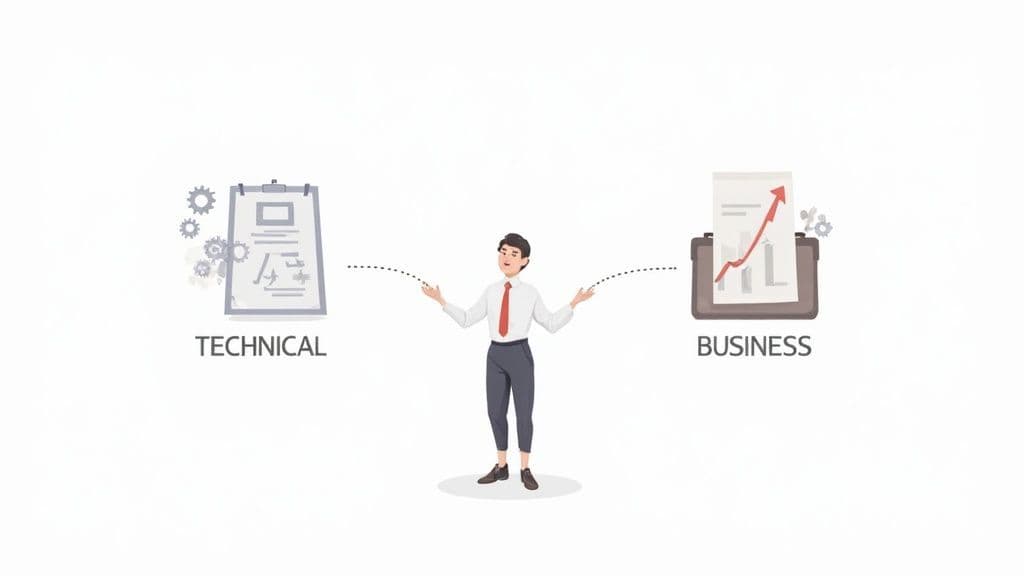
The right model connects your technical execution to your business goals. A mismatch creates friction that can grind a project to a halt. For example, if you’re building an innovative product where user needs are still fuzzy, a rigid, plan-everything-upfront model is a recipe for failure. It leaves no room for feedback or iteration.
This isn’t just a hunch. A report from the Project Management Institute found that 11.4% of all investment is wasted due to poor project performance- a risk often tied directly to a mismatched development approach.
Aligning process with outcomes
Your choice of model has a direct line to your bottom line. It shapes how you handle risk, how fast you can react to market feedback, and how predictable your budget will be. Ultimately, this decision defines your company's ability to compete.
A well-chosen model ensures that:
- Resources are used efficiently. You’re not burning cash building features nobody asked for.
- Risks are managed proactively. You spot potential trainwrecks before they happen.
- Your team stays aligned. Everyone, from developers to stakeholders, knows the game plan.
This guide will walk you through the foundational application development models, from the old-school Waterfall to modern powerhouses like Agile and DevOps. The goal isn’t just to ship code, but to build a process that drives measurable results.
Understanding the core application development models
Let's break down the most common application development models without the dense tech jargon. Think of each model as a different recipe for building software. Some are like following a strict, step-by-step baking guide, while others are more like a chef improvising.
To get a handle on these, it helps to understand the basic Software Development Cycle Stages that every approach builds upon.
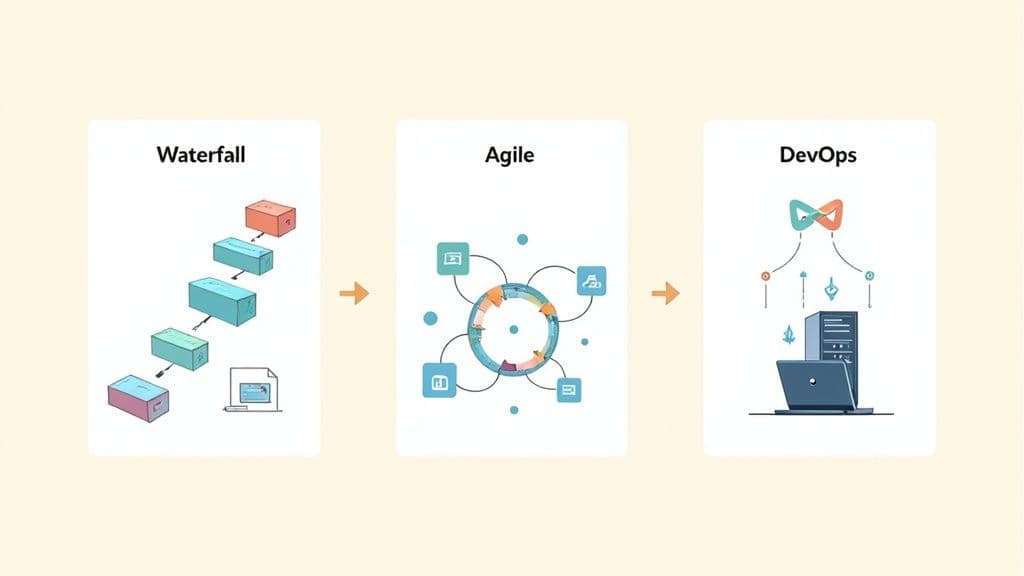
Each model gives you a unique playbook for managing a project from idea to launch. Knowing their core philosophies is key to picking the right one.
The waterfall model
Waterfall is the classic, linear approach. Imagine building a house: you pour the entire foundation before framing the walls. You finish all framing before touching the plumbing. You cannot move to the next phase until the previous one is 100% complete and signed off.
This model is rigid and sequential. Every requirement, feature, and design choice is documented upfront in a massive plan before a single line of code is written.
- Best for: Projects with crystal-clear, stable requirements that won't change. Think of a simple compliance application where the rules are fixed from the start.
- Business benefit: It offers high predictability. Because everything is planned in painstaking detail, you get a clear budget and timeline right out of the gate.
But its greatest strength is also its biggest weakness. If the market shifts, making a change is incredibly slow and expensive.
The agile family
Agile isn't a single model; it's a philosophy built around flexibility and continuous customer feedback. It works by breaking down huge projects into small chunks called "sprints," which usually last one to four weeks.
At the end of each sprint, the team delivers a small but working piece of the product. This creates a tight feedback loop, allowing for constant course correction. It’s like building a LEGO castle one small section at a time, showing it to someone, and adjusting the next section based on what they said.
This iterative process has taken over the industry. Since 2020, agile adoption rates have hit between 70-86% of development teams, according to Zippia. Organizations that switch often see project success rates jump significantly compared to old-school methods.
- Best for: Projects where requirements are expected to evolve. This is perfect for a new consumer app, an e-commerce site, or an AI-powered tool where you learn as you go.
- Business benefit: You get a basic version of your product to market faster (an MVP) and can adapt to what customers actually want, which reduces the risk of building the wrong thing.
The DevOps approach
DevOps isn't a standalone development model. It's a cultural and operational shift that takes agile’s principles and cranks them up to eleven. Its entire focus is on tearing down the walls between the software development (Dev) team and the IT operations (Ops) team.
Think of it like a Formula 1 pit crew. The engineers who design the car (Dev) and the mechanics who keep it running (Ops) work in perfect, seamless sync. This collaboration, powered by heavy automation, allows for unbelievably fast and reliable software releases.
- Best for: Businesses that need to release new features constantly and reliably. This is the lifeblood of SaaS products and any company in a fast-moving digital space.
- Business benefit: You get a dramatic boost in deployment speed, better application stability, and the ability to innovate faster than your competitors.
How to compare models on risk, speed, and flexibility
Now that you know the players, let’s see how they stack up. When you’re picking an application development model, you’re making a series of strategic trade-offs between risk, speed, cost, and your ability to adapt.
Choosing a framework is a core business decision. Get it right, and your development engine aligns with your market reality. Get it wrong, and you can burn your entire budget building something nobody wants. This is especially true for early-stage companies where every dollar and week is critical.
This visual from a Wikipedia article on the software development process perfectly captures the difference between linear and iterative models.
Alt text: A diagram comparing the linear path of the Waterfall model with the cyclical, iterative path of an Agile model.
Waterfall locks you into a rigid, one-way street. In contrast, iterative models like agile are all about feedback loops, giving you chances to course-correct.
Breaking down the trade-offs
Every model forces you to pick your priorities. A framework that gives you perfect budget predictability will sacrifice your ability to pivot. A model built for maximum flexibility makes it tough to give your board a precise launch date and final cost.
Let’s be clear about what these trade-offs mean:
- Risk: This isn’t just about code bugs. We're talking about market risk (building the wrong product), budget risk (overspending), and timeline risk (missing a launch window).
- Speed: How fast can you get a working product- or a single new feature- into the hands of users? The sooner you ship, the sooner you learn.
- Flexibility: Your biggest customer calls with a game-changing request. How easily can your team adapt without throwing the project into chaos?
- Cost predictability: How much faith can you have in your initial budget? Can you forecast your total spend with any accuracy?
To make this simple, let's put the main models side-by-side.
Comparing key application development models
This table cuts through the noise and shows you what you’re getting with each approach. It’s a cheat sheet for aligning your development strategy with your business goals.
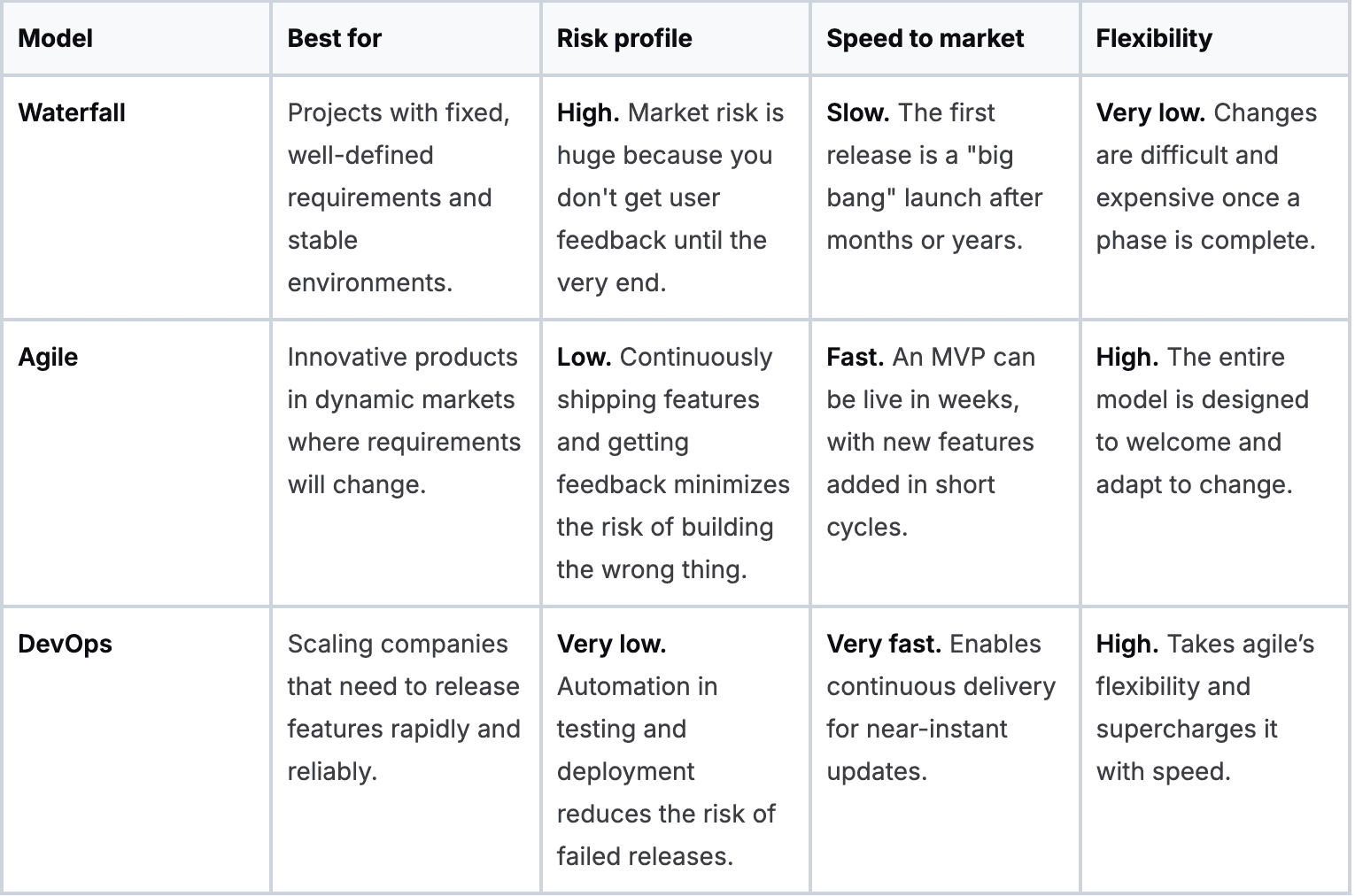
See the pattern? Moving from waterfall to agile and then to DevOps, you're essentially trading upfront certainty for adaptive speed and lower market risk.
For most modern software products- especially anything involving AI- this is a no-brainer. According to a Gartner report, this is why organizations are ditching rigid plans for adaptive approaches that can keep up with the pace of business.
Adopting modern practices like DevOps and AI
The world of application development doesn't sit still. While models like waterfall and agile provide solid blueprints, two recent shifts have become critical: DevOps and AI-assisted development. These aren't just trendy terms; they are fundamental changes in how the best teams build software.
Think of DevOps less as a rigid model and more as a cultural philosophy. Its mission is to tear down the walls between development (Dev) and IT operations (Ops). By automating the build, test, and release cycle, DevOps creates a smooth pipeline for continuous integration and continuous delivery (CI/CD). The result? Faster, smaller, and more reliable updates.
Organizations that get DevOps right see incredible results. According to McKinsey, top-performing companies reduce their change failure rate by 5x and can recover from incidents 106x faster. This isn’t just about moving quickly; it’s about building a resilient system that can handle rapid growth.
The rise of AI in the development lifecycle
Running parallel to DevOps, artificial intelligence is changing the day-to-day grind for developers. AI is no longer a far-off concept; it’s a hands-on tool plugged directly into the software development lifecycle. The goal is to augment human developers, not replace them.
AI tools now show up across the entire development process- from planning and coding to testing and deployment. This approach, sometimes called AI-assisted development, frees up teams to focus on creative, strategic work. Our guide on how to implement AI in business provides a great starting point.
Here’s where AI is already making a real difference:
- Automated code generation: Tools like GitHub Copilot act as an AI pair programmer, suggesting whole lines or functions as you type. This cuts down on writing boilerplate code and gets development moving faster.
- Intelligent code review: Before a human reviewer sees it, AI can scan code for bugs, security holes, and style issues. As applications get more complex, using the best AI code review tools is becoming non-negotiable for maintaining quality.
- Smarter testing: AI algorithms can generate more effective test cases, predict which parts of the codebase are most likely to have bugs, and automate chunks of the quality assurance (QA) process.
By pairing the cultural shift of DevOps with the smart assistance of AI, modern teams can build better software, faster. This combination is the new standard for companies serious about winning in their market.
A simple framework for choosing your model
Theory is great, but you have to make a call. Deciding on an application development model comes down to answering a few honest questions about your project, your market, and your team. This is about making your workflow match the reality of your business.
The right choice hinges on three key variables: how stable your requirements are, how unpredictable your market is, and how much pressure you’re under to deliver quickly.
The decision checklist
Before you lock in a model, run through this simple checklist. Your answers will point you in the right direction.
- Are my requirements crystal clear? If you know exactly what needs to be built and that won’t change, waterfall is an option. If you expect requirements to evolve, lean toward agile.
- How stable is my market? A steady, predictable market can handle a rigid, long-term plan. But a fast-moving market with shifting customer demands requires the adaptive nature of agile or DevOps.
- Is speed to market critical? Need to get an MVP out the door fast to test an idea? Agile is your best bet. If continuous delivery is central to your business model, then DevOps is the end goal.
- What is my tolerance for risk? Waterfall front-loads all risk to the end- you don't know if you've built the right thing until it's done. Agile and DevOps chip away at risk by delivering value in small chunks.
This decision tree gives you a visual for how to think about this, mapping your project’s stability against the need for speed.
When requirements are fuzzy and you must move fast, an adaptive model like agile is almost always the safest and most effective choice. These agile development statistics show how quickly things are moving.
AI-assisted tools are also changing the calculus. They are built for iterative environments and shine when they can accelerate coding, shorten feedback cycles, and automate testing, which makes agile and DevOps even more powerful. An AI readiness assessment can help you analyze your project's variables and align your technical strategy with your business objectives.
Putting your chosen model into action
A brilliant strategy is useless without solid execution. Once you’ve picked your application development model, the real work begins: weaving that framework into your team’s day-to-day work. It's time to move from theory to reality.
Defining your operational cadence
Success isn’t about just picking a project management tool. It’s about building a rhythm- a culture- that brings your chosen model to life. This means setting up a clear operational cadence with well-defined roles, consistent communication, and a shared understanding of what "done" means.
Here's how to get started:
- Assign clear roles and responsibilities: Who owns the product backlog? Who’s the final word on QA? Any ambiguity here is a recipe for friction.
- Select the right tools for the job: If you're running an agile process, a tool like Jira is non-negotiable for managing sprints. For simpler workflows, Asana or Trello might be all you need.
- Establish communication rhythms: Lock in your key ceremonies. Daily stand-ups, weekly sprint planning sessions, and end-of-sprint retrospectives are the heartbeat of an agile process.
Think of your model as a living process, not a static document. You have to constantly review and tweak it based on what’s actually working. Anticipating common AI implementation challenges can save you a world of hurt later on. Choosing the right application development models from the start makes this whole process smoother.
We at N² labs can help you cut through the noise, pick the right application development model for your goals, and turn your AI concepts into production-ready results.
Get your one-page AI implementation plan
FAQ
Without a doubt, it's agile. Over 70% of software teams use some form of it. Agile is built for the real world- flexible, iterative, and focused on shipping value fast. This approach is perfect for handling the curveballs modern markets throw at you and lets you adapt quickly to customer feedback.
Technically, yes, but it’s incredibly disruptive and risky. Swapping models mid-project is like changing the engine on a plane while it's in the air. It's far better to invest time upfront to make a solid choice. If you absolutely must pivot, manage the transition with extreme care, clear communication, and team retraining to prevent momentum from cratering.
They're a perfect match. DevOps isn't a replacement for agile; it’s a supercharger. Agile helps build the right product by improving collaboration between developers and the business. DevOps then gets that product released quickly and reliably by improving collaboration between developers and IT operations. Together, you get a seamless, high-speed pipeline from idea to live product.
For most startups, an agile model like Scrum is the way to go. It’s all about building a minimum viable product (MVP) fast, getting it in front of real users, and then iterating based on their feedback. This approach saves you from the biggest startup killer: spending limited cash building a beautiful product nobody wants. It forces you to focus on features that deliver immediate value.