Written by: Igor
Published: December 2025
Rushing into development without a clear plan is a recipe for disaster. You end up with scope creep, blown budgets, and a product that doesn't solve a real problem. The discovery phase of a project is the structured process of gathering critical information-goals, scope, risks, and requirements-before writing a single line of code. This guide will show you how to run a discovery phase that aligns your team and creates an actionable plan to avoid costly mistakes.
Key takeaways
- De-risk your project: A proper discovery phase forces you to answer tough questions about business value, data readiness, and technical hurdles early on.
- Align everyone: Get stakeholders from business, product, and engineering on the same page with a shared vision and clear goals.
- Define clear goals and deliverables: Translate vague ideas into measurable KPIs, a technical readiness report, a risk register, and a prioritized roadmap.
- Follow a structured framework: Use a five-step process including stakeholder interviews, readiness assessments, user journey mapping, and backlog creation.
- Measure success: Track leading indicators like "time to backlog" and lagging indicators like "rate of change requests" to prove the ROI of your discovery process.
Why the discovery phase is non-negotiable for AI projects
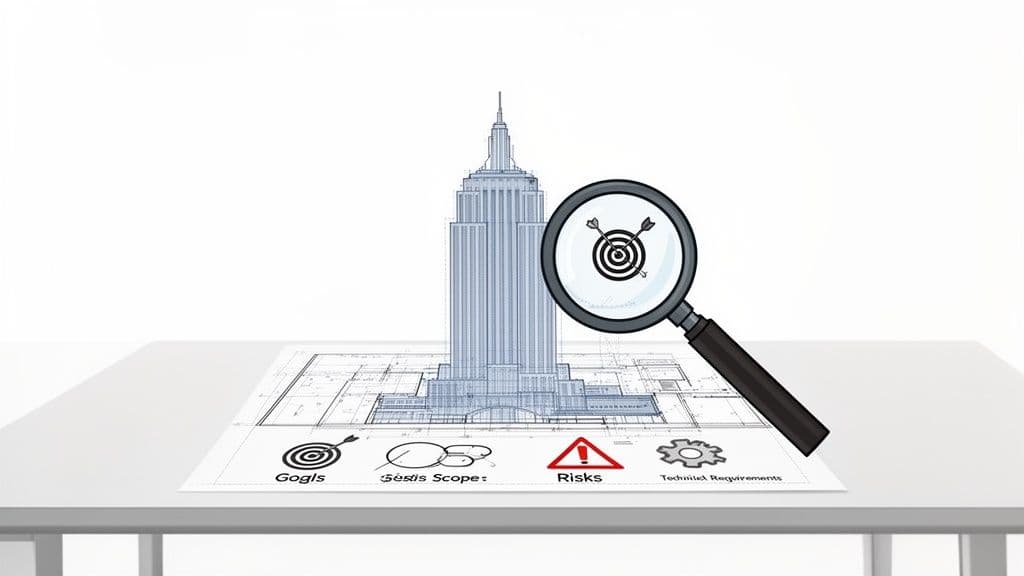
The discovery phase of a project is where you separate a good idea from a viable business initiative. Skipping it is like trying to build a skyscraper without architectural plans. You might get a few floors up, but the whole structure is doomed from the start. This is the stage where you turn a vague concept into a validated, rock-solid roadmap.
This initial deep dive is especially vital for AI projects. They are notoriously complex, tangled in uncertain data requirements, tricky technical dependencies, and a constant need for collaboration between business leaders and data scientists.
Bridge the gap from experiment to production
Too many AI projects get stuck in "pilot purgatory," never making the leap from a cool experiment to a production-ready system that delivers real value. According to a McKinsey report, only 53% of AI projects make it from prototype to production. Check out the latest state of AI research for more details.
A proper discovery phase tackles this problem head-on by forcing you to answer the tough questions early:
- What specific, measurable business problem are we trying to solve?
- Do we have the right data-and enough of it-to train a reliable model?
- What are the hidden technical landmines and operational hurdles?
- How will we define and measure success in terms of tangible ROI?
Aligning everyone on the same map
Misalignment is a silent project killer. When business leaders, product managers, and engineers have different ideas about what "done" looks like, you're guaranteed to waste time, blow your budget, and end up with a solution nobody loves.
The discovery process gets everyone in the same room, looking at the same map. Through focused workshops and stakeholder interviews, it hammers out a shared understanding of the project's goals, constraints, and vision.
A well-run discovery phase ensures every stakeholder-from the CEO to the junior developer-is working from the same set of plans. This alignment is the foundation for moving quickly and confidently once development starts.
Investing time in discovery isn't about slowing down. It's about de-risking the entire initiative and ensuring that when you build, you're building the right thing, the right way.
Defining your project discovery goals
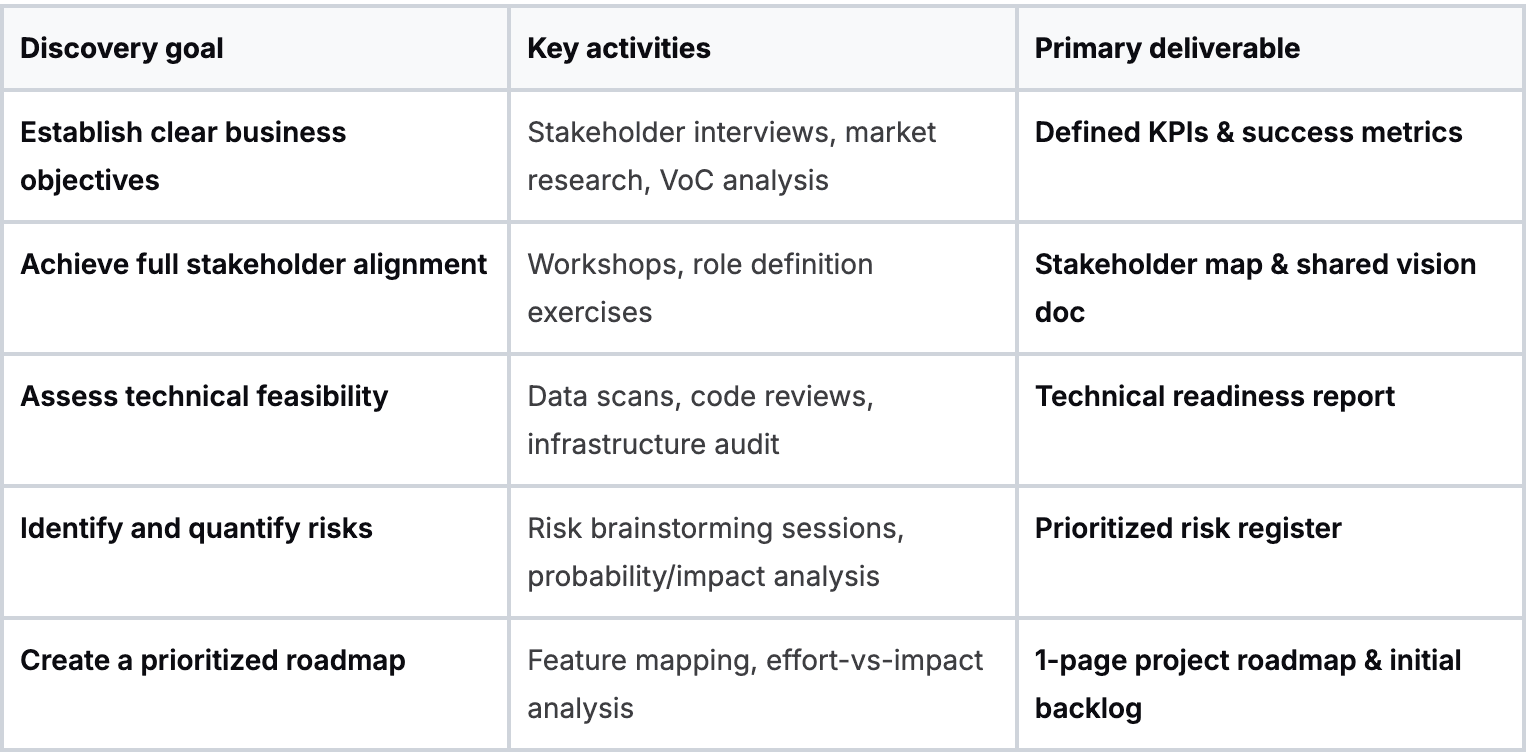
A solid discovery phase isn't just about gathering information. It's about locking in specific, tangible outcomes that set your project up for a win. For founders and operators, the discovery phase of a project needs to nail five critical goals, each producing a clear deliverable that turns your idea into an action plan.
Establish clear business objectives
First, translate a business idea into a goal you can measure. What does success look like? If you can't put a number on it, you're not ready to build.
Get past vague statements like "improve customer support." A real objective sounds like this: "Reduce average customer support ticket resolution time by 25% within three months of launch." That's a target your team can aim for.
To nail your project's goals, you have to get inside your audience's head. Learning about mastering Voice of the Customer programs is a great start for gathering direct feedback to shape those objectives.
Achieve full stakeholder alignment
There's no faster way to kill a project than having stakeholders who aren't on the same page. Your head of sales might see a new feature as a lead-gen machine, while your engineering lead sees it as a chance to pay down technical debt. If those visions don't sync up, you're heading for a collision.
The discovery phase forces these conversations to happen before code is written. Through structured workshops and interviews, you ensure every key player shares a single, unified vision for the project’s purpose and success metrics. The result is a clear stakeholder map and a shared understanding of who owns what.
Assess technical feasibility and readiness
An idea is only as good as your team's ability to build it. This is especially true for AI projects, which depend on data quality, infrastructure, and your existing codebase. A key goal of discovery is to get a frank assessment of your technical readiness.
This comes down to a few critical questions:
- Data readiness: Do we have clean, accessible, and enough data to train a reliable model?
- Code readiness: Can our current systems handle this new AI feature, or do we need a massive architectural overhaul?
- Team readiness: Does our team have the skills for this, or do we need outside help?
Answering these gives you a realistic picture of the technical lift involved. For a deeper look, you can check out what goes into a full AI readiness assessment and how it eliminates guesswork.
Identify and quantify project risks
Every project has risks, but successful ones see them coming. The discovery phase is your chance to brainstorm everything that could go wrong-from technical roadblocks and blown budgets to market shifts.
But you don't just list them. You quantify them. You figure out the probability of each risk and the potential damage it could cause. This process creates a risk register-a critical document that outlines every threat and a plan to deal with it. This turns risk management from a reactive panic into a strategic advantage.
Create a prioritized project roadmap
Finally, you distill everything-objectives, stakeholder input, tech assessments, and risks-into a prioritized roadmap. This isn’t a 50-page document that collects digital dust. It’s a clean, one-page plan showing what to build, in what order, and why.
The roadmap is built around an effort-versus-impact analysis, ensuring your team works on the highest-value features first. It creates a focused backlog for the initial development sprints, giving your team the clarity they need to start building fast. This is the bridge from planning to execution.
Key goals and deliverables of the discovery phase
Your step-by-step discovery framework
A solid discovery process turns a high-level idea into a concrete, buildable plan. It's a structured workflow designed to produce specific, actionable outputs. Think of this framework as a recipe-the core steps ensure you capture business needs, check technical assumptions, and get everyone aligned.
Step 1: Conduct stakeholder interviews
First, you have to listen. Get inside the heads of the people who have a stake in the project’s outcome-executive sponsors, department heads, end-users, and the tech team.
The goal is to dig up the real pain points, desired outcomes, and hidden assumptions. For a practical approach, this step-by-step guide to conducting user interviews can help structure your conversations.
These interviews aren't for collecting a feature wish list. They’re about understanding the why behind the project. What business problem are we really trying to solve? When done right, you walk away with a clear understanding of the business context and user needs.
Step 2: Perform a comprehensive readiness assessment
Once you grasp the business goals, it’s time to look under the hood. For AI projects, this is where ideas meet reality. A readiness assessment is a deep dive into your data, code, and infrastructure to determine if you're ready to build.
This isn’t a quick check. It involves:
- Data quality scans: Poring over datasets to check for completeness, accuracy, and biases.
- Codebase audits: Reviewing your application architecture to find integration points, technical debt, and bottlenecks. You can explore various application development models to see how this fits in.
- Infrastructure evaluation: Making sure your systems can handle the demands of training and deploying AI models.
This assessment surfaces hidden risks and quick wins, giving you a realistic picture of the technical effort required.
Step 3: Develop an AI readiness scorecard
The findings from your assessment need to be easy to digest. An AI readiness scorecard does just that. It grades your organization across key areas like data maturity, technical infrastructure, and team skills.
This scorecard provides a clear, visual summary of your strengths and weaknesses. It helps stakeholders quickly see where the biggest risks are and where investments are needed. It shifts the conversation from technical jargon to strategic decision-making.
Step 4: Map user journeys and define success metrics
Now, connect the technical findings back to the user experience. In collaborative workshops, map out the ideal user journey for the new feature. This helps everyone visualize how users will interact with the system and what value they’ll get at each step.
From this map, define key performance indicators (KPIs) that will measure success. They must be specific, measurable, and tied to the business objectives from Step 1. Instead of a vague goal like "improve efficiency," you'll have a concrete KPI like "reduce manual data entry time by 40%."
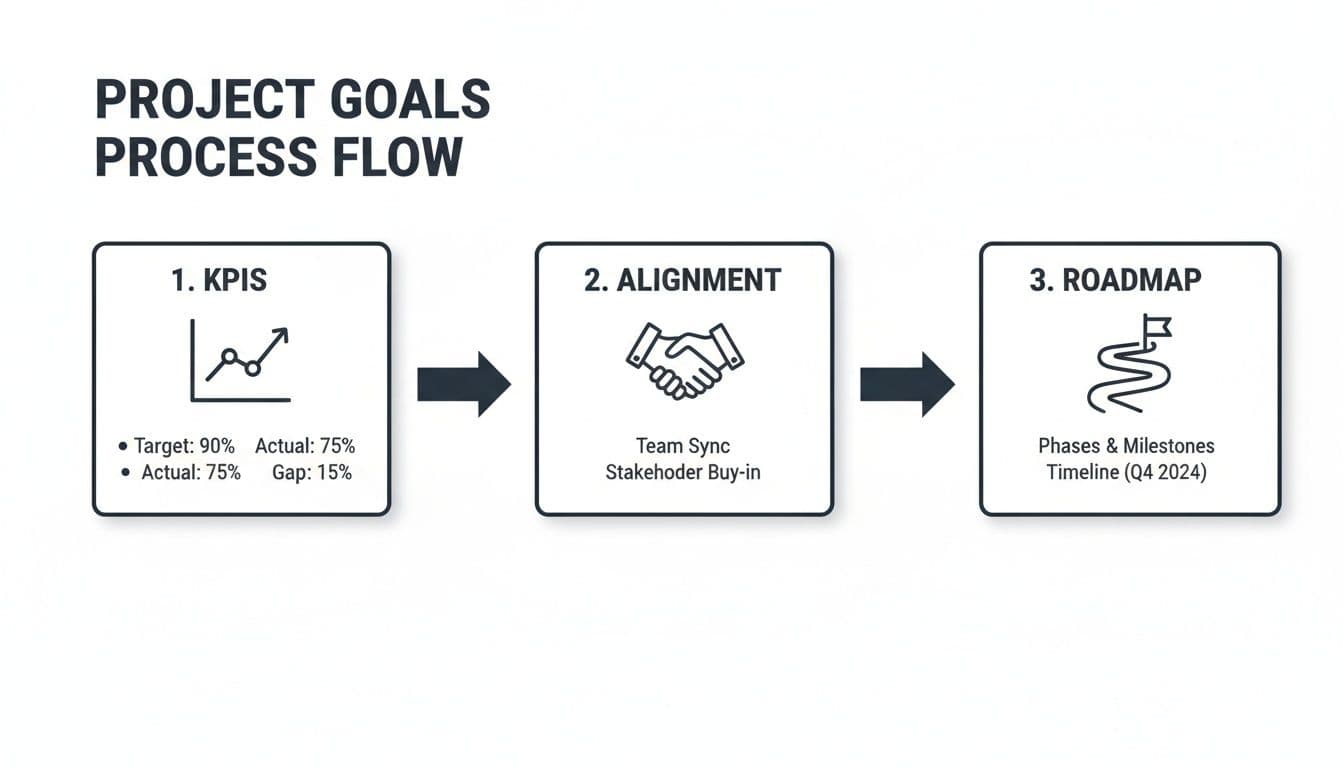
This visual makes it clear: a project’s success hinges on turning business goals into measurable metrics and a shared plan.
Step 5: Synthesize into a roadmap and backlog
The final piece is pulling everything together into a clear, prioritized plan. This usually takes two forms:
- A one-page project plan: A high-level summary of the project’s vision, goals, milestones, and success metrics.
- A focused backlog: A prioritized list of tasks for the first one or two development sprints.
Disciplined discovery makes a huge difference. Organizations that invest in a formal discovery slash their aborted proof-of-concept rates significantly. The best teams report they can compress build-and-ship cycles to deliver production-ready workflows in just 2-6 weeks for focused use cases.
How to measure discovery phase success
How do you know if your discovery phase worked? Success is measured by the clarity, confidence, and alignment it builds. Think of it as a strategic investment that de-risks development and clears a path to business value.
Leading indicators of a successful discovery
You can gauge the health of your discovery in real-time by watching a few key indicators. These are your early warning signals.
- Time to prioritized backlog: The total time from kickoff to a signed-off, prioritized backlog for the first sprint. A healthy range is typically 10-15 business days.
- Stakeholder consensus score: After workshops, survey stakeholders to rate their agreement with project goals on a scale of 1 to 5. An average score of 4.5 or higher is a strong sign of consensus.
- Reduction in scope uncertainty: Document all open questions at the beginning. A successful process should resolve at least 90% of these, leaving a clear scope.
Tracking these numbers helps show discovery is a value-driver that sets the pace for what follows.
Lagging indicators that prove the ROI
The true value of a solid discovery shines through once coding starts. Lagging indicators are the downstream results that reflect the quality of your upfront work.
- Lower rate of change requests: A well-defined scope kills confusion and scope creep. Teams that invest in discovery often see up to 50% fewer change requests in the first three months of development.
- Higher pilot-to-production conversion rate: A strong discovery ensures your pilot solves a real business problem and is technically sound. This dramatically increases the odds of a full-scale deployment. For a deeper dive, see how a production readiness checklist can smooth that transition.
- Faster time-to-value: With a clear, prioritized backlog, the team ships the most important features first. The business starts seeing a return on investment much sooner.
By tracking both leading and lagging indicators, you can draw a straight line from the work in the discovery phase of a project to a faster, cheaper, and more successful development cycle.
Common discovery pitfalls and how to avoid them
Even with the best intentions, the discovery phase of a project can go off the rails. Knowing the common traps is the first step to sidestepping them.
Pitfall 1: Getting stuck in analysis paralysis
This is the classic one. Teams get so obsessed with collecting information that they forget to make a decision. Discovery turns into a hamster wheel of endless research.
- How to avoid it: Timebox everything. Put a hard deadline on the discovery process-usually two to four weeks. Force prioritization by asking, "What is the single most critical question we have to answer this week?" This pushes everyone to make decisions with the info they have.
Pitfall 2: Involving the wrong stakeholders
A discovery without the right people is a waste of time. When key decision-makers or end-users are missing, you build your strategy on shaky assumptions. This almost always leads to massive scope changes later. A report in Forbes points to this as a top reason discoveries fail.
- How to avoid it: Create a stakeholder map on day one. Identify everyone with influence over the project or who will be affected by its outcome. Make their attendance at key workshops non-negotiable.
Pitfall 3: Treating discovery as a one-time event
Some teams see discovery as a box to check before the "real work" begins. They draft a plan and never think about it again. But your assumptions will be tested-and often proven wrong-the moment you start building.
- How to avoid it: Build in checkpoints. Plan for quick, iterative feedback loops after the initial discovery is "finished." For example, schedule a review after the first development sprint to see if your initial assumptions hold up. This transforms discovery from a static document into a living process.
Turning discovery insights into production-ready AI
A great discovery phase leaves you with a clear, validated plan. But a plan on a shelf doesn’t generate ROI-execution does. This is where you turn insights into a live, production-grade AI solution that moves the needle for your business.
A successful discovery phase of a project is the perfect launchpad. It gives you the essential coordinates-the readiness scorecard, risk register, and prioritized roadmap. An experienced partner uses these inputs to build and ship a measurable AI workflow in weeks, not months.
From roadmap to reality: an example workflow
An expert partner will grab the top-priority item from your backlog and start building. Here’s what that looks like in practice.
- Kickoff & sprint planning (Day 1-2): Review the one-page roadmap and backlog. Define the scope for the first two-week sprint.
- Develop minimum viable feature (Day 3-8): Build the core functionality of the highest-priority item. Provide daily progress updates.
- Internal demo & feedback (Day 9): Showcase the working feature to key stakeholders. Gather immediate feedback.
- Iterate & finalize (Day 10-12): Incorporate feedback and prepare for deployment.
- Ship & monitor (Day 13-14): Deploy the feature to a controlled user group. Monitor KPIs defined in the discovery phase.
This approach is designed to get your AI initiatives out of the pilot phase and into production with speed and confidence. For a detailed guide on making that final leap, our production readiness checklist offers a structured framework.
The next step is to take action. A well-executed discovery phase of a project is the single best investment you can make to ensure your project delivers real business value on time and on budget.
We at N² labs can help you run a focused AI readiness assessment that delivers a clear, prioritized roadmap in weeks, not months.
FAQ
The main purpose of a discovery phase is to de-risk a project by defining its goals, scope, requirements, and potential challenges before development begins. It aligns all stakeholders on a single vision, validates technical feasibility, and creates a prioritized roadmap. This ensures that the team builds the right solution, for the right problem, in the most efficient way.
A well-run discovery phase is time-boxed, typically lasting between two to six weeks. For a focused project with a clear scope, two weeks is often enough to align stakeholders and produce a prioritized backlog. More complex initiatives involving multiple departments or significant technical unknowns might require four to six weeks to ensure thoroughness without getting stuck in analysis paralysis.
The key deliverables are actionable documents that guide the development process. These include a business requirements document (BRD) outlining goals and KPIs, a technical readiness report, a prioritized risk register with mitigation plans, a one-page project roadmap for high-level alignment, and a focused backlog with tasks for the first development sprints.
A successful discovery phase requires a cross-functional team. Key participants include executive sponsors (for strategic direction), product managers (as the voice of the user), lead engineers or architects (for technical feasibility), and representatives of the end-users who will interact with the final product. For AI projects, data scientists are also critical for assessing data readiness.