Written by: Igor
Published: December 2025
Marketing chatbots are more than a tech trend- they're a fundamental shift in how businesses talk to their customers. They solve the old problem of not being everywhere at once for every person who shows interest. Using chatbots for marketing means you have an always-on digital team, ready to engage high-intent leads the second they land on your site. This guide will show you how to use them to automate conversations and guide potential customers through the sales journey without missing a beat.
Snapshot: Key takeaways
- Focus on one job: Start by automating a single, high-impact task like booking demos on your pricing page.
- Measure what matters: Track conversation-to-lead rate (aim for 15-25%) and meetings booked, not just conversations started.
- Integrate your stack: Connect your chatbot to your CRM and sales tools to ensure a smooth data handoff.
- Hybrid is best: Use bots for 24/7 qualification and scheduling, but always provide an easy handoff to a human for complex issues.
The strategic shift to conversational marketing
Modern customers expect instant answers. They won't wait for your office to open or for a sales rep to get to their email. This demand for immediate, one-on-one connection at scale is a massive headache for most marketing teams.
Conversational marketing is the answer. Instead of forcing people through clunky forms and making them wait, it opens a direct line of communication when they're most engaged. Chatbots are the engine that makes this strategy work, turning passive website visits into active dialogues.
Why conversational marketing matters now
The shift is driven by a simple reality: buyers are in control. A slow response isn’t just a minor annoyance- it’s a lost deal. This is where getting good at chatbots for marketing gives you a serious edge.
- Meet customer expectations: You're there with answers 24/7, exactly when your buyers need them.
- Increase engagement: A two-way conversation keeps people on your site longer and pulls them deeper into your world.
- Accelerate the sales cycle: You can qualify leads and book meetings in real-time, cutting out the friction that causes prospects to disappear.
This isn't about replacing your sales team, but making them more effective. By handling initial, repetitive interactions, chatbots free up your people to focus on high-value conversations. If you want to go deeper, check out this ultimate guide to chatbots for marketing.
The market growth tells the same story. The global chatbot market is expected to reach $17.17 billion by 2030, according to Statista. That's a clear signal that companies are investing heavily in this tech.
How chatbots deliver measurable marketing ROI
Talking about new tech is one thing. Turning it into actual business results is what really matters. When it comes to chatbots for marketing, the return on investment (ROI) is a clear win for your budget and bottom line.
The core idea is simple: chatbots automate high-volume, repetitive tasks, freeing up your team for strategic work. This creates a powerful combination of cost savings and new revenue.
Slash your operational costs
One of the first places you'll see a financial win is in how a chatbot handles routine questions. Think about the time your team spends answering the same things over and over- questions about pricing, features, or support docs. A chatbot can field all of that instantly, 24/7, at a fraction of the cost of a person.
This isn’t about replacing people. It’s about reallocating their time to where it generates the most value, like closing deals or building your next campaign.
Get more efficient at lead generation
If you’re just waiting for people to fill out a form, you’re leaving money on the table. A chatbot acts as your always-on digital greeter, engaging potential customers the second they land on your site.
But it goes deeper than a simple "hello." Chatbots can actively qualify leads on the spot. By asking a few smart questions, a bot can figure out if a visitor is a good fit, segment them, and collect their contact info in a natural way.
- 24/7 availability: You’ll start capturing leads that used to slip through the cracks outside of business hours.
- Instant qualification: The bot automatically filters out tire-kickers, so your sales team only talks to prospects with real potential.
- Reduced friction: A smooth chat experience feels easier for the user, which means more of them will complete the process.
This all adds up to a much lower cost per qualified lead. You’re not just getting more leads- you're getting better leads with less manual effort.
Chatbots directly attack the cost and inefficiency in most marketing funnels. The result is a leaner, more effective growth engine.
Chatbot ROI drivers across the marketing funnel
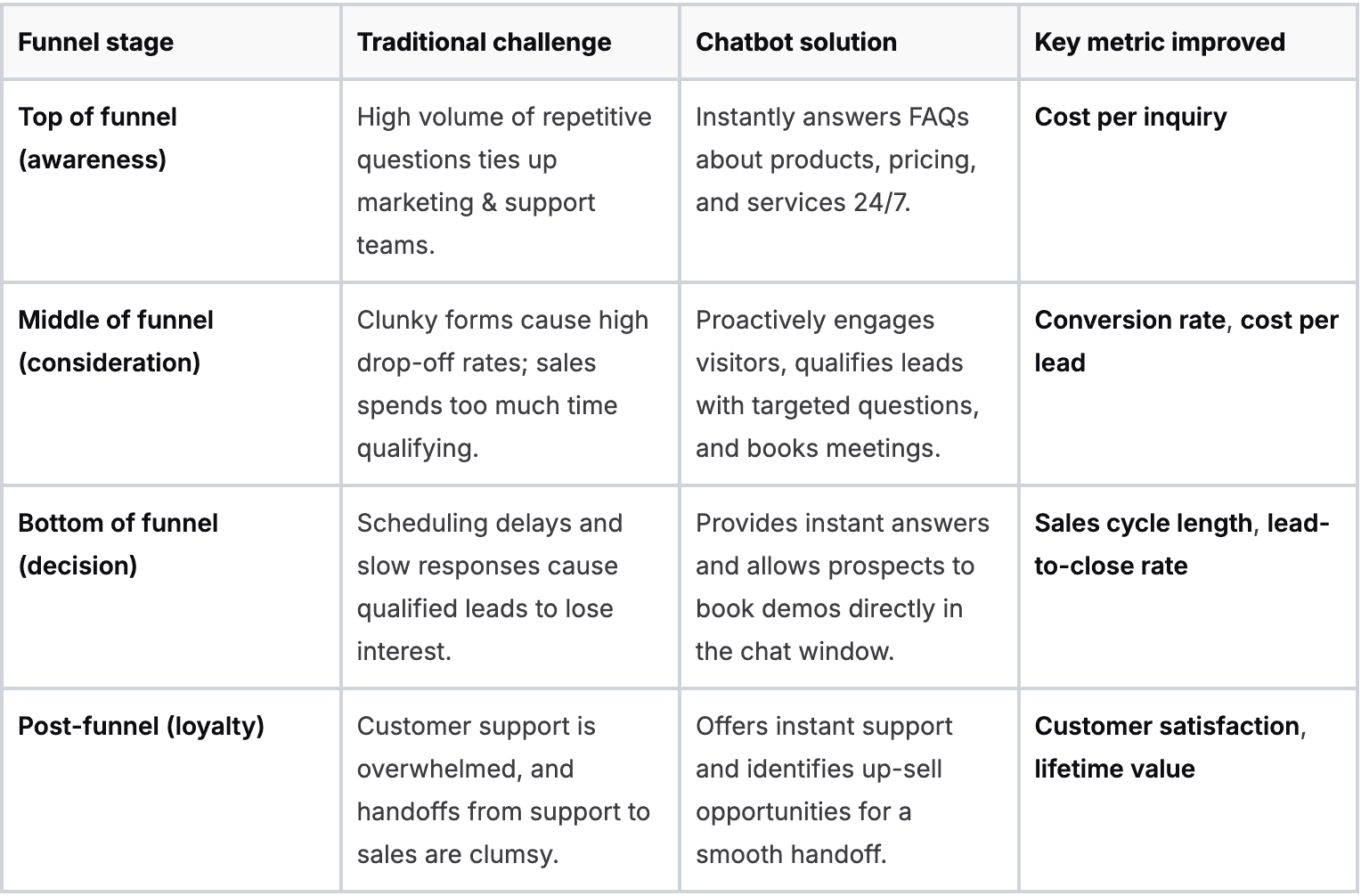
By addressing the friction points at every stage, chatbots create a compounding effect that improves efficiency from the first touchpoint to the final sale.
Speed up the sales cycle
Time kills deals. The longer a prospect waits for an answer, the more likely they are to lose interest or find a competitor.
Marketing chatbots solve this by delivering instant gratification. A qualified buyer can get their questions answered and book a demo on a sales rep's calendar- all without leaving the chat window. This removes the painful back-and-forth of scheduling emails and keeps the momentum going.
The numbers back this up. Global retail spend via chatbots is projected to hit $142 billion by 2024, a massive jump from $2.8 billion in 2019 (Juniper Research). For more data, dig into these chatbot statistics.
This move toward conversational commerce is about meeting modern buyers where they are. By giving them a faster path to what they need, you improve their experience and get revenue in the door faster.
Core use cases for chatbots for marketing
This is where the rubber meets the road. Knowing exactly where to deploy chatbots is how you get results. The most successful strategies focus on specific, high-impact jobs where automation makes a real difference.
Here are the four core use cases that deliver the most value, fast.
Proactive lead generation
Waiting for a visitor to fill out a contact form is an outdated strategy. Proactive chatbots turn your website into an active lead generation machine, especially on high-intent pages like pricing or feature comparisons.
When a user hesitates on one of these key pages, the bot can pop up with a relevant message. It’s a timely offer of assistance that captures leads that would have been lost. To see how AI powers this, get more insights on AI Chat for Marketing.
Example conversation: Bot: "Hi there! I see you're looking at our enterprise plan. Any questions about the features or pricing I can help with?" User: "Yeah, what's the difference between this and the pro plan?" Bot: "Great question. The enterprise plan includes dedicated support and SSO. Can I get your work email to send you a detailed comparison sheet?"
24/7 lead qualification
Not every lead is a good lead. Your sales team's time is their most valuable asset. A marketing chatbot acts as your frontline qualifier, working around the clock to vet visitors against your ideal customer profile.
The bot asks a series of targeted questions to gather key information. This data determines if the prospect gets fast-tracked to sales or nurtured with content. This is a cornerstone of modern automation, which you can explore in these powerful AI tools for marketing automation.
Example conversation: Bot: "To make sure we're a good fit, could I ask a couple of quick questions? First, what is your company size?" User: "100-500 employees." Bot: "Perfect. And what's your biggest challenge with your current process?" User: "It's too manual and slow." Bot: "That's exactly what we help solve. It sounds like a chat with our product specialist would be really valuable. Are you free tomorrow?"
Automated appointment scheduling
One of the biggest friction points in any sales process is scheduling a meeting. Email tag is slow and gives a qualified lead plenty of time to get cold feet.
A chatbot eliminates this problem. Once a lead is qualified, the bot can integrate directly with your sales team's calendars and present available time slots right inside the chat window. This simple workflow can shrink the time from first touch to first meeting from days down to minutes.
Personalized content delivery
Your blog and case studies are valuable assets, but only if the right person sees them at the right time. Think of a chatbot as a smart content librarian, ready to recommend the perfect resource based on what a user is doing on your site.
If a visitor asks about a specific feature, the bot can offer a link to a relevant case study. This builds trust, keeps users on your site longer, and positions your brand as a helpful authority.
Building your first chatbot marketing strategy
A great strategy is the difference between a helpful chatbot and one that just annoys your visitors. Your goal should be to build a tool that feels like a natural extension of your brand- helpful, efficient, and never in the way. This framework gives you a practical roadmap to get started right.
Define your primary objective
Before you write a single line of dialogue, answer one question: what is the number one job this chatbot will do? Trying to make your first bot do everything is a classic recipe for failure. Focus on a single, clear key performance indicator (KPI).
Your goal has to be specific and measurable.
- Bad goal: "We want to generate more leads."
- Good goal: "We want to increase qualified leads from our pricing page by 20% in Q3."
This clarity gives you a north star for designing conversations, choosing technology, and knowing if you've succeeded. Start small, prove the value, and then expand.
Identify high-impact deployment pages
Where you place your chatbot matters just as much as what it says. Be strategic. Put it where it can have the biggest impact on the primary objective you defined.
Think about your user's journey. Where do your highest-intent prospects hang out?
- Pricing page: Visitors here are actively evaluating your solution. A bot can answer last-minute questions, preventing them from bouncing.
- Product feature pages: This is a great spot to offer proactive help or guide users toward booking a demo.
- "Contact us" page: Instead of a lifeless form, a bot can qualify the inquiry instantly and route it to the right team.
By targeting these high-intent locations, you ensure your chatbot engages with visitors who are closer to making a decision.
Design helpful conversational flows
A chatbot's script is its entire personality. A robotic, unhelpful script will drive users away. A natural, well-designed flow builds trust and guides them toward their goal.
Start by mapping the conversation out on a whiteboard. Anticipate user questions and design clear, logical paths for each scenario.
Checklist for a user-friendly script:
- Start with a clear, friendly greeting. State what the bot can help with.
- Use simple, direct language. Ditch the jargon.
- Offer clear choices. Use buttons or numbered lists to make it simple for users to respond.
- Provide an escape hatch. Always give users an easy way to connect with a human.
- End with a clear next step. Confirm the action taken.
A great conversational flow feels less like an interrogation and more like a helpful concierge. Efficient scripting is a key part of a successful strategy, much like the processes that drive AI content automation.
Choose the right technology and integrations
Finally, you need the right tools for the job. Chatbot platforms range from simple no-code builders to advanced solutions. For your first chatbot, a no-code or low-code platform is almost always the best choice.
Seamless integration with your existing marketing stack is critical. Your chatbot should never be a data silo. Make sure it can connect to your core systems, like your CRM, to pass information back and forth.
Measuring success and optimizing performance
Launching a marketing chatbot isn’t a “set it and forget it” project. The real difference between a bot that drives serious ROI and one that annoys visitors comes down to constant measurement and optimization.
To see real value, you have to look past vanity metrics like ‘conversations started.’ Focus on the numbers that actually move the needle for your pipeline and revenue. A structured approach turns your chatbot from a simple tool into a smart, data-driven growth engine.
Key metrics for chatbot marketing performance
Tracking performance is about understanding the story the numbers are telling. Is your bot engaging people effectively? Are those conversations turning into actual leads? Are those leads the right leads? This table breaks down the essential metrics.
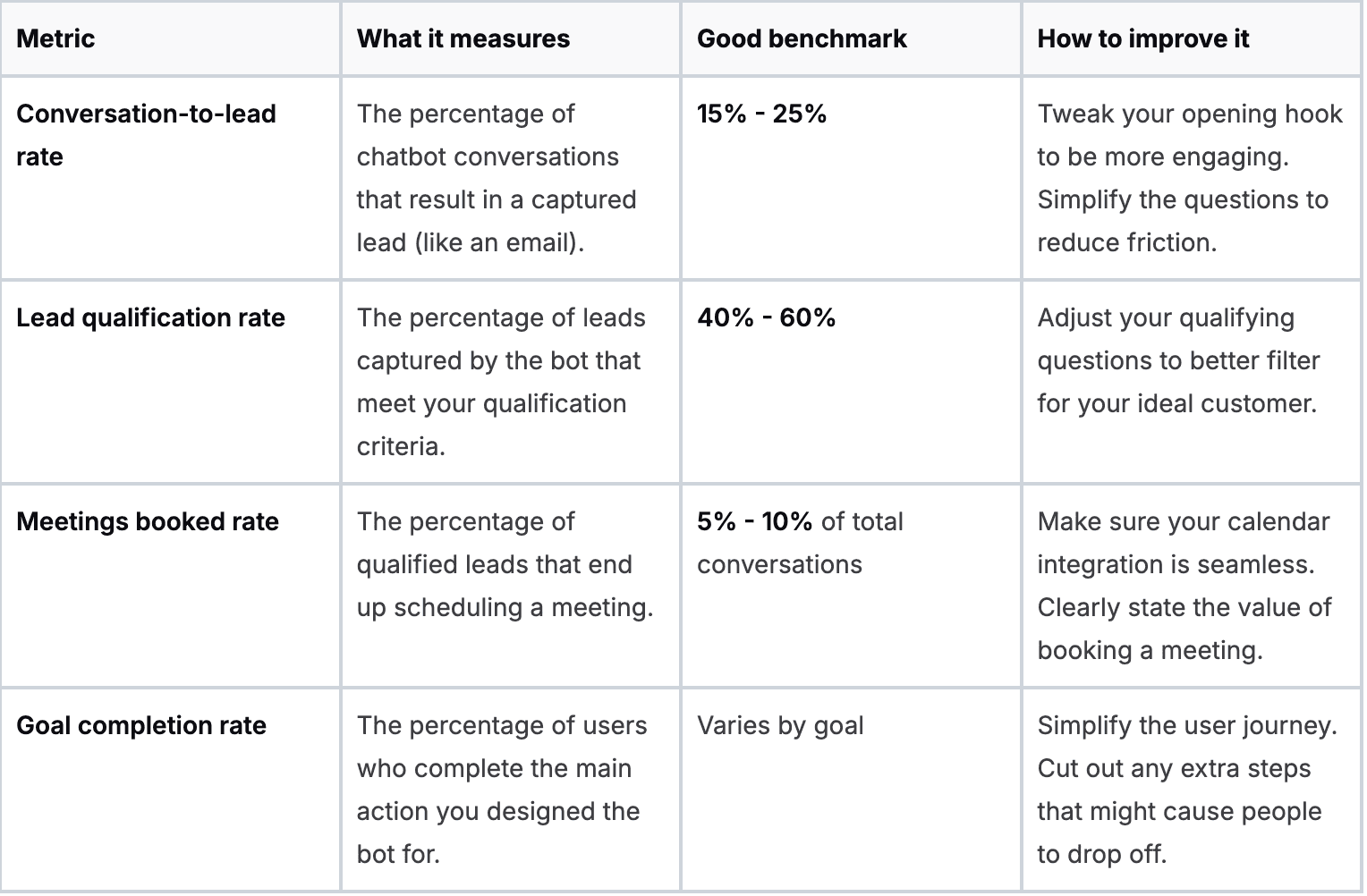
By keeping a close eye on these numbers, you can spot leaks in your conversational funnel and make targeted changes that have a real impact.
The monthly chatbot performance review checklist
Data is useless if you don't act on it. Set up a simple monthly review to create a regular habit of analyzing what's happening and rolling out smart fixes.
Here’s a straightforward checklist to run through every month:
- Review core KPIs: Pull the numbers for the metrics in the table above. Are they trending up or down?
- Analyze conversation transcripts: Read the actual conversations, especially the ones where people bailed.
- What questions are people asking that your bot can’t handle?
- Where does the dialogue feel robotic or awkward?
- Are there common objections you could address upfront?
- Identify one key improvement area: Based on your analysis, pick the single biggest opportunity for improvement. For a deeper dive on how analytics can shape your marketing, check out these insights from Harvard Business Review on AI for marketing.
- Implement and test: Make the change. It could be tweaking a script, adding a new conversation path, or clarifying a question.
This simple loop- track, analyze, refine- is how you build a high-performing chatbots for marketing program that delivers measurable results.
A simple chatbot workflow in action
Let's walk through a real-world example of chatbots for marketing to see how these pieces connect. Imagine we're a B2B SaaS company. Our goal is to get more qualified demo requests from our pricing page.
Trigger and engagement
The whole thing kicks off with a specific user action. We only want to talk to people showing real interest.
- The trigger: A visitor stays on the pricing page for more than 15 seconds. This simple time delay filters for engaged prospects.
Once that timer hits, the chatbot slides into view with a proactive, contextual opener.
Bot opening: "Hi there! I see you're looking at our pricing plans. Have any quick questions about which one is the right fit for your team?"
This relevant hook positions the bot as a helpful guide, not a pushy salesperson.
alt text: A three-step workflow diagram: Track, Analyze, and Refine.
This constant loop- tracking data, analyzing what works, and tweaking the script- is how your bot gets smarter with every interaction.
Qualification and action
Now the bot gets to its main job: qualification. It asks a couple of quick, targeted questions to see if this lead is a good match for the sales team.
- Company size question: "To point you in the right direction, what's your team size? (e.g., 1-10, 11-50, 50+)"
- Role question: "Thanks! And what's your role? (e.g., Founder, Marketing, Sales, Other)"
If the lead fits our ideal customer profile- say, 50+ employees and a marketing role- it goes for the meeting.
Bot (to qualified lead): "Great, it sounds like our pro plan would be a perfect fit. Our team can walk you through a personalized demo. Here's our calendar- feel free to book a time that works for you."
If the lead isn't a good fit, the bot still provides value without taking up the sales team's time.
Bot (to unqualified lead): "Thanks for the info! Based on your team size, our latest e-book on scaling growth might be helpful. Can I send it to your email?"
Data handoff and automation
The final step is plugging this into the rest of our tech stack. When a qualified lead books a demo, the chatbot automatically:
- Creates a new contact and deal in the company's CRM.
- Sends a notification to the sales team's Slack channel with the lead details.
- Adds the prospect to a pre-demo email nurture sequence.
This seamless handoff ensures no lead falls through the cracks and the sales team has all the context they need. You can learn more about bridging this gap in our guide to using AI for sales.
Wrapping up
Getting started with chatbots for marketing doesn't have to be complicated. The key is to stop thinking about it as a massive, company-wide AI project and start with one specific, measurable problem. Pick a single high-intent page, identify the biggest point of friction, and deploy a simple bot to solve it. Your one thing to do next is to go to your pricing page and map out a simple conversation that answers the top three questions and offers to book a demo. That small step is the foundation of a powerful lead generation engine.
We at N² labs can help you build and scale your marketing automation strategy. We specialize in creating custom AI solutions that drive real business results, from lead generation to customer retention.
FAQ
The primary benefits of using chatbots for marketing are increased lead generation, 24/7 customer engagement, and a shorter sales cycle. They automate repetitive tasks like lead qualification and appointment scheduling, which lowers your cost per lead and frees up your sales team to focus on high-value conversations.
You can create a chatbot using no-code or low-code platforms like Intercom, Drift, or Tidio. The process involves defining a specific goal (e.g., booking demos), identifying the page to place it on (like your pricing page), designing a conversational flow with a script and branching logic, and integrating it with your existing tools like your CRM and calendar.
No, a well-implemented chatbot augments your sales team, it doesn't replace it. The bot handles high-volume, top-of-funnel tasks like answering common questions and qualifying initial interest. This allows your human sales reps to spend their time on more complex negotiations and closing deals with highly qualified leads, making them more efficient and effective.
Rule-based chatbots follow a pre-defined script and logic, like a flowchart. They are ideal for structured tasks like lead qualification. AI chatbots use Natural Language Processing (NLP) to understand user intent and can handle more free-form conversations. For most initial marketing use cases, a rule-based or hybrid chatbot is sufficient and easier to implement, as highlighted by Forbes, which notes their effectiveness for specific tasks.
The cost varies widely. Simple rule-based chatbot platforms can start from $50-$150 per month. More advanced AI-powered platforms with deep CRM integrations can range from several hundred to thousands of dollars monthly. The best approach is to start with a lower-cost solution for a single, high-ROI use case to prove its value before scaling your investment.