Written by: Igor
Published: November 2025
Founders and marketers face constant pressure to scale campaigns, personalize customer journeys, and prove ROI-all without expanding their teams. The challenge isn't a lack of options, but finding the right AI tools for marketing automation that integrate seamlessly and deliver measurable results. Getting this wrong means wasted budget and stalled growth, while getting it right builds a powerful, efficient marketing engine. This guide cuts through the noise to help you choose the right tools and build a smarter stack.
Key takeaways
- Start with your problem, not the tool: Identify a specific bottleneck-like lead scoring or content creation-before you shop for software.
- Prioritize integration: The best tools connect seamlessly with your existing CRM and data sources to create a unified system, not another data silo.
- Focus on one high-impact workflow first: Secure a quick win to prove ROI and build momentum before expanding your automation efforts.
- Think beyond features to outcomes: A tool's real value is its ability to drive measurable business results, like higher conversion rates or lower customer acquisition costs.
How to choose the right AI marketing automation tools
Choosing a tool is only half the battle. The other half is implementation, integration, and optimization. Before diving into the specific platforms, use this simple framework to guide your decision-making. A recent report from McKinsey highlights that high-performing companies are already using AI in marketing to increase revenue and reduce costs. The key is strategic selection.
A simple framework for tool selection
- Integration capability: How easily does this tool connect with our existing CRM, analytics platforms, and data warehouses? A siloed tool creates more work than it saves.
- Scalability: Will this solution grow with us? Consider not just the pricing tiers but the technical capacity to handle increased data volume and user complexity.
- Team adoption: Is the user interface intuitive for my team? A powerful platform that no one uses is worthless. Prioritize a tool that fits your team's current skill set or has a manageable learning curve.
Keep these three criteria in mind as we explore the top tools.
The top 12 AI tools for marketing automation
We've organized the list into distinct categories-from comprehensive CRM and email automation suites to powerful content generation and integration platforms. Each review includes practical implementation considerations to help you visualize how these tools fit into your workflow.
1. HubSpot – Marketing Hub
HubSpot’s Marketing Hub is an all-in-one platform combining a powerful CRM with a growing suite of AI-driven marketing tools. It's designed for teams wanting a single source of truth for customer data, campaign execution, and performance analytics. This integration is its core strength, allowing AI features to draw from deep customer information, making it one of the most cohesive ai tools for marketing automation available.
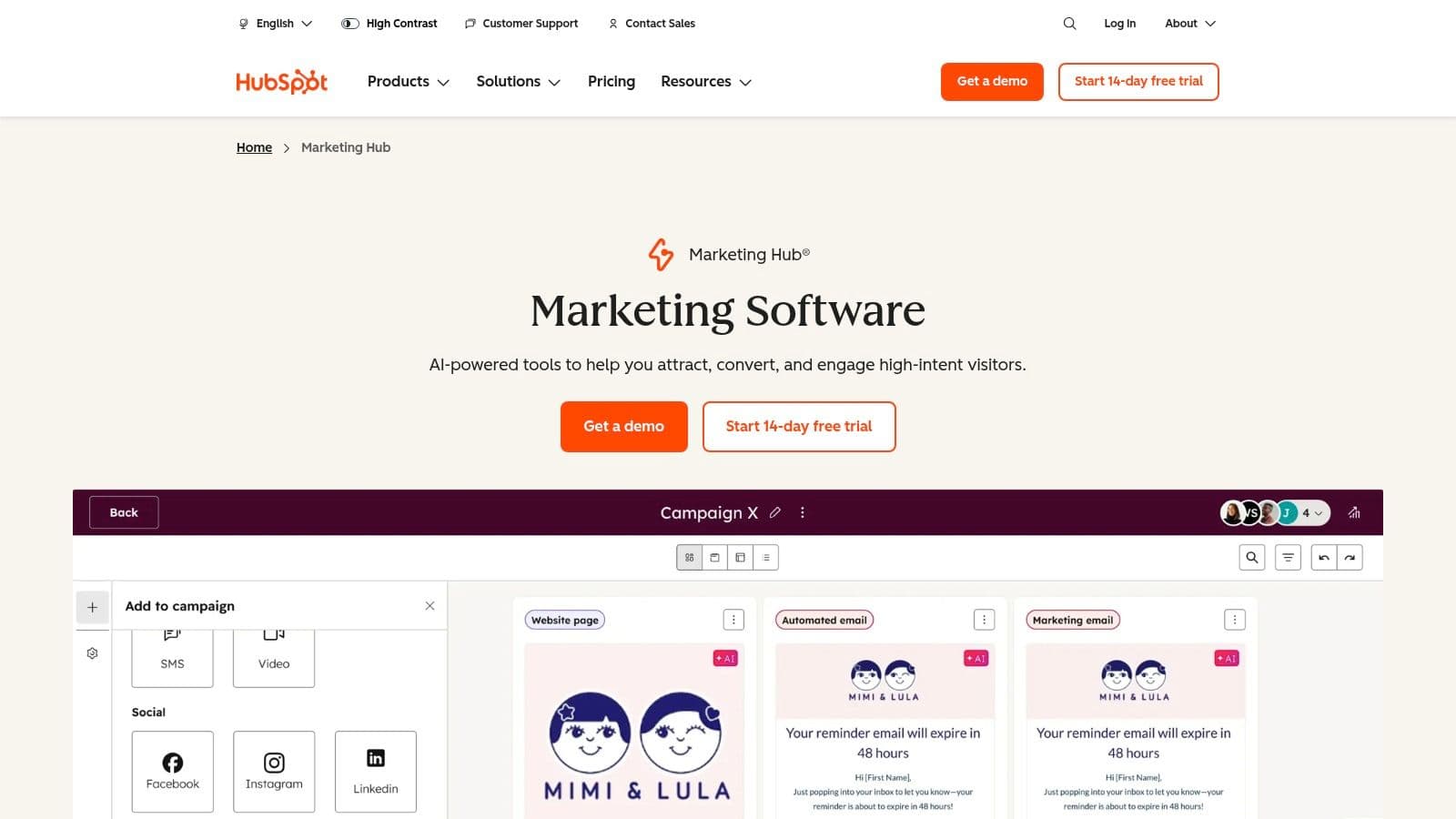
The platform excels at simplifying complex processes. You can use its AI to draft social posts, generate blog ideas, write emails, and even create website copy. Its visual workflow builder lets you automate lead nurturing sequences and internal tasks without code, while built-in attribution reporting connects marketing touchpoints to revenue.
Key considerations and use cases
- Best for: SMBs and mid-market companies needing an integrated marketing and sales platform that is easy to adopt.
- Use case: A B2B marketing team can use HubSpot to automatically score leads based on website behavior, enroll high-scoring leads into an AI-personalized email sequence, and create a task for a sales rep once the lead engages.
- Pricing: Scales from a free tier to enterprise plans. Pricing is contact-based, so costs can rise quickly as your database grows.
Pros:
- Fast time to value and a user-friendly interface.
- Strong integration between CRM, marketing, sales, and service tools.
- Extensive app marketplace for third-party integrations.
Cons:
- Contact-based pricing can become expensive at scale.
- Mandatory onboarding fees for premium tiers are a significant upfront cost.
Website: https://www.hubspot.com/products/marketing
2. Salesforce Marketing Cloud Account Engagement (Pardot)
Salesforce's B2B marketing automation platform, formerly Pardot, is deeply embedded within the Salesforce ecosystem. Its strength is its native integration with Sales Cloud, allowing marketing and sales teams to operate from a unified dataset. This cohesive environment enables powerful, AI-driven features like predictive lead scoring, making it a top choice among ai tools for marketing automation for organizations already on Salesforce.
The platform is built for complex, sales-led organizations. Einstein AI, Salesforce's artificial intelligence layer, provides predictive insights on lead and account behavior to help prioritize sales efforts. The advanced journey builder allows for multi-path nurturing sequences, while features like business units offer the governance needed for large deployments.
Key considerations and use cases
- Best for: Enterprise B2B companies with long sales cycles and a heavy reliance on the Salesforce CRM.
- Use case: An enterprise tech firm can use Einstein AI to predict which accounts are most likely to convert. This triggers an automated, multi-channel journey while creating prioritized tasks for account executives in Sales Cloud.
- Pricing: Offered in several tiers billed annually. The total cost can be significant, positioning it as a premium market solution.
Pros:
- Unparalleled native integration with the Salesforce CRM.
- Enterprise-grade security, governance, and a broad partner ecosystem.
- Powerful AI-driven attribution and predictive analytics with Einstein.
Cons:
- Setup and administration can be complex, often requiring specialized expertise.
- Annual contracts and a high total cost of ownership can be prohibitive for smaller companies.
Website: https://www.salesforce.com/marketing/b2b-automation/pricing/
3. Salesforce Marketing Cloud Engagement
Salesforce Marketing Cloud Engagement is an omnichannel platform built for enterprise B2C marketing. It handles massive communication volumes across email, mobile, and social channels. Its strength lies in orchestrating complex customer journeys using AI to optimize send times, content, and channel selection. It's designed for organizations that need to deliver personalized experiences at exceptionally high scale.
The platform integrates deeply with the broader Salesforce ecosystem, allowing marketers to build unified customer profiles and trigger automated actions based on real-time data. You can leverage its AI features to segment audiences, predict customer churn, and personalize content recommendations across your entire journey map. This makes it a powerful, albeit complex, solution.
Key considerations and use cases
- Best for: Enterprise B2C companies in sectors like retail or travel that require high-volume, cross-channel messaging.
- Use case: An e-commerce brand can use Marketing Cloud to build a journey that sends an abandoned cart email, followed by an SMS reminder, and then a personalized push notification, all optimized by AI for timing.
- Pricing: Pricing is tiered and highly customized. It requires direct consultation with a sales representative.
Pros:
- A mature enterprise platform that reliably handles very high messaging volume.
- Extensive channel coverage (email, mobile, social, ads) and powerful analytics.
- Deep integration with Salesforce Data Cloud for unified customer profiles.
Cons:
- Pricing and packaging are complex and can be opaque.
- Implementation is not self-service and usually requires expert consultants.
Website: https://www.salesforce.com/marketing/engagement/pricing/
4. Adobe Marketo Engage
Adobe Marketo Engage is an enterprise-grade marketing automation platform designed for complex B2B and considered-purchase customer journeys. Its strength lies in its deep segmentation, lead scoring, and lifecycle management. Integrated into the Adobe Experience Cloud, it leverages AI to analyze customer journeys and personalize experiences at scale, making it a powerhouse for large, data-driven teams.

The platform’s AI features, such as Predictive Audiences and Journey Analytics, help marketers identify high-value segments and optimize campaign touchpoints automatically. Marketo Engage is particularly effective for sophisticated account-based marketing (ABM) strategies, allowing teams to coordinate personalized outreach across multiple channels.
Key considerations and use cases
- Best for: Enterprise B2B companies with dedicated marketing operations teams that require granular control over complex nurturing programs.
- Use case: An enterprise software company can use Marketo Engage to build a predictive lead scoring model that identifies sales-ready accounts. It then automates a multi-channel ABM campaign, delivering personalized ads, emails, and sales alerts.
- Pricing: Pricing is not publicly listed and requires contacting the Adobe sales team. It's positioned at the higher end of the market.
Pros:
- Very strong for complex, multi-stage nurture programs and ABM.
- Mature partner network and extensive ecosystem for enterprise-level integrations.
- Powerful attribution and revenue cycle analytics.
Cons:
- Public list pricing typically requires contacting sales, making initial evaluation difficult.
- Has a steeper learning curve for new teams compared to more simplified platforms.
Website: https://business.adobe.com/products/marketo
5. Mailchimp
Mailchimp has evolved from an email tool into a platform offering accessible automation for small and growing businesses. Its strength is its user-friendly interface and pre-built journey templates, which lower the barrier to entry. By integrating generative AI for content creation, it stands out as one of the most approachable ai tools for marketing automation for non-technical users.
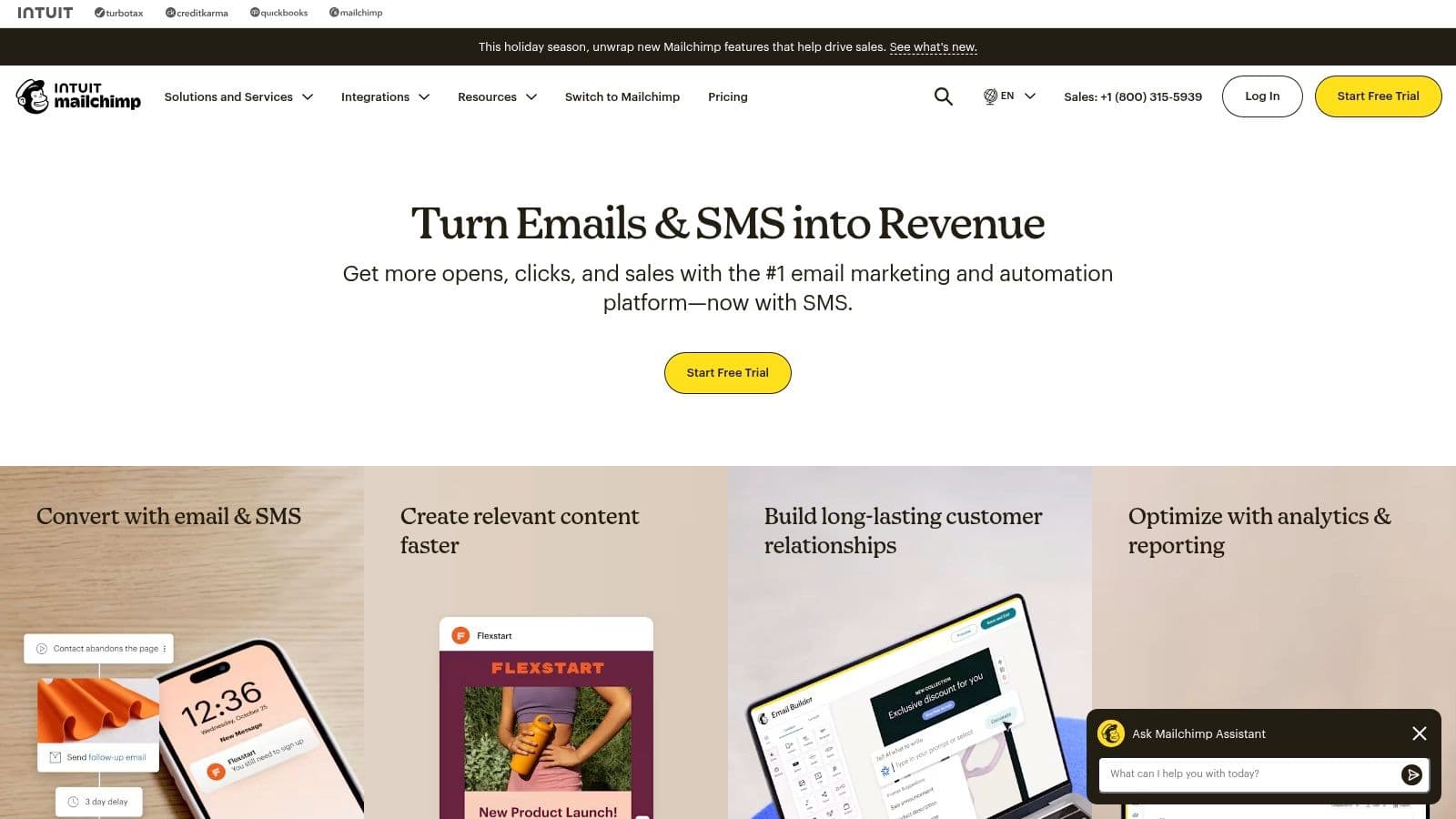
The platform’s Journey Builder allows you to create multi-step automations based on customer behavior. You can use its AI to generate email subject lines, body copy, and product recommendations. While it lacks deep CRM functionality, its native integrations with platforms like Shopify make it a powerful starting point for online retailers.
Key considerations and use cases
- Best for: Small businesses, e-commerce stores, and startups needing an easy-to-use platform for email automation.
- Use case: An online store owner can set up an abandoned cart journey that uses AI to generate a compelling subject line, then automatically sends a follow-up SMS message 24 hours later.
- Pricing: Offers a free plan for up to 500 contacts, with paid plans scaling based on contact count and features.
Pros:
- Low barrier to entry and a very intuitive user interface.
- Flexible billing options, including pay-as-you-go for occasional senders.
- Strong native e-commerce integrations and a large template library.
Cons:
- Advanced analytics and attribution reporting are locked behind higher-tier plans.
- Costs can escalate quickly with large contact lists or high send volumes.
Website: https://mailchimp.com/
6. ActiveCampaign
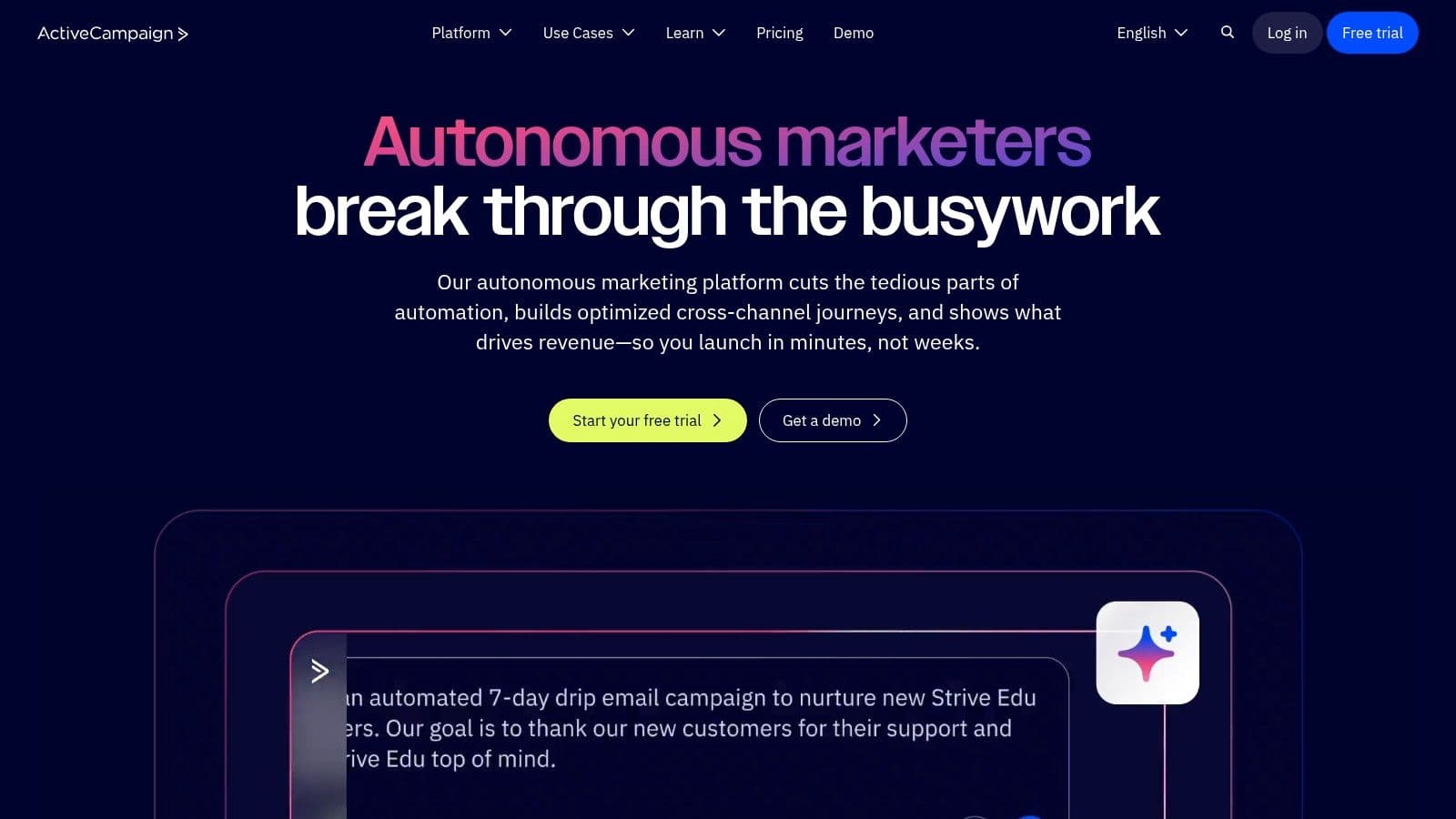
ActiveCampaign is an automation-first platform that excels in delivering sophisticated email marketing and CRM functionalities for SMBs. It’s known for its powerful visual journey builder, which allows users to create complex workflows without deep technical expertise. The platform’s strength lies in making high-level automation accessible, leveraging AI for predictive sending and segmentation.
Key considerations and use cases
- Best for: SMBs and e-commerce businesses that have outgrown basic email tools and need advanced automation.
- Use case: An online retailer can use ActiveCampaign to track cart abandonment, trigger a personalized follow-up email sequence, and use Predictive Sending to ensure the first email arrives when the user is most likely to engage.
- Pricing: Uses a contact-based subscription model. Costs increase as your list grows.
Pros:
- Extremely powerful and flexible visual automation builder.
- Predictive AI features for sending and segmentation are included in most plans.
- Strong reputation for delivering enterprise-level automation at a competitive price.
Cons:
- The interface can feel complex for new users due to its depth of features.
- Pricing scales directly with contact count, which can become costly.
Website: https://www.activecampaign.com/
7. Klaviyo
Klaviyo is an e-commerce-first communication platform built for direct-to-consumer (DTC) brands. Its deep integrations with platforms like Shopify and BigCommerce allow it to pull in rich customer data to power hyper-granular segmentation and automated flows. This focus on commerce data makes its AI features particularly effective for lifecycle marketing.
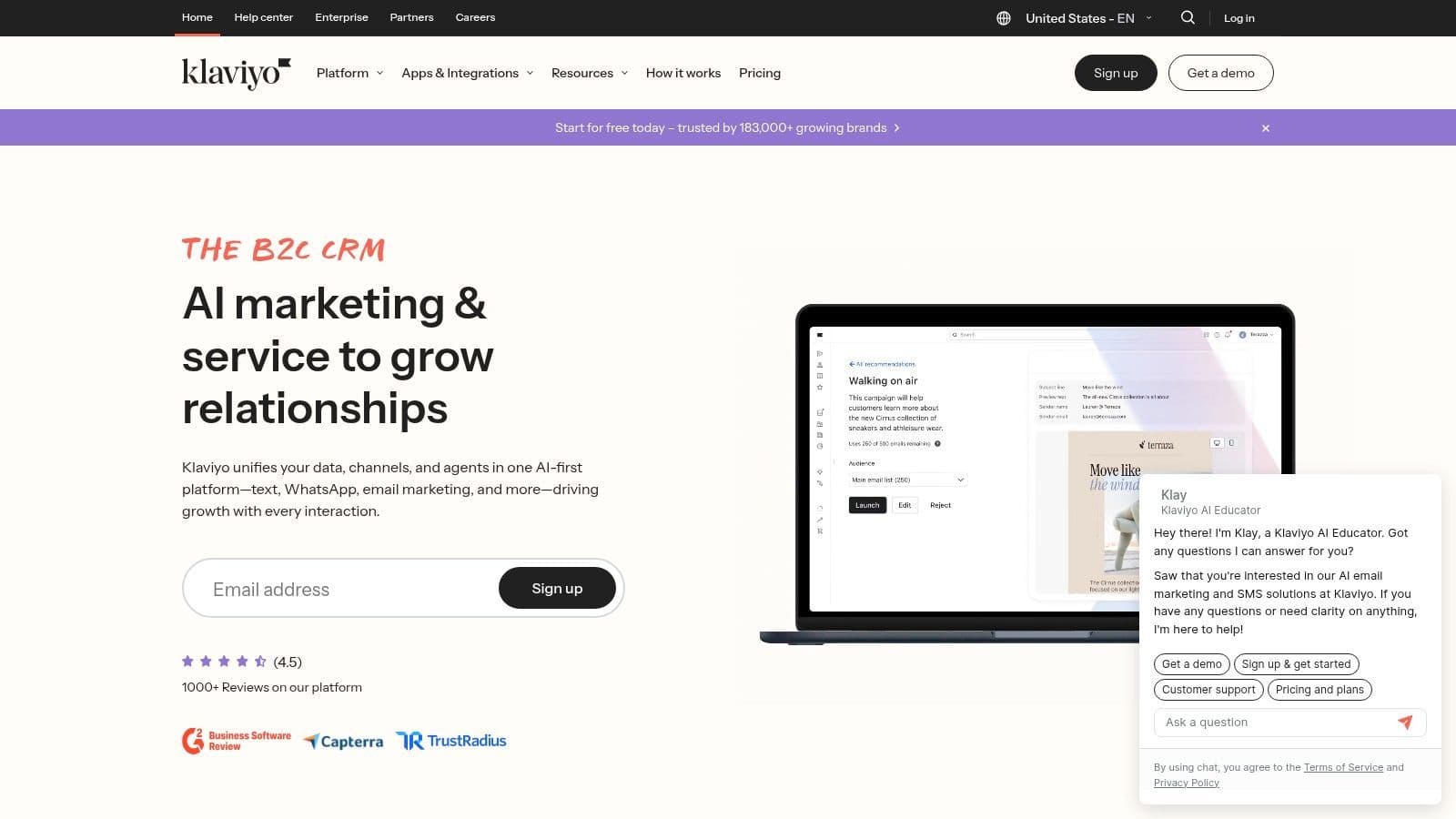
The platform uses AI to help generate subject lines, SMS copy, and entire email campaigns. Its predictive analytics can forecast future purchase dates, lifetime value, and churn risk, enabling proactive marketing. Klaviyo’s newer features are expanding its capabilities into customer service, making it a more centralized hub for customer interaction.
Key considerations and use cases
- Best for: E-commerce and DTC brands that rely heavily on email and SMS marketing for revenue.
- Use case: A Shopify store owner can use Klaviyo to create an automated abandoned cart flow. The AI can craft a sequence of emails and an SMS message with personalized product recommendations and a time-sensitive discount.
- Pricing: Based on the number of active email and SMS contacts, along with messaging volume. Costs can grow quickly with list size.
Pros:
- Exceptional e-commerce integrations provide deep customer data.
- Strong email deliverability and robust reporting focused on revenue.
- Combines email and SMS channels seamlessly in automated flows.
Cons:
- Pricing can become expensive as contact lists and messaging volume increase.
- Some advanced analytics and customer service features are priced as separate add-ons.
Website: https://www.klaviyo.com/
8. Jasper
Jasper is a generative AI platform built to help marketing teams scale content creation while maintaining brand consistency. It moves beyond simple text generation by incorporating a company's specific brand voice, product knowledge, and audience profiles into its workflows. This makes it an ideal engine for feeding other systems-like CRMs and email platforms-with on-brand, high-quality content.
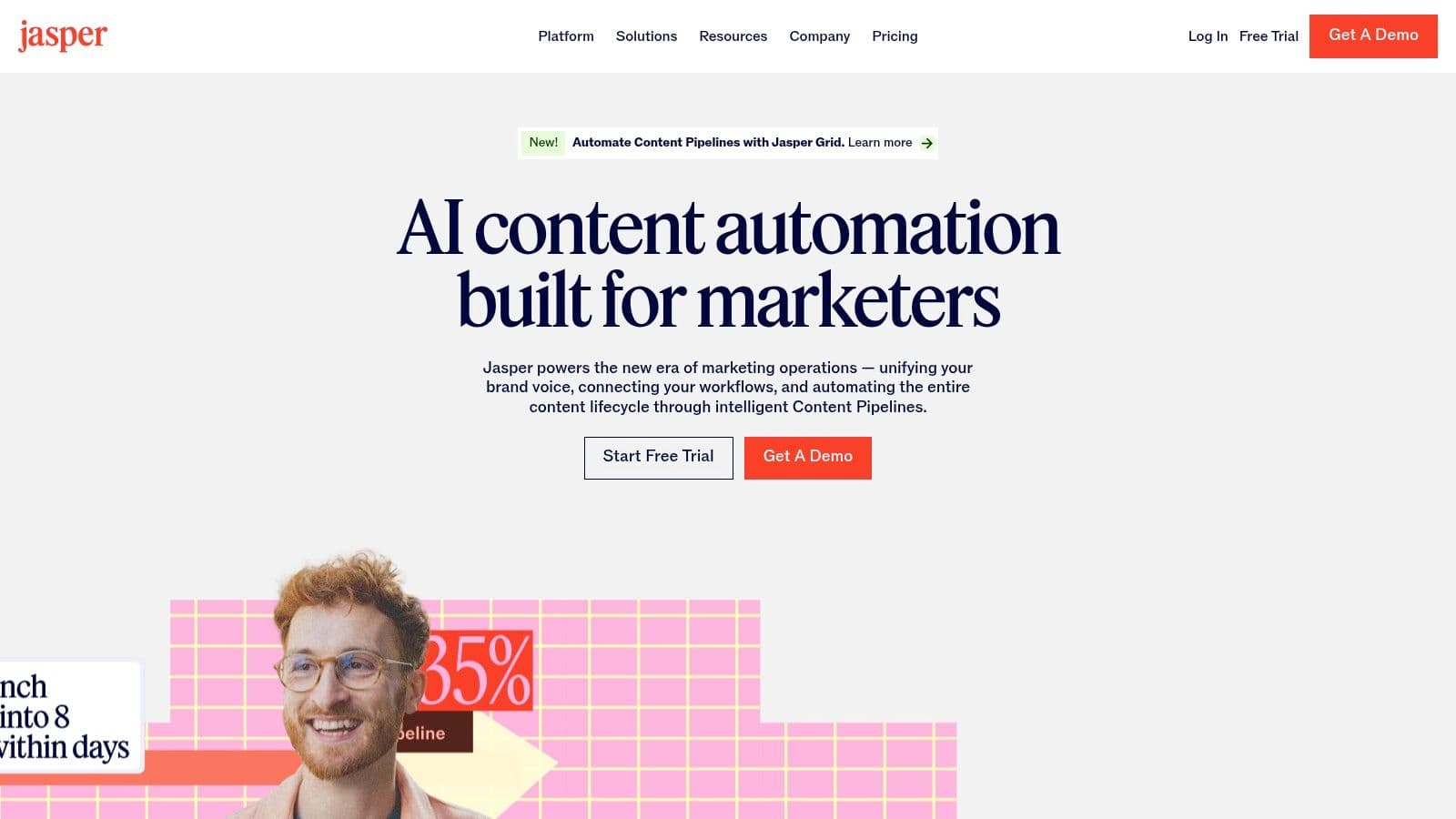
The platform’s strength lies in its governance and collaboration features. Marketers can create and reuse "Brand Voices" and tap into a centralized "Knowledge" base to ensure all generated content is accurate and aligned. Jasper’s API and App Builder allow teams to create custom, no-code AI tools and marketing agents, automating repetitive content tasks.
Key considerations and use cases
- Best for: Marketing and content teams in mid-market to enterprise companies that need to produce high-volume, on-brand content.
- Use case: A global marketing team can use Jasper’s Brand Voice and Knowledge features to generate localized ad copy, social posts, and landing page variations for a new product launch. We at N² labs can help you integrate Jasper into your marketing stack.
- Pricing: Offers a 7-day free trial. Pricing is seat-based, with plans scaling to custom Business plans for teams.
Pros:
- Strong brand consistency tools (Brand Voices, Knowledge).
- Excellent collaboration features for marketing teams.
- API access and an App Builder enable custom automation workflows.
Cons:
- It is not a full marketing automation platform; it requires integration with a CRM or ESP.
- Advanced team features are locked behind the more expensive Business plan.
Website: https://www.jasper.ai/
9. Zapier
Zapier is the connective tissue for the modern marketing stack, a no-code automation platform that links over 8,000 different applications. It functions as a powerful force multiplier, allowing marketers to create custom automations and data pipelines between their favorite tools. Its true value lies in bridging gaps, making it one of the most flexible AI tools for marketing automation for teams with a diverse software stack.
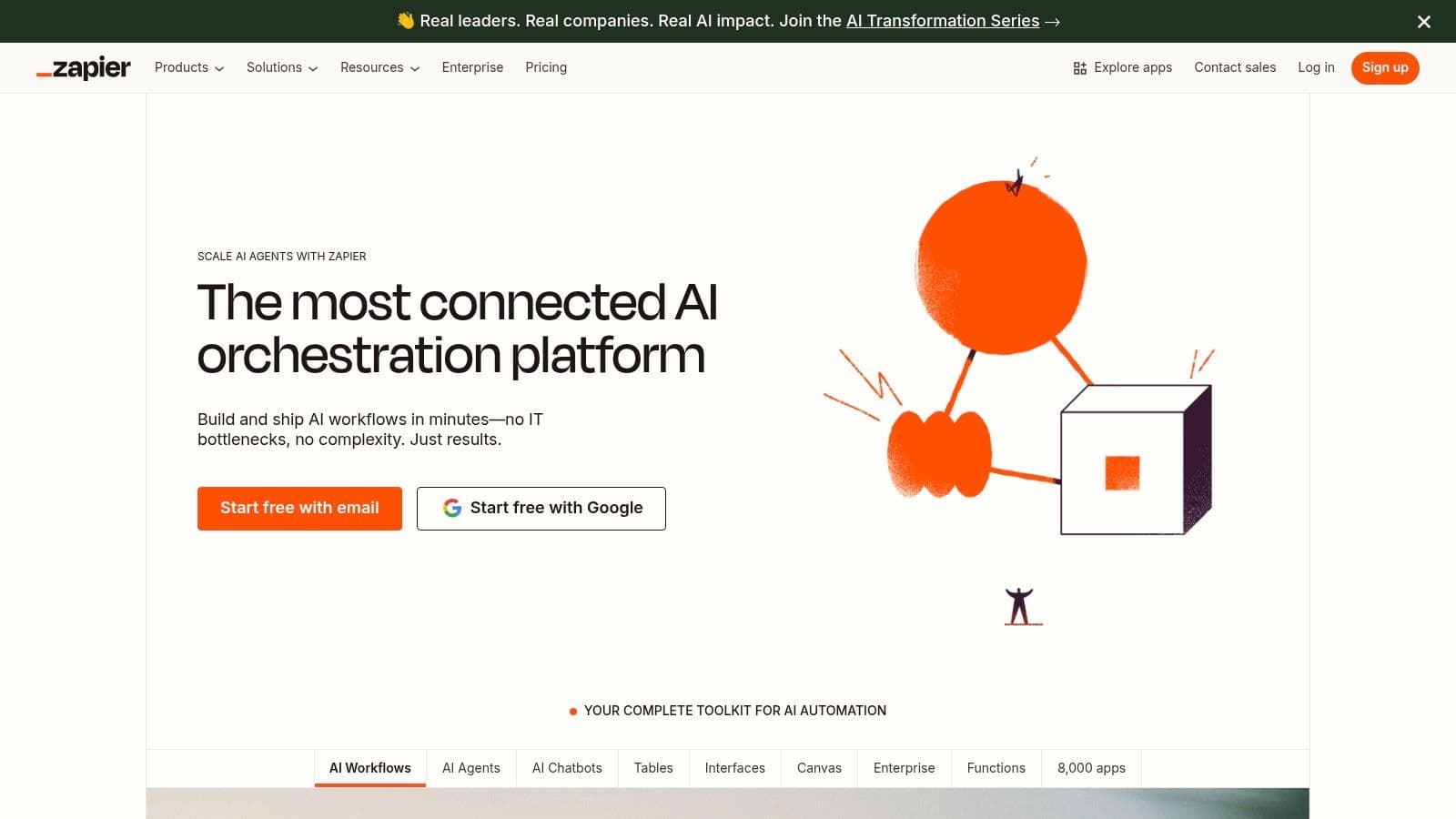
The platform has evolved beyond simple "if-this-then-that" triggers. With AI Agents, you can build sophisticated workflows that research topics, draft content, and trigger multi-step actions across your stack. This allows marketers to automate complex content operations or lead management processes without needing a developer.
Key considerations and use cases
- Best for: Teams of any size looking to integrate disparate tools and automate cross-platform workflows without writing code.
- Use case: A content marketer could create a "Zap" that triggers when a new article is published. The Zapier AI Agent then researches social trends, drafts five unique posts, and schedules them through Buffer in one flow.
- Pricing: Offers a free tier with limited tasks. Paid plans are based on task usage and the complexity of Zaps.
Pros:
- Fast to prototype and deploy automations around your existing toolset.
- Massive library of over 8,000 app integrations.
- Flexible and scalable pricing with a functional free trial.
Cons:
- Task and activity limits require careful monitoring to manage costs.
- Best used alongside, not as a replacement for, a dedicated CRM or ESP.
Website: https://zapier.com/
10. G2 – Marketing Automation category
While not a tool itself, G2’s marketing automation category is an indispensable resource for vetting software. It serves as a B2B marketplace where real user reviews, feature comparisons, and rankings help you navigate marketing technology. It aggregates up-to-date user sentiment and data, allowing you to filter potential AI tools for marketing automation by company size, user satisfaction, and specific features.
The platform’s strength is its ability to create a shortlist based on your specific needs. You can compare vendors side-by-side, read pros and cons from hundreds of reviews, and request demos. G2 also provides market reports and buyer intent data, offering a strategic layer of insight.
Key considerations and use cases
- Best for: Marketing and RevOps leaders who need to conduct due diligence before committing to a new platform.
- Use case: A mid-market CMO can use G2’s grid reports and reviews to narrow a list of ten potential platforms to their top three, then use vendor pages to schedule demos, saving significant research time.
- Pricing: Access to G2’s reviews and comparison tools is free for buyers.
Pros:
- Extensive coverage of vendors, from niche players to enterprise leaders.
- Authentic user reviews and sentiment provide real-world insights.
- Powerful filters for company size, industry, and feature requirements.
Cons:
- Sponsored placements can sometimes influence vendor visibility on category pages.
- Pricing information is not always transparent and may require contacting sales.
Website: https://www.g2.com/categories/marketing-automation
11. Capterra – Marketing Automation listings
Capterra is a comprehensive software discovery platform. Its value lies in its extensive, user-reviewed directory of marketing automation solutions. For teams in the research phase, it provides a structured way to compare features, pricing models, and real-world user feedback for hundreds of AI tools for marketing automation side-by-side.
The platform is useful for its detailed filtering capabilities. You can narrow options based on specific business needs, such as lead scoring or campaign analytics. The verified reviews offer candid insights into the pros and cons of each tool, often highlighting implementation challenges or customer support quality.
Key considerations and use cases
- Best for: Marketing and operations leaders in the procurement phase who need to build a shortlist of vendors.
- Use case: A marketing manager can use Capterra to filter for automation platforms that integrate with their existing CRM, are priced for a team of 10, and have top user ratings for ease of use.
- Pricing: Capterra is free for users. It’s a lead generation platform for software vendors.
Pros:
- Extensive directory with strong coverage of SMB-focused tools.
- Verified user reviews provide authentic, practical insights.
- Powerful filtering and side-by-side comparison features.
Cons:
- Pricing information is not always current for every vendor.
- Sponsored profiles can influence visibility in search results.
Website: https://www.capterra.com/marketing-automation-software/
12. Shopify App Store – Marketing & Conversion apps
For DTC brands, the Shopify App Store is an essential marketplace for building a custom marketing automation stack. It is a curated ecosystem where merchants can discover and manage specialized marketing apps directly within their Shopify admin. This native integration is its greatest advantage, allowing AI-powered applications to access store data for highly targeted automations.
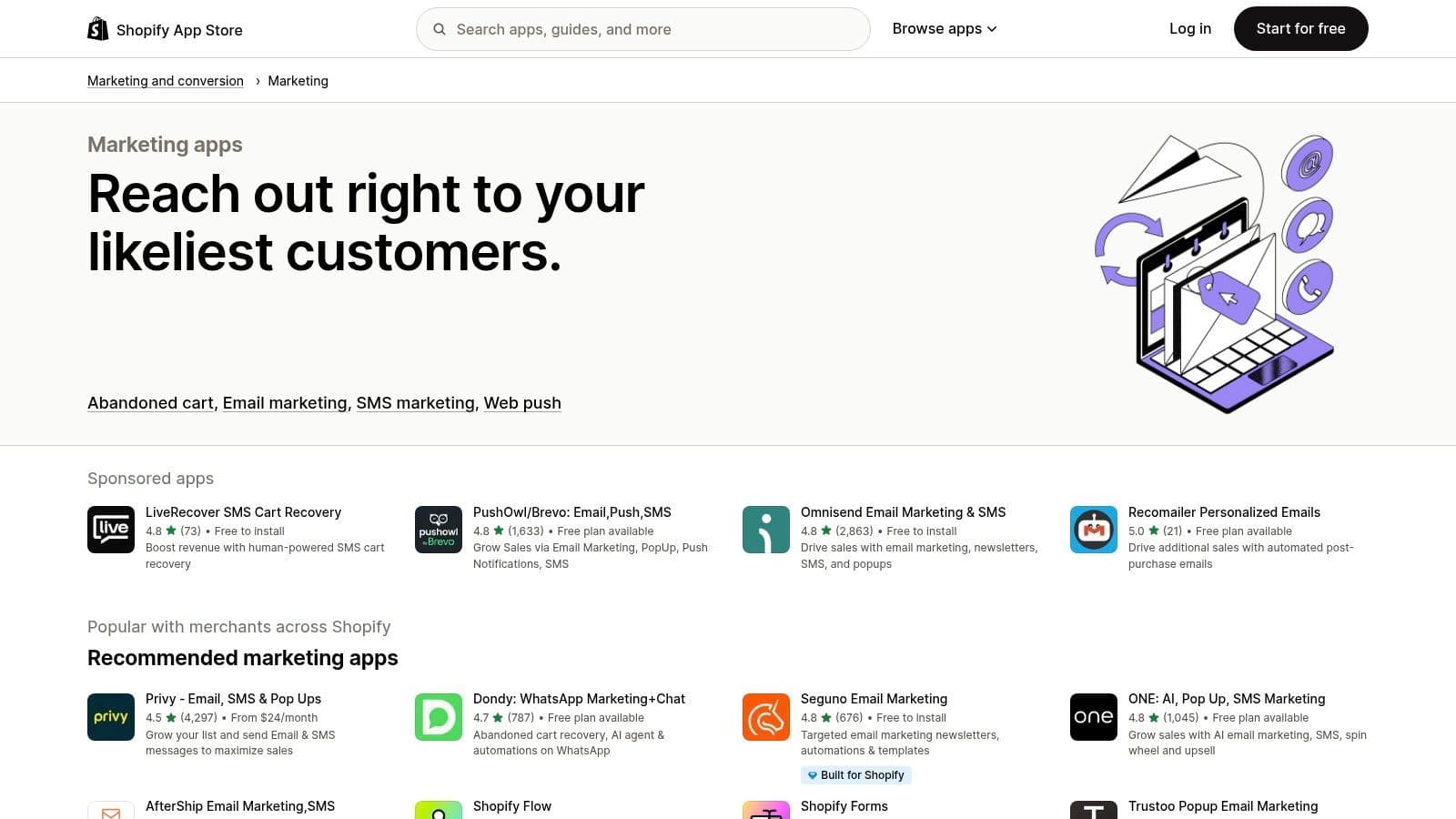
The platform is a launchpad for deploying powerful AI tools for marketing automation without complex development. Merchants can quickly add AI-driven apps for personalized email campaigns, ad creation, SEO optimization, and social media management. With native billing and transparent reviews, it lowers the barrier to entry for experimenting with advanced automation.
Key considerations and use cases
- Best for: Ecommerce and DTC brands of all sizes looking for marketing apps that integrate seamlessly with their Shopify store.
- Use case: A fashion retailer can install an AI-powered email app to automatically send abandoned cart reminders featuring the exact products a customer left behind.
- Pricing: Varies widely by app. Most operate on a monthly subscription model, often tiered by usage or feature set.
Pros:
- Fast deployment with one-click installs and clear monthly pricing.
- Broad choice of specialized ecommerce apps for every marketing function.
- Deep integration with Shopify store data for effective personalization.
Cons:
- Risk of "app sprawl," where too many apps can slow down a site.
- App quality and support can vary significantly between different vendors.
Website: https://apps.shopify.com/categories/marketing-and-conversion-marketing
How to get started with AI marketing automation
Choosing the right tool is just the first step. True transformation happens when you move from simply acquiring tools to strategically implementing them to achieve specific, measurable business outcomes.
Here's a simple workflow to get your first automated campaign running.
- Step 1: Identify one high-impact bottleneck. Don't try to automate everything at once. Is it lead qualification? Cart abandonment? Content creation for social media? Pick one process that is manual, repetitive, and has a clear impact on revenue.
- Step 2: Choose your pilot tool. Based on the lists above, select one tool that directly addresses that bottleneck. For cart abandonment, Klaviyo is a strong choice. For content creation, Jasper is a good fit. Use the free trial to validate your choice.
- Step 3: Map your automation logic. Before you build anything, sketch it out. For an abandoned cart flow:
- Trigger: User adds item to cart but does not complete checkout in 2 hours.
- Action 1: Send Email #1 with a reminder and a link back to the cart.
- Condition: Wait 24 hours. Has the user purchased?
- Action 2 (If no): Send Email #2 with social proof (reviews) and a 10% discount code.
- End: If user purchases, remove them from the flow.
- Step 4: Build, test, and launch. Recreate your mapped logic in the tool. Send test emails to yourself to ensure everything works. Once you're confident, set it live.
- Step 5: Measure and iterate. Track your key metric. For this example, it would be the cart recovery rate. After a week or two, analyze the data. Is Email #2 more effective? Could an SMS message improve results? Use these insights to refine your workflow.
This focused approach allows you to secure a quick win. It demonstrates tangible ROI, builds internal momentum, and provides invaluable learnings you can apply to the next project. A Gartner report notes that organizations establishing strong AI governance will see the value of their AI initiatives increase significantly. Starting small with a defined scope is the first step toward building that governance.
Wrapping up: your next step
The journey into ai tools for marketing automation is not a one-time purchase but a continuous cycle of implementation, measurement, and refinement. Start with one problem, master one tool, and build your automated marketing engine one successful outcome at a time. This iterative process is how you turn a list of promising technologies into a powerful engine for sustainable growth. Your next step is to pick that one bottleneck and start your first pilot this week.
We at N² labs can help you build a cohesive, scalable marketing automation stack and move from selecting tools to achieving tangible outcomes. If you're ready to design a practical roadmap for implementation, let's connect.
FAQ
AI tools for marketing automation are software platforms that use artificial intelligence (AI) and machine learning (ML) to automate repetitive marketing tasks. This includes personalizing customer communication, scoring leads, optimizing ad campaigns, and generating content. Unlike traditional automation, these tools can analyze data to make predictive decisions, improving efficiency and campaign effectiveness. For a deeper dive, our post on generative AI marketing is a great resource.
AI enhances marketing automation in several key ways. It enables hyper-personalization at scale by analyzing customer data to deliver unique content and product recommendations. AI-powered predictive analytics can forecast customer behavior, such as churn risk or likelihood to convert, allowing marketers to be more proactive. Finally, generative AI can automate the creation of marketing copy, from email subject lines to social media posts, saving significant time.
A common example is an AI-powered abandoned cart workflow for an e-commerce store. When a customer leaves items in their cart, the system automatically triggers a sequence of messages. AI can personalize the product recommendations in the email, generate a compelling subject line to increase open rates, and use predictive sending to deliver the message at the exact time the user is most likely to engage, maximizing the recovery rate.
Start by identifying your single biggest marketing bottleneck, not by looking at features. Are you struggling with lead quality, content creation speed, or customer retention? Once you've defined the problem, look for tools that specialize in that area. Prioritize platforms that integrate easily with your existing CRM and other core systems. Always start with a free trial to ensure the tool is a good fit for your team's workflow and skill set before committing.