Written by: Igor
Published: November 2025
Your supply chain is either a competitive advantage or a costly liability. For most founders, it’s the latter. Trying to manage soaring freight costs, unpredictable disruptions, and demanding customers with spreadsheets is a recipe for failure. This guide breaks down how supply chain optimization software works, how to connect its features to real business outcomes, and the exact steps to choose and implement the right solution. You’ll learn how to turn your biggest cost center into your sharpest weapon.
Key takeaways
- Move from reactive to proactive: Instead of firefighting, optimization software uses a central data hub to run "what-if" scenarios, helping you anticipate and solve problems before they happen.
- Connect features to financials: The best software directly impacts key performance indicators (KPIs). For example, route optimization lowers your cost-per-mile, and AI forecasting improves inventory turnover.
- Start with a focused pilot: Don't attempt a "big bang" launch. Prove the software's value with a small, high-impact pilot program that can deliver a return on investment (ROI) in 6-9 months.
- Pick a partner, not just a product: Your goal is to find a solution that integrates smoothly with your existing systems, can scale with your growth, and provides a clear implementation roadmap.
Why supply chain optimization matters now more than ever
Modern supply chains are walking a tightrope. Every day, operators wrestle with rising costs, sudden disruptions, and customers who expect orders faster and cheaper than ever. Managing this with manual guesswork isn’t just inefficient-it’s a threat to your bottom line.
This is where supply chain optimization software steps in. Think of it less as another piece of IT and more as a strategic tool. It's what transforms your supply chain from a cost center into a competitive advantage. The market agrees; valued at $19.8 billion in 2022, the global supply chain management software market is expected to surge past $45 billion by 2028, according to McKinsey analysis.
Moving from reactive to proactive
The core job of this software is to get you out of firefighting mode. Instead of constantly reacting to problems, you start preventing them. It does this by creating a single, central hub for data from every part of your operation-procurement, manufacturing, warehousing, and delivery.
With a single source of truth, the software can do the heavy lifting for you:
- Analyze complex trade-offs: It can finally answer tough questions, like finding the perfect balance between inventory holding costs and shipping expenses.
- Run what-if scenarios: What if a major port shuts down? Or if demand for a new product triples? The software lets you model these potential disasters and map out the best response before they hit.
- Automate decision-making: Smart algorithms can instantly recommend the cheapest shipping routes, most efficient production schedules, or ideal inventory levels for each warehouse.
By connecting all the parts of your business, optimization software gives leaders the power to make faster, data-backed decisions. Guesswork gets replaced by intelligent recommendations, giving you the control to build a resilient and profitable operation..
How AI and algorithms power modern supply chain optimization software

At the heart of any modern supply chain software, you'll find two engines: predictive AI and prescriptive optimization. These are the brains of the operation, turning raw data into smart, actionable decisions.
Predictive AI is like an in-house forecaster. It analyzes historical sales, market trends, weather patterns, and even social media to answer one question: “What’s likely to happen next?” For example, it might predict a 15% spike in demand for a product next month based on external signals.
That foresight is a game-changer. But it's only half the story.
From prediction to action
Once the predictive engine tells you what’s coming, the prescriptive optimization engine kicks in. This is where the magic happens, answering the more critical question: “So, what should we do about it?” It crunches the numbers on millions of potential choices to find the best path forward.
For example, if you need to ship 1,000 pallets to 50 stores, a prescriptive algorithm calculates the most efficient routes, juggling variables like fuel costs, driver hours, and real-time traffic. The result is a concrete plan that cuts costs and ensures on-time arrivals. This is where the software pays for itself.
It's no surprise that companies embracing this tech have seen logistics costs drop by 15% and inventory levels fall by 35%. These systems have also boosted service efficiency by 65%, leading to happier customers. You can dig into more of these supply chain statistics to see the full picture.
A practical example: linear programming
One of the workhorse algorithms behind this is linear programming. The concept is simple. It’s a mathematical method for finding the best possible outcome (like maximum profit or lowest cost) given a set of constraints.
Imagine you run a factory making two products, A and B.
- You have limited machine hours.
- You have a limited supply of raw materials.
- Each product has a different profit margin and uses different resources.
Linear programming figures out the perfect mix of A and B to produce, maximizing your profit without running out of materials or machine time. It’s a classic optimization problem that software solves in seconds, removing the guesswork from a major business decision.
Understanding these core ideas helps you ask vendors the right questions and see how their technology will deliver the results you need.
Connecting software features to business outcomes
It’s one thing to hear that a platform uses AI; it’s another to understand how its features will move the needle on your P&L. The best supply chain optimization software isn’t a random collection of tech. Each capability is designed to improve a specific business metric.
To evaluate any solution, you have to connect the dots between what a feature does and the financial outcome it delivers.
This outcome-first mindset is your best defense against slick sales pitches. Instead of getting bogged down in jargon, you can cut to the chase. Ask pointed questions like, "How does this feature reduce our cost-per-mile?" or "Show me how this tool improves our inventory turnover." This shifts the conversation from what the software is to what it will do for your business.
Essential features and their impact on business KPIs
The real value lies in how specific functions translate into measurable business improvements. This table breaks down that connection, showing how core software features drive tangible outcomes.
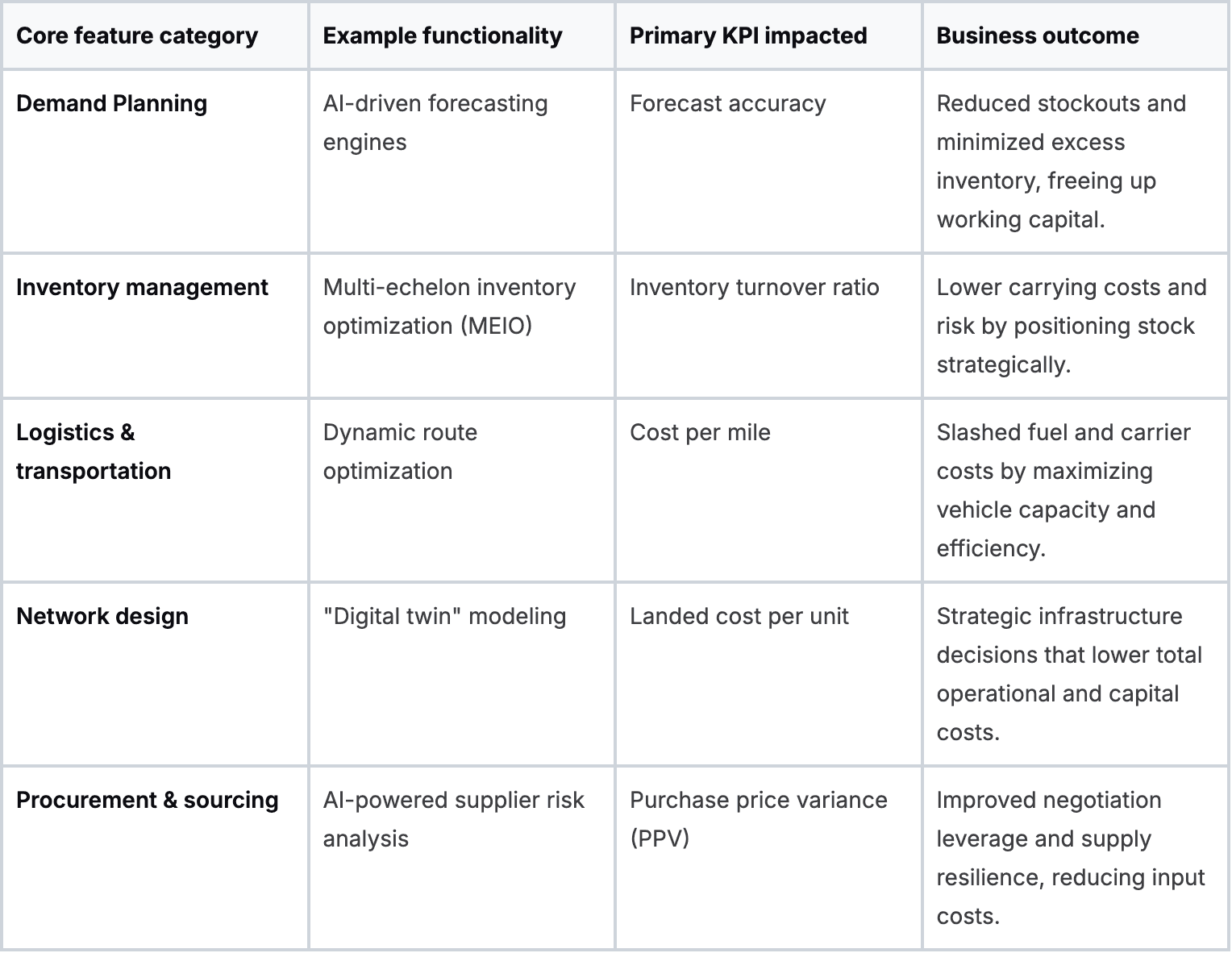
By mapping software capabilities to these KPIs, you can move beyond buzzwords and focus on the ROI each feature is engineered to deliver.
Demand planning and forecasting
An intelligent supply chain begins here. Instead of relying on last year's sales, modern software uses AI to create a clearer picture of what customers will want.
- Key feature: AI-powered forecasting. The system pulls in external signals-market trends, competitor promotions, economic indicators, even weather-to predict what customers will buy, where, and when.
- Business outcome: improved forecast accuracy. Higher accuracy attacks the two biggest profit killers: holding the wrong inventory and running out of the right stock. You buy, make, and move products that are much closer to actual demand.
Inventory management
Managing inventory is a balancing act. Too much, and cash is tied up on shelves. Too little, and you let customers down. Optimization software helps find and maintain that sweet spot.
- Key feature: multi-echelon inventory optimization (MEIO). This is a fancy way of saying the software views your entire inventory as a single, interconnected system. It figures out the optimal level and location for every SKU, from central hubs to retail shelves.
- Business outcome: higher inventory turnover ratio. By positioning products where they are most likely to sell, MEIO helps you move through stock faster. This frees up working capital, slashes carrying costs, and cuts obsolescence risk. Find more detail on these savings in our guide to AI-driven cost reduction strategies.
Logistics and transportation
For any company that moves physical goods, freight is a large and volatile budget item. This is where optimization software can deliver its quickest and most substantial ROI.
- Key feature: route optimization and load building. The software’s algorithms process thousands of variables in seconds-fuel prices, traffic data, driver hours, and vehicle capacity-to plan the most efficient routes and pack trucks as tightly as possible.
- Business outcome: lower cost per mile. Every mile you don’t drive and every empty space in a trailer is money wasted. This feature directly attacks that inefficiency, leading to immediate reductions in fuel spend and freight charges. According to a Deloitte report, companies using these "digital twin" models have improved on-time delivery by 13%.
How to choose the right supply chain optimization software
Picking the right software isn't about finding the "best" product. It’s about finding the right partner for your business. The process can feel overwhelming, but a structured approach helps you cut through the sales hype.
It all starts by looking inward long before you talk to a vendor.
First, pull together a cross-functional team from operations, finance, and IT. Your mission? Agree on the primary business outcomes you need. Are you trying to slash freight costs? Is inventory eating up your cash flow? Pinpointing your top 1-2 goals is crucial-it gives you a north star for every decision.
Establish your core evaluation criteria
Once you know your goals, build a scorecard to measure solutions. Every vendor will promise you the world. Your criteria will help you separate substance from sales talk.
Focus on these critical areas:
- Integration capabilities: How will this software plug into your existing ERP and other systems? A clunky integration can derail your project.
- Scalability and flexibility: The solution must grow with you. Can it handle more users, products, and transactions in 3-5 years?
- User experience (UX): A powerful tool is worthless if your team can’t use it. The interface must be intuitive for your planners and managers.
- Total cost of ownership (TCO): Look beyond the license fee. Factor in implementation, training, support, and hardware upgrades to understand the true long-term investment.
A practical checklist for vendor demos
When you talk to vendors, use a consistent checklist. This forces an apples-to-apples comparison based on what matters to your operation.
- Request a custom demo. Insist vendors use a sample of your own data to show how their software solves your specific problems.
- Verify integration claims. Ask for case studies or references from companies running the same ERP system you do.
- Talk to real customers. This is non-negotiable. Ask to speak with current customers similar to you in size and industry. Find out what their implementation was really like.
- Assess the implementation plan. A good partner provides a clear, phased roadmap from contract to go-live. For more on this, see our guide on how to successfully implement AI in your business.
This disciplined approach ensures you end up with a partner who can deliver.
A phased roadmap for a smooth rollout
Even the best software will fail if the implementation is clumsy. Success is a major business change that needs a smart, phased approach. Treating it like just another IT project is a common mistake.
Breaking the process into manageable stages helps you build momentum and prove value early.
Phase 1: data readiness and goal alignment
Before you touch the software, get your data house in order. The platform's algorithms are only as good as the information you feed them. Clean up messy data in your ERP, WMS, and TMS.
This is also the time to get clear on your goals. Are you trying to slash freight spend by 10%? Or boost on-time delivery by 15%? Pick a primary objective and define success in plain numbers. You can use this guide on conducting an AI readiness assessment to get started.
Phase 2: the pilot program
Forget the risky "big bang" launch. Start small with a focused pilot program. Pick one high-impact area-like optimizing routes for a single distribution center-to prove the software’s value quickly.
A successful pilot builds internal confidence, generates a quick ROI to fund the bigger rollout, and helps you find a champion on your team to advocate for the project.
A successful implementation starts long before the software is installed. It begins with a clear definition of what you’re trying to achieve.
Phase 3: integration, training, and full rollout
Once your pilot is a success, you have the momentum to move forward. The next steps are about scaling up intelligently.
- System integration: Get the new software talking seamlessly with your core systems. Create smooth data flows to establish a single source of truth.
- Team training: Ditch generic training. Focus on practical, role-based education. Your logistics planners need to become experts in route optimization, while inventory managers master demand forecasting.
- Phased rollout: Scale the solution across the business. You could expand geographically, from one region to the next. Or expand functionally, rolling out one module at a time. This methodical approach minimizes disruption.
What's your next move?
We've covered what this software is, how to select a partner, and how to roll it out. The one thing to take away is this: supply chain optimization is no longer just a "nice-to-have." It’s the engine for both profitability and resilience. It’s how you turn a cost center into a competitive edge.
So, where do you start? Don't boil the ocean.
Your next step is a quick internal reality check. Pinpoint your single biggest operational headache. Is it freight costs? Cash tied up in inventory? Or poor on-time delivery?
Once you identify that primary pain point, your search for the right supply chain optimization software becomes laser-focused. You solve a tangible, measurable problem from day one, which dramatically cuts the time to see a real return.
Get help from the experts
We at N² labs can help you assess your supply chain and uncover the optimization opportunities that will deliver the biggest impact. Let's start building a more resilient and profitable future for your business.
FAQ
Supply chain optimization software is a set of digital tools that use data, AI, and algorithms to improve the efficiency and resilience of a company's entire supply chain. It helps businesses manage everything from raw material procurement to final delivery by analyzing data to find cost savings, reduce waste, and improve on-time performance. It automates complex decisions like demand forecasting, inventory management, and route planning.
While a full implementation can take 12-18 months, you don't have to wait that long to see a return. A smart pilot program focused on a high-pain area, like freight spend, can deliver a positive ROI in just 6-9 months. The idea is to let the early wins from optimizing one part of your supply chain pay for the next stages of the project.
Not anymore. The rise of cloud-based Software as a Service (SaaS) models has made supply chain management solutions accessible for small and medium-sized businesses (SMBs). Many vendors now offer modular platforms with flexible pricing, allowing you to start with one critical function, like inventory planning, and add more capabilities as your business grows.
This is where modern software excels. It’s about being proactive. These platforms use real-time data and AI to run "what-if" scenarios. If a major port suddenly shuts down, the system can model the financial and operational impact in minutes. It will immediately suggest the smartest alternative routes, carriers, or sourcing options to minimize the damage, turning a multi-day crisis into a quick, data-backed decision.