Written by: Igor
Published: December 2025
Struggling to move AI from a buzzword to a real business tool? You're not alone. Many founders get stuck trying to solve massive problems, only to burn through time and budget with nothing to show for it. The secret to implementing AI in business is to start small, target a specific pain point, and deliver a measurable win in weeks, not years. This guide gives you the step-by-step framework to do just that.
Key takeaways
- Start small: Focus on high-impact, low-effort projects first to build momentum.
- Assess your readiness: Evaluate your data, processes, and people before you build anything.
- Problem first, tech second: Define a clear business problem before choosing an AI solution.
- Measure everything: Track clear KPIs from day one to prove ROI and guide your next steps.
- Use existing tools: Leverage third-party APIs to get your first project live quickly and cost-effectively.
Why implementing AI is no longer optional
For founders today, the single biggest operational hurdle is moving AI from a theoretical "what if" to a practical "what's next." The potential is obvious, but the path forward often gets murky, tangled up in complex tech and a dozen different places you could start. This guide is your playbook for actually getting it done, written for operators who need results.
This isn't about chasing the latest shiny object. It’s about solving real-world business problems. I'll walk you through how to figure out if your company is ready, pinpoint some easy wins, and draft a simple roadmap to get your first project out the door.
We break it down into a simple three-step process: assess, launch, and measure. That's it.
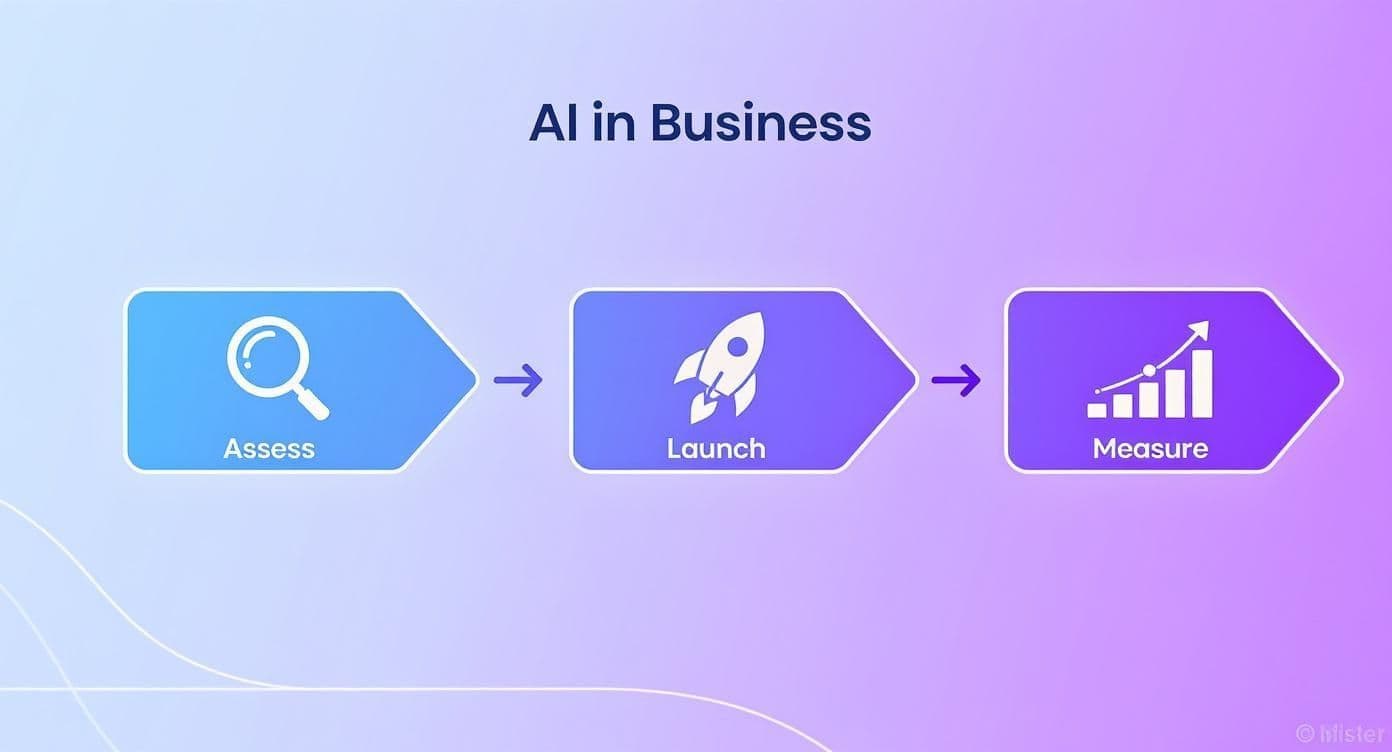
This framework keeps your team laser-focused on delivering value you can actually see, instead of getting bogged down in the technical weeds.
The urgency is real. A recent McKinsey report found that generative AI could add the equivalent of $2.6 trillion to $4.4 trillion annually to the global economy. Companies that move now are seeing proven productivity gains and significant ROI.
This playbook is built to give you a clear, repeatable process for turning AI concepts into tangible business outcomes. We'll give you the exact steps needed to get your first AI-powered workflow live. For a deeper dive, our comprehensive AI playbook for B2B teams offers additional strategies. It's also worth checking out other perspectives, like this How to Implement AI in Business: A Practical Guide, for more insights.
Gauging your AI readiness before you start
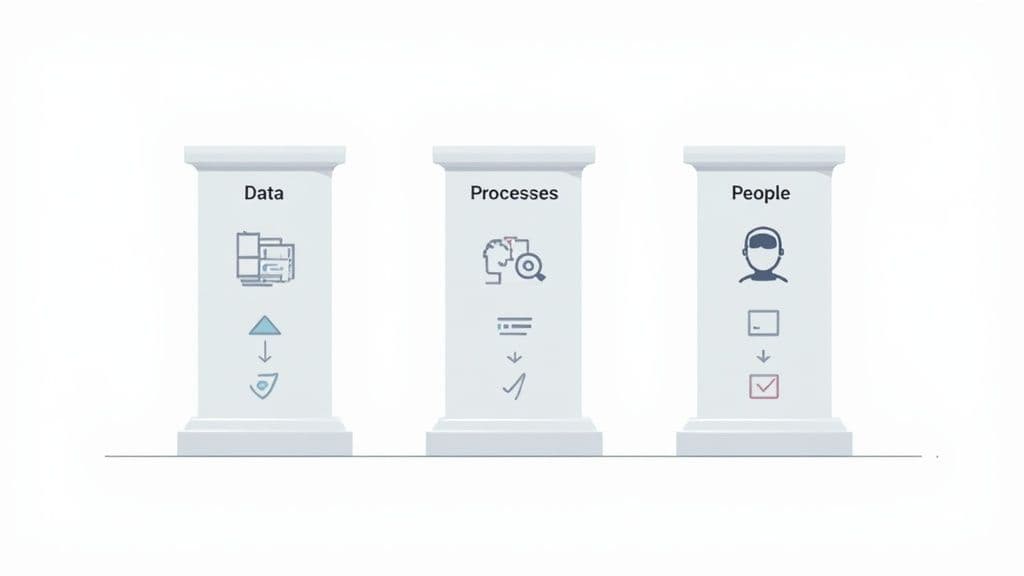
Jumping headfirst into an AI project without knowing where you stand is a recipe for disaster. It’s the fastest way to burn through your budget and end up with a project that goes nowhere. Before you write a single line of code or sign a single check, you need an honest look at your company's readiness across three key pillars: data, processes, and people.
A successful AI initiative is built on this foundation. This isn't about being perfect from day one- it's about spotting your biggest gaps so you can plug them before they sink the whole project. You might find that your first "AI project" is actually just cleaning up your data- and that's a huge win.
Assessing your data foundation
Data is the fuel for any AI model. The smartest algorithm in the world is useless if you feed it garbage. You have to start by asking some tough questions about the state of your data.
Is your most critical information locked away in a central data warehouse, or is it scattered across a hundred different spreadsheets and legacy systems? If your engineers can't easily get their hands on the data, your project is dead on arrival.
Next, you have to be brutally honest about its quality.
- Completeness: Are there massive holes in your records? For example, do half your customer profiles lack basic info like industry or company size?
- Consistency: Are your data formats a mess? Think about something as basic as state abbreviations- do you have "CA," "Calif.," and "California" all living in the same column?
- Accuracy: Can you actually trust your data? An AI model trained on last year's sales numbers or outdated contact info will only give you bad answers, faster.
A recent Harvard Business Review study drives this point home: companies that are great at data and analytics are 23 times more likely to acquire customers. Getting your data house in order isn't just a technical step for AI; it's a massive business advantage on its own.
Evaluating your processes and people
Once you have a handle on your data, it's time to look at your internal workflows and the people running them. AI delivers the biggest wins when it can automate the soul-crushing, repetitive tasks that eat up your team's time.
Where are the biggest bottlenecks? Think about things like manually triaging support tickets, qualifying sales leads one by one, or pulling numbers from invoices by hand. These are perfect candidates for a first AI project because the ROI is so easy to see- you can measure it in hours saved.
Finally, you can't ignore the human element. Gartner research shows that a major roadblock to AI adoption is a lack of internal skills and training. You don't need a team of PhDs to get started, but you do need people who are willing to learn and leaders who get it.
- Skills: Do you have engineers who are comfortable with APIs? Do your business leaders understand what AI can realistically do, or are they expecting magic?
- Champions: Who inside the company is going to bang the drum for this project? You need internal champions to get buy-in and cut through red tape.
- Culture: Is your team open to trying things and failing? If your culture punishes every small misstep, you'll never get the experimentation needed for AI to work.
Running through this three-part check-up gives you a clear, no-nonsense scorecard. If you want to dig deeper, you can use our guide on running a formal AI readiness assessment to get a structured plan of attack. This first step is critical; it ensures you're aiming your resources at the right problem from the very beginning.
Finding your first high-impact AI project
Your first AI project is more than just a technical test-run- it’s a political one. Its success or failure sets the tone for the entire initiative. The goal isn’t to overhaul the company overnight. It's to secure a quick, tangible win that builds momentum, proves value, and gets key stakeholders excited about what’s next.
This is a make-or-break step when you're first implementing AI in business for the long haul.
Forget the moonshot projects for now. The perfect pilot solves a real, nagging problem that is high-frequency, low-complexity, and has a crystal-clear success metric. Think less about building a custom recommendation engine from scratch and more about automating the tedious, daily tasks that drain your team's energy.
Finding the sweet spot with an impact-effort matrix
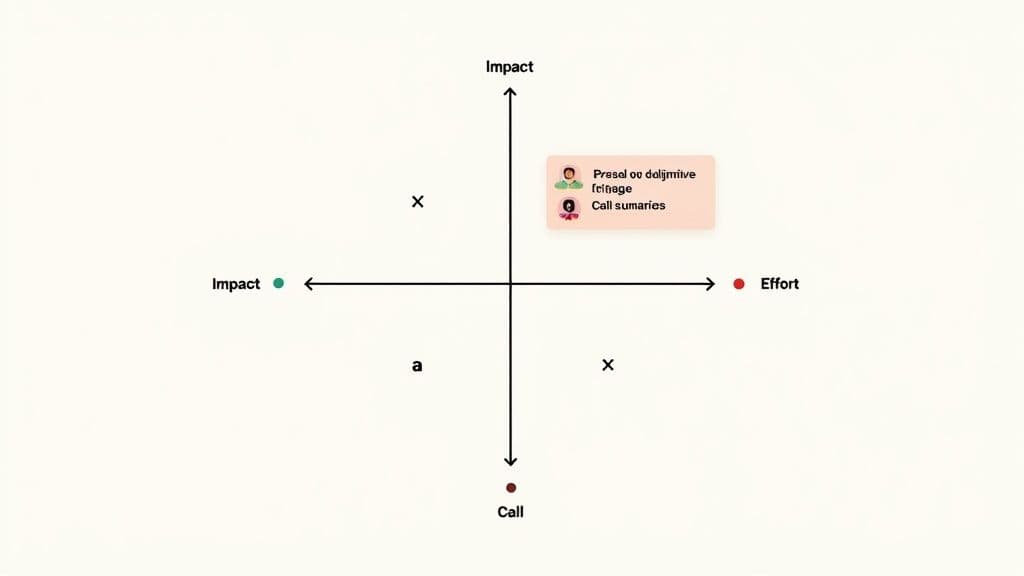
To find your ideal starting point, you need to map potential use cases on a simple two-by-two grid. On one axis, you have "Business Impact" (low to high), and on the other, you have "Implementation Effort" (low to high).
Your target is the high-impact, low-effort quadrant. These are your quick wins.
These are the projects that deliver visible results without requiring a massive upfront investment in time, budget, or engineering headcount. According to a McKinsey report, focusing on such targeted improvements can increase productivity by up to 50% in specific functions.
Here’s how to think about the matrix:
- High-Impact, Low-Effort (Do First): These are your prime candidates. Think AI-powered summaries of sales calls or automated triage for support tickets. They solve a clear pain point and can often be built using off-the-shelf APIs.
- High-Impact, High-Effort (Plan Strategically): These are your major initiatives, like building a predictive inventory management system. They offer huge returns but require careful planning and significant resources. Put them on the roadmap for later.
- Low-Impact, Low-Effort (Do Later): These are minor tweaks and optimizations. They might be worth doing eventually, but they won't build the momentum you need right now.
- Low-Impact, High-Effort (Avoid): Stay away. These are resource traps that consume a lot of energy for very little return.
Identifying low-effort high-impact AI use cases
Here are some common low-effort, high-impact examples across different business functions to help you brainstorm where to look for your first win.
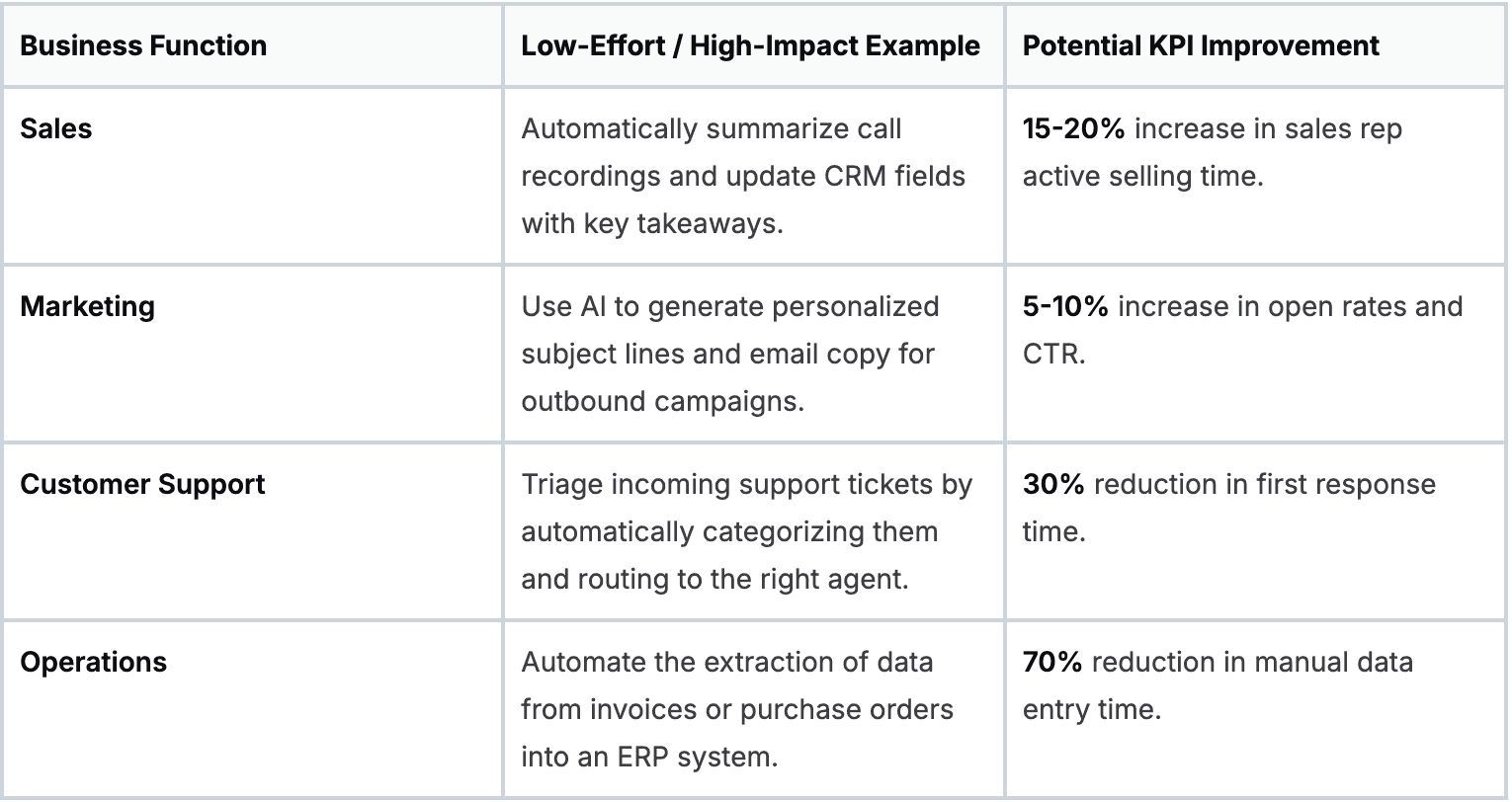
These examples are just starting points. The key is to find a repetitive, rule-based task within your own operations where a small dose of automation can make a big difference. If you're looking for more ideas, check out our guide to building a winning AI-powered business strategy.
Example workflow: Automating lead qualification
Let's look at a practical example. A mid-sized SaaS company was struggling with slow lead response times. Sales reps spent hours manually researching and qualifying inbound leads from their website, and valuable prospects were slipping through the cracks.
- Problem: Sales reps spend 5+ hours per week manually researching leads, delaying response time and losing deals.
- Goal: Reduce lead response time by 80% and increase qualified meetings by 15%.
- Solution: Build an AI workflow using the OpenAI API that connects to their CRM.
- Process:
- A new lead enters the CRM.
- The workflow triggers, sending lead data (name, company URL) to the AI model.
- The AI enriches the lead with company size, industry, and relevant news.
- It scores the lead based on ideal customer profile (ICP) criteria.
- High-scoring leads are instantly routed to the correct sales rep.
- Results: Lead response time dropped from 4 hours to under 30 minutes, and qualified meetings booked increased by 15% in the first month.
This single, focused project didn't just move a key metric; it showed the concrete value of AI to the entire organization. It built trust and paved the way for more ambitious projects down the line.
Creating a simple AI roadmap and backlog
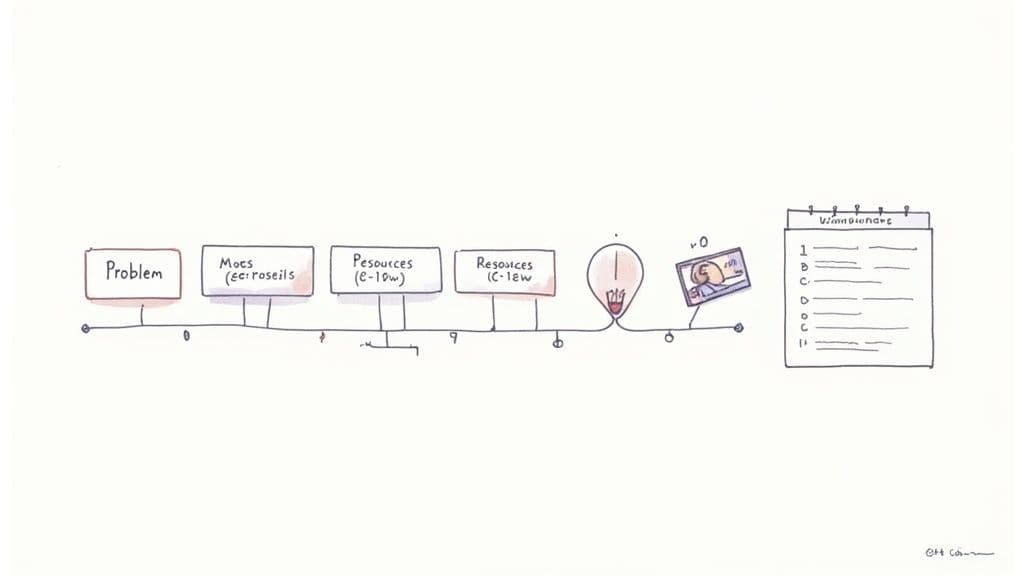
Once you’ve locked in on your first high-impact pilot project, it's time to sketch out a simple plan. Forget those dense, 50-page strategy documents that just gather dust. The goal here is a one-page AI roadmap that acts as a north star for your team and stakeholders, keeping everyone pulling in the same direction.
This isn't about getting lost in the technical weeds. It’s a high-level guide that gives clear, concise answers to four critical questions:
- What business problem are we actually solving? Get specific. "Slash customer support response time" is miles better than a vague goal like "Improve support."
- What does winning look like? Define the key performance indicators (KPIs) you’ll use to measure impact. For instance, "Hit a 25% reduction in manual ticket categorization by the end of Q1."
- What resources do we need for the next 6–12 weeks? This means people (like one backend engineer and one product manager) and tools (like access to an API and a set usage budget).
- What are the key milestones? Break the project down into simple, tangible phases: 'Data access confirmed,' 'Prototype built,' 'Initial workflow live for 10% of users.'
Think of this one-pager as your anchor. It’s what stops scope creep in its tracks and makes sure every decision ties directly back to the original business objective.
Building your prioritized backlog
With your roadmap in hand, you can start turning that vision into actual work. That's where a prioritized backlog comes in- it's a simple, living list of what your team will tackle to bring the pilot project to life. The whole point is to break down the big idea into small, manageable chunks that deliver value fast.
A great way to frame these tasks is with user stories. This simple format keeps the focus squarely on the end-user and the value they're getting.
For example, if you’re building an AI to analyze support tickets, your backlog might have stories like:
- "As a support agent, I want incoming tickets automatically tagged with a sentiment score (positive, neutral, negative) so I can prioritize upset customers first."
- "As a support manager, I want a daily summary of the top three customer issues identified by the AI so I can spot emerging trends before they blow up."
This approach makes the work concrete and ensures your engineering team isn't just building features- they understand the "why" behind every single task.
Keeping it agile and iterative
Your roadmap and backlog aren't carved in stone. They're living documents. The whole reason you start small is to learn and adapt based on what happens in the real world.
Maybe after your first two-week sprint, you find the AI model is a genius at spotting sentiment but clumsy at categorizing technical issues. Perfect. That's valuable feedback. You can now adjust the backlog to focus on improving categorization accuracy in the next sprint.
This cycle of building, shipping, and learning is what makes implementing AI in business successful. It turns a massive, intimidating initiative into a series of achievable, value-driven steps.
Wrap-up
Getting started with implementing AI in business doesn't need to be a massive, company-wide overhaul. The most successful founders treat it as a series of small, focused experiments. Your goal for the next 30 days is simple: identify one high-impact, low-effort problem, define what success looks like, and build a minimum viable product to prove the value. This first win will build the momentum you need to tackle bigger challenges and truly transform your operations.
We at N² labs can help you identify that first high-impact project and build a roadmap for success. We specialize in turning AI concepts into practical, revenue-driving workflows for founders who need to move fast.
FAQ
The cost varies wildly, but starting is cheaper than ever. Using third-party AI APIs like those from OpenAI can cost anywhere from a few hundred to a few thousand dollars per month, depending on usage. Building a custom model from scratch is a major investment, often running into the tens or hundreds of thousands of dollars. For 99% of businesses, starting with an API-based pilot project is the most cost-effective approach.
The absolute first step is to identify a specific, measurable business problem. Don't start with the technology. Instead of asking "What can we do with AI?", ask "Where is our team wasting the most time on manual, repetitive tasks?" Grounding your AI strategy in a real pain point ensures you're building something with clear business value from day one.
You measure ROI by defining key performance indicators (KPIs) before you start building. These metrics must connect directly to the business problem you're solving. Common KPIs include cost savings (hours of manual work eliminated), revenue generation (increase in qualified leads or conversion rates), and efficiency gains (reduction in customer response time). Track these metrics before and after implementation to calculate your return.
Not necessarily, especially for your first project. Modern AI platforms and APIs from providers like OpenAI and Anthropic are designed for developers, not just machine learning PhDs. A good software engineer or technical product manager can often build and deploy your first AI-powered workflow, allowing you to prove value before investing in specialized data science talent.
The most common challenges include starting with technology instead of a business problem, underestimating the importance of clean data (garbage in, garbage out), and failing to plan for user adoption. To overcome these, always ground your project in a real business need, perform a data readiness assessment first, and involve your end-users early in the process to ensure the tool you build actually gets used.