Written by: Igor
Published: November 2025
Scaling content marketing isn't about writing more articles; it's about building a system. To move past ad-hoc content, you need clear business goals, strong governance, and a process that maps every piece of content to a measurable outcome. This guide walks you through building that predictable engine for growth.
Here’s what you’ll learn:
- How to build a content blueprint tied to business goals.
- The right team structure and workflows for efficient production.
- How to use technology and AI to amplify your team's impact.
- A measurement framework to prove content ROI.
- A 6-week roadmap to launch your scaled operation.
Build your content scaling blueprint
Scaling content isn't about publishing more. Pushing out articles without a plan is a fast track to burning cash on content no one sees. Real scale comes from a documented, repeatable system that ties every asset to a business outcome.
Many founders think "scale" means hiring more writers. While team growth is part of it, it's useless without a solid foundation. You need a blueprint that defines what success looks like and how to hit it consistently.
Anchor everything to business goals
First, connect your content to business objectives. Are you generating MQLs? Establishing brand authority? Improving product adoption? Your answer changes the type of content you need.
For example, an MQL goal requires bottom-of-funnel content like case studies and comparison guides. Brand authority needs top-of-funnel thought leadership and industry reports.
Without this clarity, your team operates in a vacuum, creating content that doesn't move the metrics that matter.
Establish simple, effective governance
As you add writers, freelancers, or AI, maintaining quality becomes your biggest challenge. A simple governance model keeps your brand from sounding disjointed.
This model needs two core parts:
- A content style guide: This defines your brand’s voice, tone, and personality. Is your brand an expert mentor or a witty challenger? Include specific "do's and don'ts" to make the voice tangible.
- A messaging framework: This is your source of truth for value props, differentiators, and audience pain points. It ensures everyone tells the same core story. According to a Forbes report, consistent brand presentation across all platforms can increase revenue by up to 23%.
With these pieces in place, you empower a distributed team to create content that feels unified. This is critical as you integrate new tech. To see where your operations stand, learn more about conducting an AI readiness assessment and how it can shape your scaling strategy
Design your content engine for growth
A great strategy is one thing, but the engine gets you there. To scale content marketing, you need an efficient machine built on a smart team structure and repeatable workflows. Without this, your blueprint will buckle under pressure.
The goal is to design a system that removes friction from the creation process, freeing your team to do high-quality work.
Choosing your team model
How you organize your team impacts your ability to scale. An early-stage startup might have one content generalist, but growth requires specialization.
A centralized model groups all creators into a single team. This "content hub" serves the whole company, keeping brand voice and quality consistent. It's ideal for companies focused on building a unified brand.
A decentralized model embeds creators into business units like product marketing. This ensures content is deeply connected to departmental goals. It works well in larger organizations with different audiences.
Whichever model you choose, role clarity is non-negotiable.
Defining core roles for scalable production
Once you move beyond a single marketer, you need specialists. Each role is a stop on the production line, preventing bottlenecks.
Your core team should have:
- Content strategist: The architect of your program. They handle keyword research, topic ideation, and performance analysis.
- Content creator(s): The writers, videographers, and designers making the assets. Scale this with a mix of in-house staff and freelancers.
- Editor/content manager: The quality gatekeeper. They enforce the style guide and manage the workflow from pitch to publish.
- Distribution specialist: Your amplifier. This role gets content in front of the right audience through SEO, social, email, and paid promotion.
This operational engine flows directly from the blueprint you've already built.
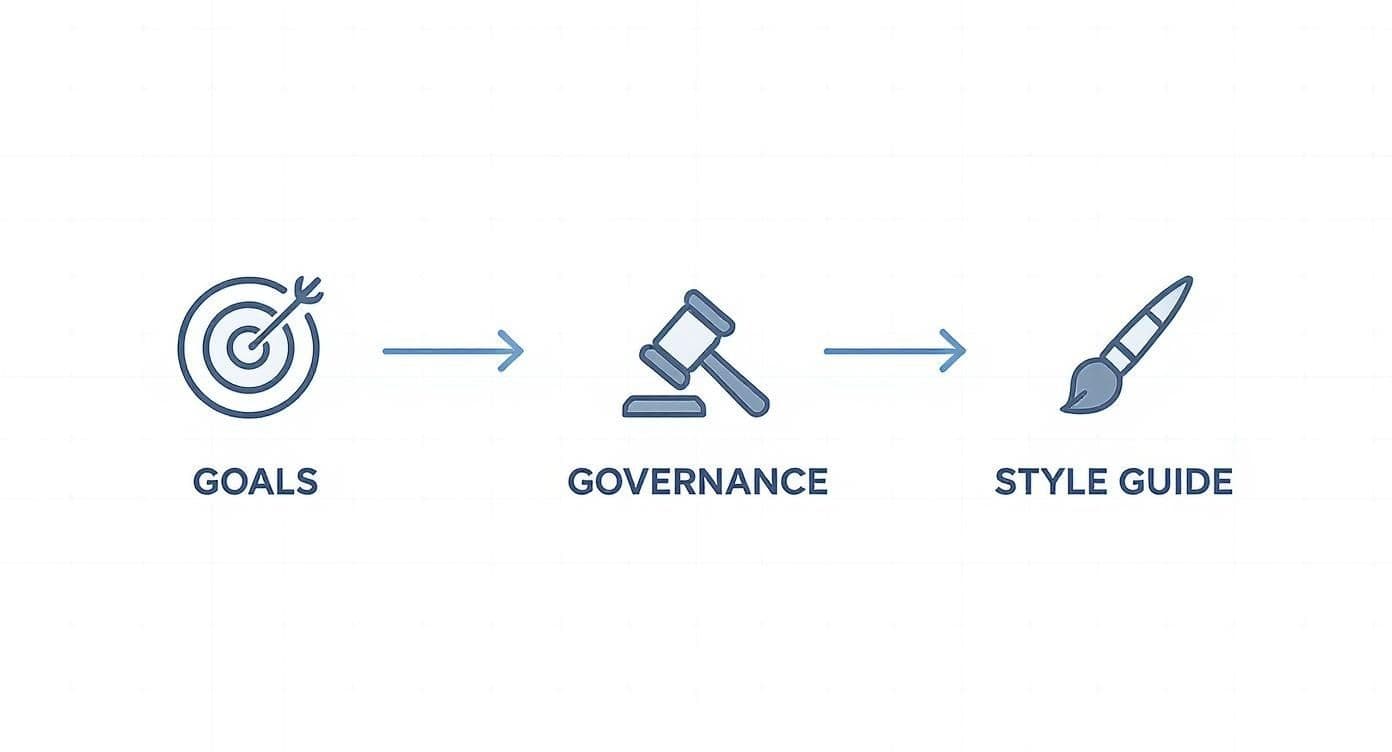
A clear strategy is the starting point. It allows you to build a content production system that is truly scalable.
Mapping your production workflow
A documented workflow is the playbook for consistent, high-quality execution. It turns content creation from chaotic art into a predictable science. A classic Harvard Business review article on operational excellence notes that standardized processes are key to scaling any business function.
Here’s a straightforward workflow you can adapt:
- Ideation and briefing: The strategist identifies a topic and builds a detailed content brief with the target audience, keyword, and outline.
- Drafting: The creator produces the first draft. AI tools can assist here by generating an initial outline or pulling research.
- Editing and review: The editor refines the draft. For technical content, this must include a review by a subject matter expert (SME).
- Finalization and publishing: The content is formatted, optimized, and published in the CMS.
- Promotion and distribution: The distribution specialist executes the promotion plan across all relevant channels.
By defining each stage and its owner, you create a repeatable system that can handle more content without breaking.
Use technology and AI to work smarter, not harder

A solid strategy and team are your foundation. Technology is the jet fuel.
Trying to double output by making people work harder leads to burnout. The real unlock is using the right tools-especially AI-to multiply your team's impact.
The point is to build a connected tech stack where work flows smoothly. When your tools communicate, you eliminate friction and free your team to focus on creativity.
Your essential tech stack for scaling content
Your content machine needs a solid chassis. Think about your tech stack in a few key layers.
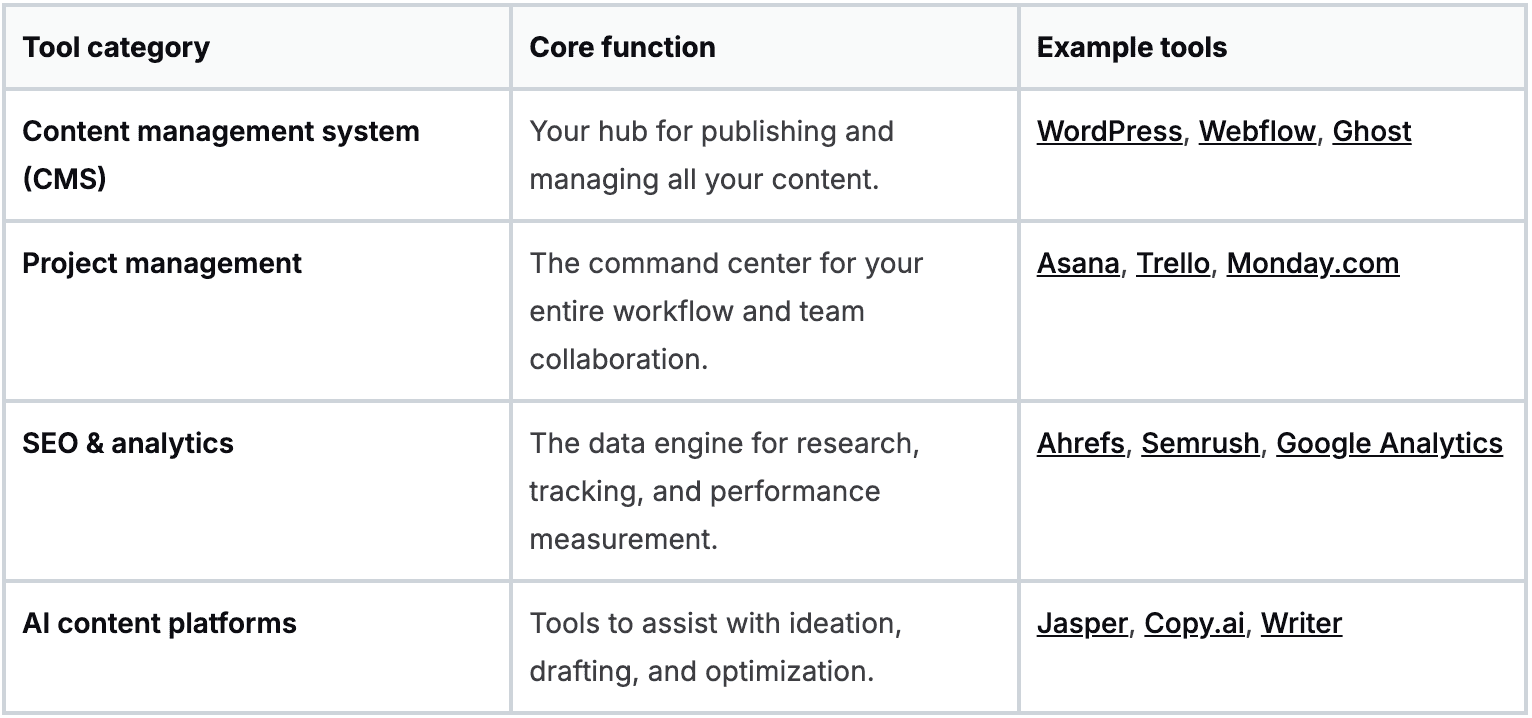
A well-integrated stack means an idea can move from Ahrefs to an Asana task to a WordPress post with minimal manual hand-offs.
Putting AI to work in your production line
AI is a core part of any content scaling plan. Treat it like a powerful co-pilot for your human writers, not a magic "write my article" button.
Here’s a practical, three-part workflow to integrate AI:
- AI-assisted ideation: Use AI to brainstorm blog titles, create outlines from competitor articles, or list audience questions. This cuts initial blank-page time to minutes.
- First drafts and research: Feed a detailed brief into an AI tool to generate a solid first draft or synthesize research. This gives your writer a head start to focus on adding expertise and personality.
- Human-led polish and optimization: This step is non-negotiable. An experienced human editor must review, fact-check, and refine every word. The AI gets you 80% there; your team adds the critical 20% that builds trust.
This human-in-the-loop system delivers both speed and quality. For a more detailed look, our guide on AI content automation dives deeper.
Build a measurement framework that proves ROI
Scaling content without measuring its impact is expensive guesswork. To justify your budget, you need a framework that ties content directly to business results. Stop obsessing over vanity metrics like page views and focus on what your CEO cares about: how content drives revenue.
Moving beyond vanity metrics to business KPIs
The goal is to draw a straight line from content to a business outcome. When you can show a clear path from a blog post to a signed contract, the conversation changes from "Can we afford this?" to "How much more can we invest?"
Content marketing budgets are rising because it's often cheaper than paid ads and works well in long buying cycles. You can discover insights on content marketing statistics and trends. But to earn that investment, track the right things.
Forget the fluff. Prioritize these key performance indicators (KPIs):
- Content conversion rate: The percentage of people who take a desired action, like a demo request. A good benchmark for B2B is 2-5%.
- Marketing-qualified leads (MQLs): How many leads from content are ready for sales.
- Pipeline influence: The percentage of closed-won deals that touched your content.
- Content-attributed CAC: Your customer acquisition cost for customers acquired through content.
Choosing an attribution model that fits
In B2B, sales cycles are long. A prospect might read a blog post today and become a customer six months later. Attribution models give credit where it's due.
A first-touch attribution model gives 100% credit to the first piece of content a user engaged with. This is great for identifying top-of-funnel winners.
A multi-touch attribution model spreads credit across multiple touchpoints. This provides a more complete picture of how different content types work together.
A simple linear multi-touch model, where every touchpoint gets equal credit, is a great place to start.
Building a simple performance dashboard
You don't need a fancy tool right away. A simple dashboard in Google Sheets can communicate performance effectively.
Your dashboard should track core KPIs month-over-month, showing trends and highlighting top-performing content. This data-first approach helps you make smart decisions, double down on what works, and kill what doesn’t. As you grow, our guide on how to implement AI in business can help you use data to your advantage.
Execute your launch with a 6-week roadmap
Strategy is great, but execution is what matters. Turning your plan to scale content marketing into a live system can feel daunting. A phased launch helps you build momentum and learn as you go.
This 6-week roadmap takes you from zero to a full rollout without the chaos. By treating the first few weeks as a pilot, you can de-risk the process and iron out kinks before committing more resources.
Weeks 1-2: the foundation
Your first two weeks are for documentation and setup. Translate your high-level strategy into concrete assets your team can use. Rushing this stage leads to confusion later.
Your goal is a single source of truth for your content operation.
Your checklist for this phase:
- Finalize business goals: Lock in the specific KPIs your pilot will be measured against.
- Document your strategy: Formalize your content pillars, audience personas, and messaging framework.
- Build your style guide: Create a detailed guide covering voice, tone, and formatting with clear "do and don't" examples.
- Select and configure your tech stack: Set up your core tools (CMS, project management, AI assistants) with user accounts.
Weeks 3-4: the pilot execution
Now, test your new system. Run a small batch of content through the entire production workflow you designed. Treat it like a dress rehearsal for scaling up.
Stick to the process to see where it breaks. You're not aiming for high volume; focus on quality and process adherence. A batch of 3-5 core pieces is enough to generate learnings.
During these weeks, execute the end-to-end workflow: brief creation, AI-assisted drafting, editorial review, and publication.
Weeks 5-6: analysis and iteration
With your pilot content live, the final two weeks are for measurement and refinement. Gather hard data and human feedback to optimize the engine before you accelerate.
First, analyze performance data. Did the pilot content hit your KPIs? See what worked and what didn't in your analytics dashboard.
Next, talk to your team. Hold a short retrospective meeting to discuss what went smoothly and identify friction points. Was the tech stack intuitive? Were the briefs clear? This feedback is as important as the numbers.
This iterative loop-build, test, measure, refine-is the secret to successful content scaling. Use these insights to tweak your style guide and workflow. Now you have a battle-tested system ready for a full-scale rollout.
FAQ
The first step is to create a documented content strategy. Before increasing volume, you must define your business goals, target audience, and brand voice in a style guide. This foundation ensures consistency and alignment as you grow your team and output. Skipping this step leads to chaotic, off-brand content that fails to deliver ROI.
A small team should focus on efficiency and repurposing. Start by creating a comprehensive "pillar" piece of content on a core topic, like an in-depth guide. Then, break that pillar down into smaller "spoke" assets: blog posts, social media updates, infographics, and short videos. This hub-and-spoke model maximizes the value of your initial effort. Using AI tools for first drafts and research can also free up your team for high-value strategic work.
When you scale, shift from vanity metrics like page views to business-focused KPIs. Track conversion rates (e.g., demo sign-ups), marketing-qualified leads (MQLs) generated, pipeline influence (the percentage of deals that engaged with content), and content-sourced revenue. These metrics prove your content's financial impact and justify further investment.
Maintaining quality requires a rock-solid system. Implement a detailed style guide that all creators must follow. Establish a multi-stage editorial workflow, including a review by a subject matter expert (SME) for technical accuracy. Use AI as a co-pilot for drafting, but rely on human editors for nuance, fact-checking, and brand personality. This ensures you can deliver both quality and quantity.