Written by: Igor
Published: December 2025
Data engineering services are the bedrock of any serious data strategy. Think of it as building the digital plumbing for your company. Before you can get reliable insights from analytics or AI tools, you need a solid system to collect, move, and prepare your raw information. This guide will show you how to build that foundation, measure its impact, and choose the right partner to help you get it done.
For founders drowning in data but starving for insight, this is the solution.
Key takeaways:
- Data engineering builds the "plumbing" to get data from sources like Salesforce and your app into a central, usable format.
- A modern data stack consists of ingestion, transformation (ETL/ELT), storage (warehouses/lakes), and automated pipelines.
- Measure ROI with hard metrics like reduced manual work (cost savings of over $39,000 per analyst annually is possible) and strategic gains like faster, more confident decision-making.
- Start with a small pilot project focused on one high-impact business problem to prove value quickly, often in just 4-8 weeks.
What are data engineering services, really?

Many founders are sitting on a goldmine of data from their CRM, product analytics, and marketing tools-but they can’t actually use it. The data is stuck in disconnected silos, it's messy, and getting a clear picture feels impossible. This is the exact problem data engineering solves.
Data engineering services design, build, and manage the systems that get data from point A to point B, ready for analysis. It’s the crucial, behind-the-scenes work that makes business intelligence dashboards and machine learning models possible.
Without it, your data analysts spend up to 80% of their time just cleaning and preparing data instead of finding growth opportunities, according to analytics professionals surveyed by Anaconda.
From data chaos to a scalable strategy
At its core, data engineering creates order from chaos by building automated "pipelines" that manage the entire data lifecycle. A fundamental concept here is ETL (extract, transform, load).
It's a three-step process:
- Extracts data from all your sources, like Salesforce, Google Analytics, or your app's database.
- Transforms it by cleaning, standardizing, and structuring everything into a consistent format. This could mean converting all date formats to a single standard or merging customer data from two systems into one profile.
- Loads the clean data into a central hub, like a data warehouse, where it’s ready for your team to analyze.
This approach moves your company from reactive, manual data pulls to a proactive, scalable strategy. It builds a single source of truth, giving everyone confidence in the numbers they’re using to make decisions. Getting this foundation right is non-negotiable before you can even think about advanced analytics; our guide on conducting an AI readiness assessment can show you where you stand.
The market for big data engineering services is projected to reach over $150 billion by 2030, according to a report from Grand View Research. This isn't just a technical upgrade; it’s a strategic investment in your ability to compete.
Building your modern data infrastructure

To understand what professional data engineering services do, picture a high-end restaurant kitchen. Raw ingredients arrive, get prepped, and are cooked into dishes following precise recipes. Your data infrastructure works the same way-turning raw, messy information into business intelligence.
Each piece of this system has a job. Let's walk through the core components of a modern data stack.
Data ingestion: the loading dock
First, you have to get your ingredients into the kitchen. This is data ingestion-the process of pulling in raw data from all your sources.
- Customer data from your CRM like Salesforce.
- Website traffic from analytics tools like Google Analytics.
- User activity logs from your product databases.
- Financials and marketing metrics from third-party APIs.
Your business has a constant stream of data flowing in. Data engineering ensures these deliveries are reliable, pulling all that raw information into a central staging area.
ETL and ELT: the prep station
Once the ingredients are in the door, they need to be prepped. This is where ETL (extract, transform, load) and its modern cousin, ELT (extract, load, transform), come into play.
The "transform" step is all about cleaning, standardizing, and structuring the data. For instance, it might involve:
- Making sure all dates follow a consistent format (like YYYY-MM-DD).
- Scrubbing out duplicate customer entries from different systems.
- Combining
first_nameandlast_namefields into a singlefull_namefield.
This prep work ensures every piece of data is clean and reliable. It's the difference between a Michelin-star dish and a sloppy mess.
Data warehouses and lakes: the pantry
After prep, everything needs a home. In the data world, this is your data warehouse or data lake.
A data warehouse stores structured, prepped data in a ready-to-use format. A data lake can hold anything-structured numbers, unstructured images, and raw server logs-before it's been fully prepped.
This central storage creates a "single source of truth." When your sales and marketing teams pull numbers, they're both getting data from the same clean, organized place. This ends arguments over whose data is "right."
Data pipelines: the recipes and workflows
Finally, you need recipes and a system to turn prepped ingredients into finished dishes. Data pipelines are the automated workflows that connect every part of the kitchen.
A pipeline spells out the steps-ingest from this source, apply these transformations, load into that warehouse-and then automates the entire sequence. This is the magic that delivers real-time dashboards to your sales team or powers a personalization engine.
When built right, these pipelines are rock-solid and can scale as you grow, making sure the right data gets to the right place at the right time.
How to measure the ROI of data engineering
Investing in data engineering services is a business decision that has to deliver a clear return. The value of a solid data foundation is surprisingly easy to measure. It’s a mix of hard cost savings and powerful strategic advantages. The trick is to connect every engineering effort back to a real business outcome.
Let's break down how you can calculate the actual return on investment (ROI).
Quantifying the hard returns
The most straightforward way to measure ROI is to look at tangible improvements in costs and productivity.
Start with efficiency gains. The biggest bottleneck in most companies is the time your data team wastes on manual tasks. Automating these workflows with proper data pipelines frees up your most expensive talent to do work that matters.
For example, if a data analyst spends 10 hours a week on manual reporting, that’s 520 hours a year. At a loaded cost of $75 per hour, you're spending $39,000 annually on that task alone. A data engineering project that automates that grunt work can pay for itself in months.
Another critical metric is time-to-insight. How long does it take your team to answer a burning question? If it takes two weeks to pull a new report, you’re making decisions based on old news. Good data engineering can shrink that cycle from weeks to hours. A McKinsey report found that data-driven organizations are 23 times more likely to acquire customers and 6 times as likely to retain them.
Identifying the strategic gains
Beyond the hard numbers, data engineering unlocks strategic value that’s often more impactful.
A huge one is increased decision confidence. When your leadership team trusts the numbers, they can make bold moves without hesitation. A single source of truth ends departmental squabbles over whose spreadsheet is "correct."
Plus, a solid data foundation is the launchpad for innovation. Want to build a personalization engine? A predictive model to spot customers about to churn? Those features are impossible without clean, accessible, and reliable data pipelines. These projects directly boost engagement, retention, and revenue, making data engineering a true enabler of growth.
Choosing the right data engineering partner
Picking a partner to build your data infrastructure is a critical decision. A great partner feels like an extension of your team. The wrong one can set you back with costly delays and a data stack that misses the mark.
You need someone who is as obsessed with your business outcomes as they are with the tech stack. Their real job is to turn your strategic goals into a reliable data foundation.
Key evaluation criteria
Before you book a sales call, sketch out a simple scorecard. Focus on three core pillars: proven experience, a focus on business value, and clear, transparent operations.
- Industry and stage-specific experience: A firm that only works with Fortune 500s probably won't get the urgency of a startup. Look for evidence that they’ve delivered for companies at a similar stage to yours.
- Outcome-oriented approach: The conversation should start with business problems, not tools. A great partner will ask about your goals-like reducing churn by 5%-before they mention tech like Snowflake or dbt.
- Transparent pricing and process: You should never be in the dark about costs. A trustworthy partner will give you clear, upfront pricing models and a well-defined project management process.
Critical questions to ask potential partners
Once you have a shortlist, it’s time to dig in. These questions are designed to get you past the sales pitch.
- How do you ensure data quality and reliability from day one? A strong answer will cover automated testing, data validation checks, and proactive monitoring.
- Can you show us a case study from a company at our stage? This is non-negotiable. It forces them to provide proof they can deliver for a business like yours.
- How will you connect your technical work to our business KPIs? They must articulate how building a pipeline will help you hit a specific business goal.
- What does your project management and communication process look like? Look for specifics like weekly check-ins, a dedicated point of contact, and shared progress dashboards.
- How do you handle scope changes or unexpected challenges? A mature partner will have a clear process for discussing changes and managing budget implications with full transparency.
A well-chosen partner can help you not just with data, but also with figuring out how to implement AI in your business.
Your playbook for a data engineering pilot project
Getting from messy spreadsheets to a scalable data asset can feel like a massive jump. The smartest way to de-risk the investment and show value fast is to start with a focused pilot project.
This isn't about building your entire data empire overnight. It's about scoring a single, high-impact win that proves the value of professional data engineering services.
Step 1: define one high-impact business problem
Before anyone writes code, anchor the pilot to a real business problem. Don't start with the data you have; start with a question your team can't answer today.
Good starting points sound like this:
- Why are our best customers churning after three months?
- Which channels are bringing in our most profitable customers?
- Where are leads getting stuck in our sales process?
Pick just one. A narrow focus is your best defense against scope creep.
Step 2: identify the essential data sources
With your problem locked in, now you can figure out which data sources you need. For the customer churn problem, your list might be short.
You’d likely just need data from:
- Your product database (user activity).
- Your CRM (customer communication).
- Your payment system (subscription history).
That's it. Fight the urge to pull in every piece of data you own. A pilot project thrives on simplicity. This focused approach helps you sidestep common AI implementation challenges that come from trying to do too much at once.
Step 3: scope a minimum viable pipeline
Your pilot needs its own minimum viable product (MVP). This means scoping the simplest possible data pipeline and dashboard that can answer your business question.
The MVP might look something like this:
- An automated pipeline that pulls data from your three sources nightly.
- A basic transformation process that cleans and joins the data in a cloud warehouse.
- A single dashboard in a BI tool that visualizes key churn metrics.
This simple setup delivers immediate value without getting bogged down in complex features you don't need yet.
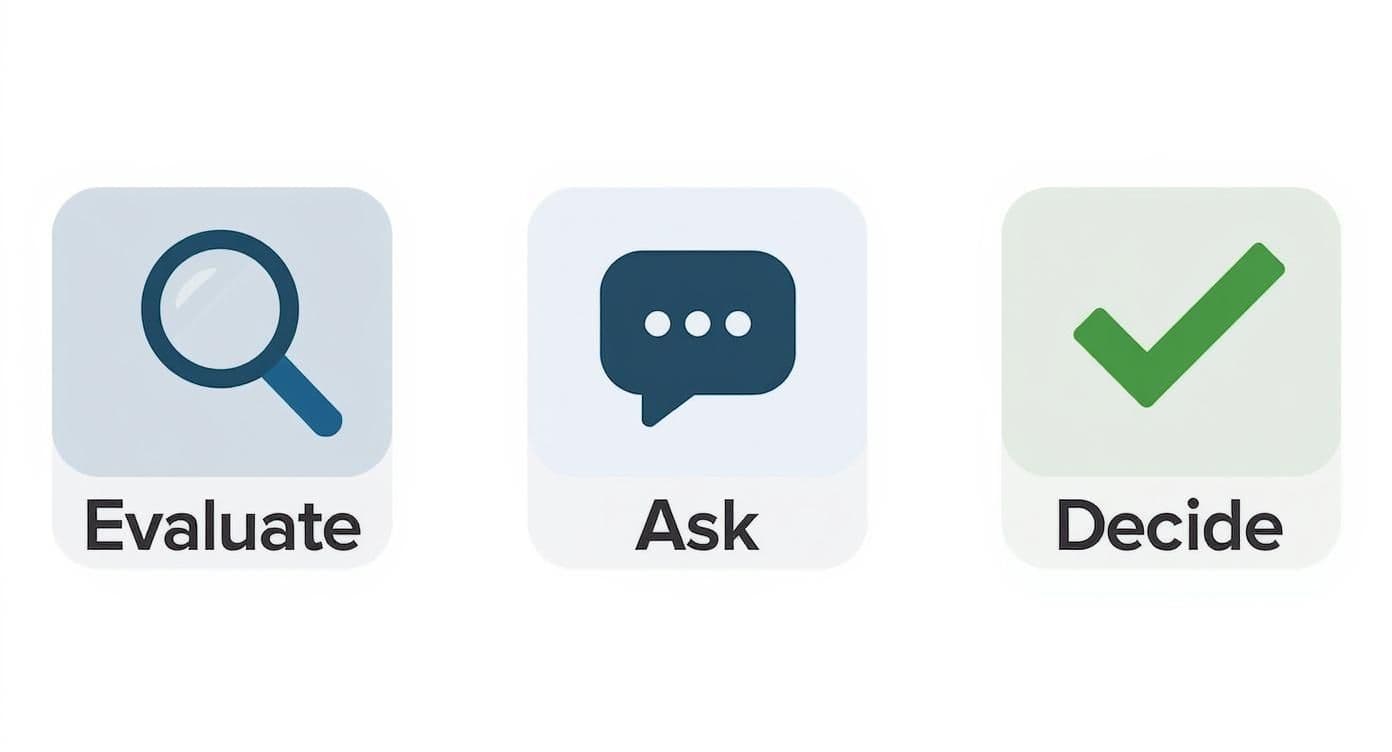
This process forces you to evaluate the core problem, ask what's truly necessary, and make a decisive move toward a working solution.
Step 4: set clear success metrics
How will you know if the pilot worked? Define clear, measurable metrics before the project kicks off.
For our churn example, success metrics could be:
- Slashing the time to build a churn report from 10 hours of manual work to 10 minutes.
- Pinpointing the top three user behaviors that are leading indicators of churn.
- Achieving 99% accuracy in the dashboard data, confirmed by the business team.
These metrics give you a clear finish line and make it simple to show the project's ROI.
Step 5: plan the transition to production
A successful pilot needs a clear path to becoming a permanent part of your operations. Plan for this transition from the beginning. It means thinking about how the MVP pipeline will be monitored, maintained, and scaled over time.
Work with your partner to map out what it would take to go from a pilot to a production-grade system. This ensures your initial investment is the first building block of a solid data foundation.
Wrap-up
We’ve covered the landscape of data engineering services, from what they are to launching a pilot project. Getting your data house in order isn't just an IT project-it's a foundational move that paves the way for predictable growth. The biggest mistake is trying to solve every data problem at once.
Instead, find one high-stakes business question you can't answer because your data is a mess. What's that one question that keeps coming up? That question is your perfect entry point. Rallying your team around solving that one problem creates instant momentum and is the quickest way to demonstrate ROI.
We at N² labs can help you pinpoint the business question that will deliver the biggest impact and build a focused plan to get you the answer.
Let's build your data foundation the right way.
FAQ
Data engineering services cover the entire lifecycle of your data. This includes setting up data ingestion from various sources (like your CRM or app), building ETL/ELT pipelines to clean and transform the data, designing and managing data warehouses or data lakes for central storage, and automating these workflows to ensure data is always fresh and reliable for analysis.
Think of it this way: data engineers build the roads, and data scientists drive the cars. Data engineers construct the reliable, high-performance data infrastructure. Data scientists then use that infrastructure to analyze data, build predictive models, and uncover insights that answer complex business questions. You need engineering before you can do effective science.
You likely need data engineering services if you're experiencing common symptoms like your team spending more time preparing data than analyzing it, different departments arguing over whose numbers are "correct," or an inability to answer critical business questions quickly. If you want to use data for advanced analytics or AI, a solid data engineering foundation is not optional.
For most startups and scale-ups, using an external service is faster and more cost-effective initially. You get immediate access to a team of senior experts without the long hiring process and high cost of a full-time employee. As your data platform matures and requires constant maintenance, hiring an in-house team becomes a more logical next step. A hybrid approach-using a service to build the foundation and then hiring to maintain and expand it-is often the most effective path.