Written by: Igor
Published: December 2025
High call volumes are swamping your support teams, operational costs are climbing, and customers expect instant, 24/7 service. Trying to scale a human team to meet this demand is unsustainable. This guide will show you how chatbots for banks solve these problems by automating routine tasks, freeing up your team for high-value work, and delivering the modern experience customers expect.
Snapshot: key takeaways
- Solve scalability: Chatbots handle up to 80% of common customer inquiries, allowing your bank to grow without a proportional increase in support staff.
- Boost efficiency: By automating tasks like balance checks and transaction lookups, chatbots reduce average handle time and free up human agents for complex issues.
- Enhance customer experience: Provide instant, 24/7 support and personalized interactions, meeting the expectations of today's digital-first customers.
- Ensure security: Modern banking chatbots are built with multi-factor authentication, end-to-end encryption, and regulatory compliance at their core.
- Follow a clear path: You can move from strategy to a live pilot in just six weeks with a focused, step-by-step implementation plan.
Why chatbots are a necessity in modern banking
Your customers expect instant answers, whether it's 2 PM on a Tuesday or 2 AM on a Sunday. Trying to scale a human team to meet that 24/7 demand is an operational headache that leads to long wait times and high overhead. This is where chatbots step in- not as a trend, but as a core solution for modern financial institutions.
AI-driven conversations directly address two of banking's biggest pain points: rising customer inquiries and steep operational costs. Instead of hiring more staff to answer the same questions, a single chatbot can handle thousands of interactions simultaneously.
Solving the scalability problem
The biggest hurdle for any growing bank is keeping up with customer interaction volume without letting service quality slip. As you add customers, the calls, emails, and chat requests pile up.
A Gartner forecast suggests that conversational AI will reduce contact center agent labor costs by $80 billion in 2026. Banks can automate up to 80% of common customer requests using chatbots. This frees your expert staff to focus on complex, high-value issues like loan consultations or fraud investigations, instead of getting bogged down with password resets and balance checks.
This is about building a smarter support system. The chatbot becomes the first line of defense, resolving simple queries instantly and intelligently escalating tougher problems to the right human agent. The result is a system that can handle growth without a proportional increase in headcount.
Meeting modern customer expectations
Today’s banking customers grew up in a digital-first world. They run their lives from their smartphones and expect their bank to offer the same seamless convenience.
- Instant gratification: People want answers now, not a promise of a callback within 24 hours.
- 24/7 availability: Financial needs don't stop at 5 PM. A chatbot ensures your bank is always open.
- Personalized service: Modern chatbots can securely access customer data to provide tailored information, like details on a recent transaction or personalized savings advice.
Falling short on these expectations is a sure way to lose customers. To understand the full scope of their advantages, you can learn more about unlocking the full benefits of AI chatbots and how they drive loyalty. A well-designed chatbot is a critical layer of your service, creating the efficient, always-on experience that modern customers demand.
How chatbots transform core banking operations
Modern chatbots for banks are not just fancy FAQ pages. They are deeply integrated tools that automate financial legwork, smooth out the customer journey, and have a measurable impact on your bottom line.
Instead of just spitting out answers, these bots do things. They complete actions, making banking faster and more intuitive for your customers.
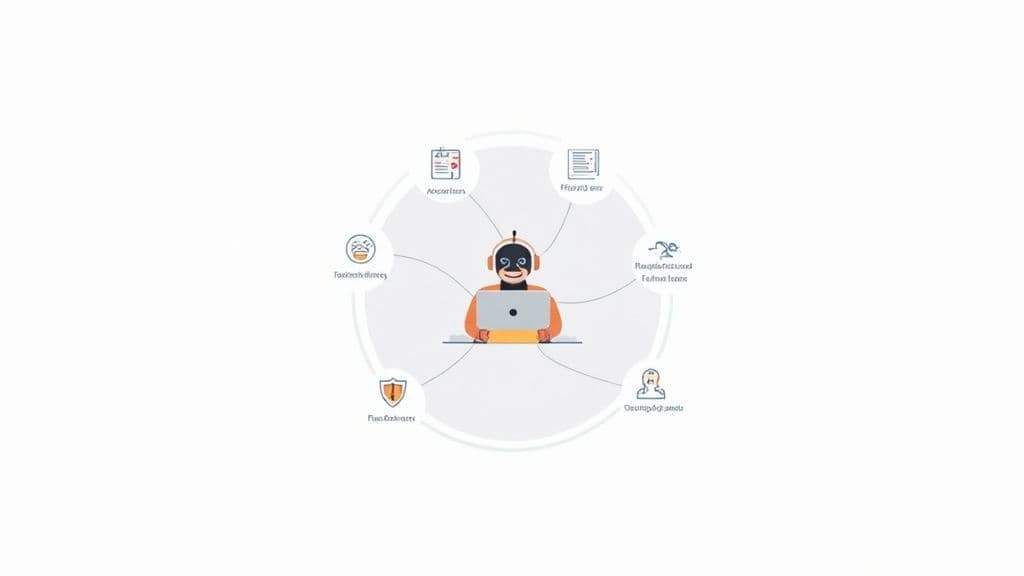
The numbers back this up. According to Juniper Research, banks are projected to save a staggering $7.3 billion in operational costs globally by this year from chatbot usage alone. With deployments showing a 148-200% ROI, it's clear these aren't just gadgets- they're serious financial tools.
Automating routine account management
The first win with a banking chatbot is its ability to handle the repetitive tasks that tie up support lines. This is where you'll see the quickest returns in both cost savings and happier customers.
Think about the basic queries that flood your call centers:
- Real-time balance checks: Customers can type, "what's my checking account balance?" and get an instant, secure answer. No waiting on hold.
- Transaction history retrieval: A quick "show me my last 10 transactions" pulls up the data right in the chat.
- Account statement requests: Need a monthly statement? The bot can process the request and send it via a secure link.
By offloading these tasks, you free up your human agents for the high-value problems that require a human touch.
Facilitating product discovery and lead generation
Good chatbots don't just solve problems; they create opportunities. They can act as personal financial guides, pointing customers toward products that fit their needs. This turns a routine service interaction into a potential sale.
For example, a customer asks about their savings account balance. The chatbot could reply with: "Did you know our high-yield savings account offers a 3.5% APY? You could be earning more. Want to learn more about it?"
This conversational suggestion feels more personal and effective than a generic banner ad. Chatbots can also pre-qualify leads for complex products like loans or mortgages, handing off a warm, informed lead to a specialist. Check out Capital One's conversational AI initiatives, including their voice assistant Eno, to see how a major player builds these experiences.
Enhancing security and transactional capabilities
The real power move is when chatbots are connected to your core banking systems. With the right security and authentication in place, they can perform secure actions for the customer.
This is where chatbots go from helpful to indispensable:
- Proactive fraud alerts: The bot can send an instant message like, "We noticed an unusual $500 transaction in another state. Was this you?" Customers can confirm or deny it on the spot.
- Secure fund transfers: After multi-factor authentication, a customer can tell the bot, "transfer $200 from my savings to my checking."
- Card management: Lost your card? Users can report it, freeze it, or order a replacement right from the chat window.
These automated processes make life easier for the customer and tighten your bank's security. The ability to automatically report on these interactions is a massive efficiency gain for internal teams. You can learn more about how AI transforms finance teams through automated reporting in our detailed guide.
Building a secure and compliant banking chatbot
In banking, trust is everything. When you introduce a chatbot, you're opening a new digital door to your institution. That door must be as secure as your physical vaults. Nailing security and compliance isn't optional; it's the foundation of a successful banking chatbot.
Security must be baked into the chatbot’s DNA from the first line of code. The system must be engineered to shield sensitive data and navigate the maze of financial regulations.
Core security protocols you cannot ignore
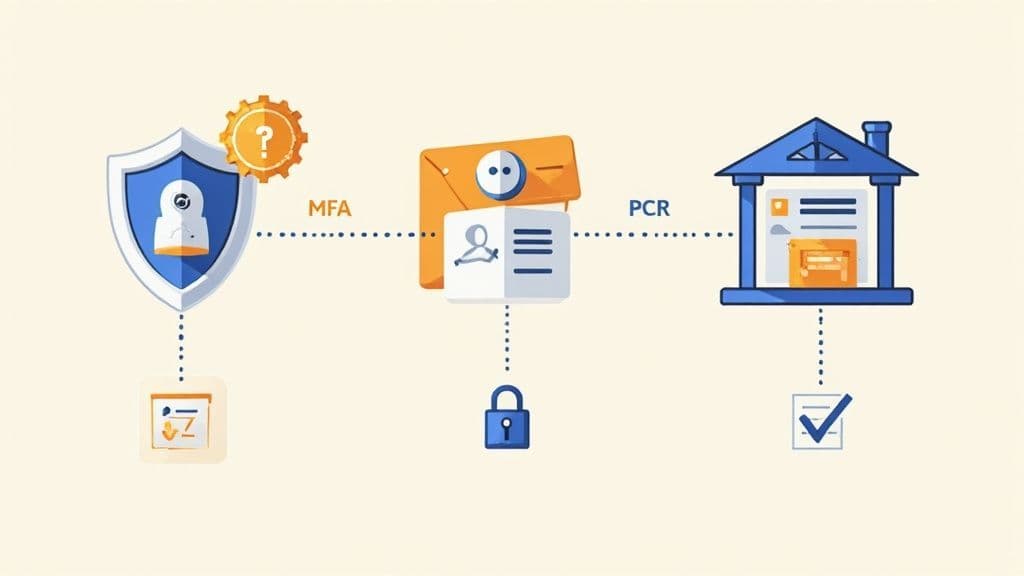
Before a chatbot can answer a question, it must know who it’s talking to. This is where multi-factor authentication (MFA) becomes non-negotiable for any interaction involving personal or financial information.
For any sensitive request- like transferring funds or changing an address- the chatbot must initiate an MFA flow. This could be a one-time code sent to a registered phone or a biometric confirmation in the mobile app.
Data protection is the other side of the coin. All conversation data needs end-to-end encryption. This ensures that even if someone intercepted the data, it would be unreadable.
Navigating the regulatory maze
Financial institutions operate under a microscope, and your chatbot is no exception. It must be built to comply with regulations that protect consumer data and financial integrity.
These are the table stakes for compliance:
- General Data Protection Regulation (GDPR): If you have customers in the European Union, your chatbot must follow GDPR's strict rules. This means getting explicit consent for data collection and honoring the "right to be forgotten."
- Payment Card Industry Data Security Standard (PCI DSS): If your bot handles card payments or displays card details, it must be fully PCI DSS compliant. This involves airtight controls over cardholder data.
- Immutable audit trails: Every action the chatbot takes must be logged in a way that can't be altered. These records are crucial for resolving disputes, conducting security reviews, and proving compliance.
A recent Deloitte report highlights the growing regulatory pressure on digital channels, making proactive compliance a strategic advantage.
Advanced security and risk management
The most robust chatbots for banks actively spot and stop risks. This turns the chatbot into another layer of your security defense.
One powerful tool is sentiment analysis. The chatbot’s AI can be trained to pick up on signs of customer distress, frustration, or confusion. If a customer's language suggests they might be the target of a scam, the bot can instantly flag the chat for a human agent. Our approach to AI implementation is all about building these safety guardrails from the start.
Finally, secure Application Programming Interface (API) integrations are the backbone of a safe chatbot. Every connection to your core banking systems must be locked down. The chatbot should only access the specific data it needs for a task, and nothing more. This "principle of least privilege" is fundamental to a secure architecture.
Your 6-week implementation plan and checklist
Turning a chatbot idea into a live tool doesn't have to be a long process. You can get from concept to a live pilot in just six weeks with a disciplined sprint. This week-by-week checklist breaks down the process to keep your project on schedule.
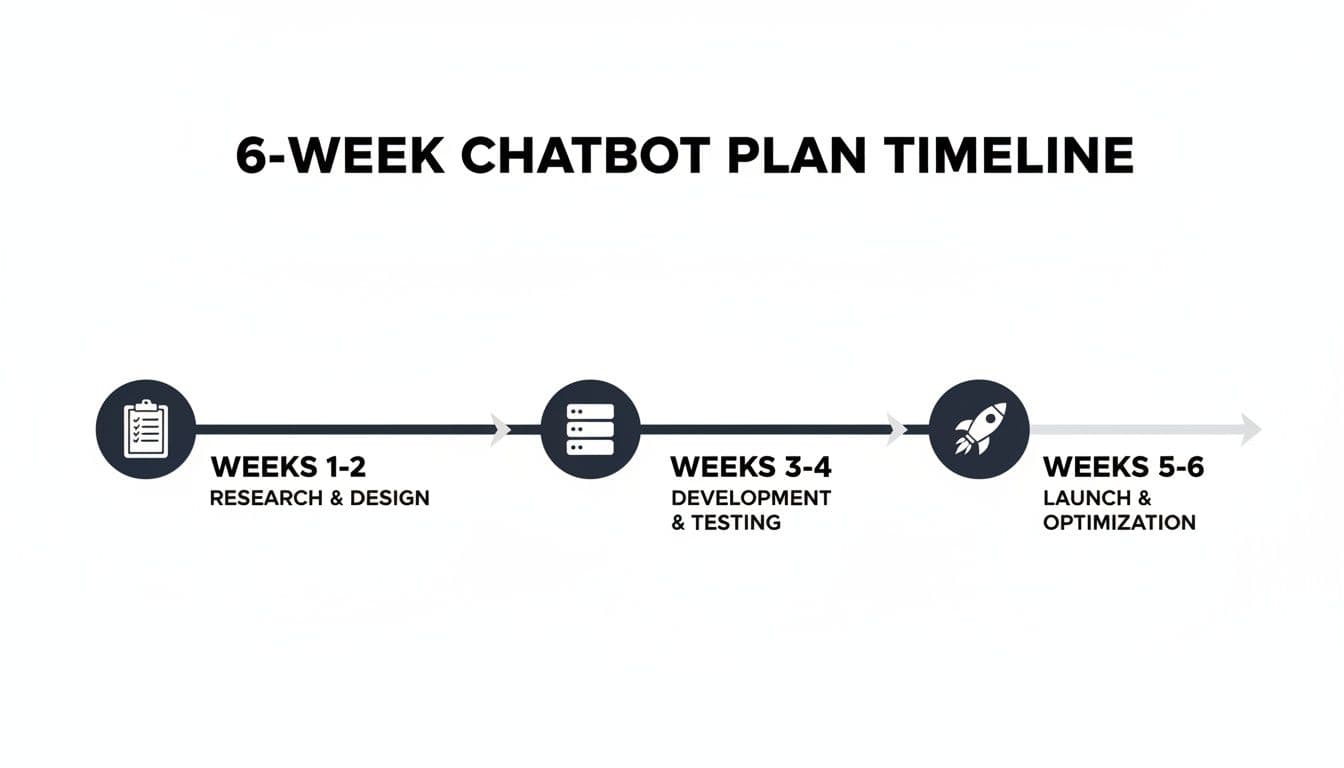
Weeks 1-2: discovery and strategy
The first two weeks are for building a solid foundation. Jumping into development without a clear plan is a recipe for failure. Your goal here is to define what success looks like and find the most impactful place to start.
First, define your key business objectives. Are you trying to reduce call center volume? Generate more leads for a loan product? Or improve customer satisfaction (CSAT) scores? Get specific. Aim for something like, "reduce calls related to password resets by 30%."
With your goals set, find the highest-impact use cases.
- Map common inquiries: Dive into your call center logs. What are the most frequent, simple questions your team answers over and over?
- Prioritize quick wins: Think about tasks like balance inquiries, transaction history requests, or finding the nearest branch. These are straightforward to automate.
- Form the core team: Assemble a small, cross-functional team with a product owner, a technical lead, and a customer support representative.
Weeks 3-4: architecture and vendor selection
Now, nail down the technical and operational framework. This ensures your chatbot will be secure, compliant, and correctly integrated with your existing systems.
This is where the "build vs. buy" decision happens. If you're buying a solution, start vetting vendors. Look at their security credentials, integration capabilities, and track record in finance. If you're building in-house, assign your engineering team and define the tech stack.
Here's your checklist for this phase:
- Technical architecture review: Map out how the chatbot will connect to your core banking system, Customer Relationship Management (CRM) software, and other critical APIs.
- Data privacy and security review: Involve your compliance and legal teams early. They must confirm the solution meets all regulatory standards like GDPR and PCI DSS.
- Vendor shortlisting or team assignment: Make your final call on a third-party platform or officially kick off the internal build. Skipping proper vetting is one of the most common AI implementation challenges. An AI readiness assessment can help you decide.
Weeks 5-6: build and pilot launch
These final two weeks are for execution and testing. Your chatbot starts to take shape and gets ready for its first real-world interactions. The key is to start small, test everything, and launch in a controlled environment.
Build out the conversation flows for the one or two use cases you chose in the first phase. Don't try to build a bot that does everything at once. Focus on making these initial interactions flawless.
Next, run a thorough User Acceptance Testing (UAT) session with internal staff, especially customer support agents. Their feedback is invaluable. Finally, prepare for a controlled pilot launch. You might limit it to a small group of mobile app users. The goal is to collect data, measure performance, and get ready to iterate.
Measuring the ROI of your banking chatbot
How do you prove your new chatbot is more than a cool feature? You need to connect its performance to business impact. Measuring the return on investment (ROI) for chatbots for banks is about tracking hard numbers that show real financial value.
A strong business case comes down to cost savings, operational efficiency, and customer engagement.
The three pillars of chatbot ROI
Organize your metrics around these core areas. Each one tells a part of your chatbot's success story.
- Cost savings: This metric gets everyone's attention. The biggest driver is call deflection- every query the chatbot handles is one less for a human agent. The math is simple: if your average cost per human interaction is $7 and your chatbot fields 10,000 queries a month, that's a potential $70,000 in savings.
- Operational efficiency: This is how the chatbot improves your entire support team. Key metrics are Average Handle Time (AHT) and First Contact Resolution (FCR). A good chatbot can resolve simple requests in under two minutes, freeing up agents for complex conversations.
- Customer engagement: This measures the actual experience. Track Customer Satisfaction (CSAT) scores after an interaction and, more importantly, the Task Completion Rate. A high completion rate proves the bot is genuinely helpful.
Chatbots now handle an estimated 3.1 billion banking interactions monthly, and customer satisfaction for these interactions is hitting 84% (per this detailed report on banking chatbot adoption). With the average bank chatbot managing over 40,000 customer queries monthly, the scale of this efficiency is massive.
Proving the ROI of your banking chatbot comes down to telling a clear story backed by solid data. First, baseline your current metrics before launch. Then, track your Key Performance Indicators (KPIs) across cost, efficiency, and engagement. This data-driven approach will not only prove the chatbot’s value but also give you the insights needed to make it even better.
Next steps
Implementing a banking chatbot is a strategic move to cut costs, boost efficiency, and meet modern customer demands. The key to success is starting with a clear plan focused on solving a few high-impact problems perfectly before expanding. Your next step should be to identify the top 3-5 repetitive queries that are tying up your support team and use them as the foundation for your pilot project.
We at N² labs can help you build a secure, compliant, and effective chatbot that delivers a clear ROI. Let's discuss your specific needs.
FAQ
Modern chatbots use secure Application Programming Interfaces (APIs) to communicate with your core banking platforms, CRM software, and other systems. This allows the bot to safely fetch real-time information- like an account balance- and push commands, like initiating a fund transfer, without altering your foundational technology. A solid API strategy ensures data flows smoothly and securely.
The biggest risks are unauthorized account access and data breaches. That's why any good chatbot is built with security as its first priority. Key features include multi-factor authentication (MFA) for sensitive actions, end-to-end encryption for all messages, and strict access controls based on the principle of "least privilege." Reputable platforms are already compliant with regulations like PCI DSS and GDPR.
Not at first, and that’s by design. The winning strategy is to let chatbots master the simple, high-volume tasks first- the 80% of common requests like password resets and balance checks. For anything more complex or emotional, the chatbot's most important job is to execute a seamless human handoff, transferring the customer and the entire chat history to a live agent.
To get the real story, you need to track a few key performance indicators (KPIs). Make sure you're tracking Task Completion Rate (did the user achieve their goal?), Customer Satisfaction (CSAT) Scores from post-chat surveys, and Containment Rate (what percentage of conversations did the bot handle without human help?). Together, these numbers provide a data-backed view of your chatbot's performance.
With a focused approach, you can move from initial strategy to a live pilot in as little as six weeks. This timeline typically involves two weeks for discovery and strategy, two weeks for architecture and vendor selection, and two weeks for the initial build, testing, and pilot launch. The key is to start with a limited scope, prove value quickly, and then expand capabilities based on user feedback and data.