Written by: Igor
Published: December 2025
When founders talk about chatbot development services, they're talking about bringing in experts to design, build, and launch automated conversational agents. This goes beyond simple, scripted bots. We're talking about using artificial intelligence (AI) and natural language processing (NLP) to create bots that understand user intent, handle complex questions, and integrate with your core business systems to get real work done. Ignoring this shift is no longer an option if you want to scale efficiently. This guide will walk you through the tech, the process, and the ROI of building a chatbot that actually contributes to your bottom line.
Key takeaways
- Define success first: Anchor your chatbot project to a specific business metric, like cutting support tickets by 30% or increasing qualified leads by 50%.
- Integrations are everything: A chatbot’s real power comes from its ability to connect to your CRM, ERP, and other business systems to take action.
- Choose the right partner: Look for a team with proven technical skills, direct industry experience, and a clear process for post-launch optimization.
- Measure what matters: Focus on ROI-driven metrics like support ticket deflection, cost-per-interaction, and lead conversion rates, not just conversation volume.
- Start small and focused: Launch a pilot project to solve one high-impact, low-complexity problem to get a quick win and build momentum.
Why chatbots are a strategic priority now
Customer expectations have changed. People want answers now, 24/7, and your ability to deliver that directly hits your bottom line. At the same time, operational costs keep rising. It’s a classic founder’s dilemma: how do you scale customer interactions without your headcount costs spiraling out of control?
This is where modern chatbot development services come in. The latest jumps in conversational AI have turned chatbots from clunky novelties into indispensable business tools. Putting off this technology means giving your competition a serious head start.
Moving beyond basic support
The conversation has moved past simple FAQ bots. Today’s AI-powered chatbots handle a huge range of business-critical jobs that impact growth and efficiency.
- Serious cost savings: A good chatbot can field a massive volume of routine questions. This frees up your human agents to tackle high-value, complex problems, immediately cutting your cost-per-interaction.
- Direct revenue generation: Think of a well-built chatbot as your most tireless sales assistant. It qualifies leads around the clock, suggests products, and walks users through your sales funnel.
- Priceless data collection: Every conversation is a goldmine of insights. Chatbots gather structured data on customer pain points, common questions, and emerging trends, creating a direct feedback loop for your product and marketing teams.
The market momentum is undeniable
The growth in this space is a clear signal of a fundamental shift in business operations. According to Mordor Intelligence, the global chatbot market is projected to grow from $7.76 billion in 2024 to $27.29 billion by 2030. You can dig into more chatbot market growth insights on Mordor Intelligence.
Gartner predicts that by 2026, generative AI will handle 30% of new outbound marketing messages for large organizations. The early adopters are already seeing annual cost savings of over $300,000.
This isn’t just about keeping up. It’s about building a more resilient, efficient, and customer-focused operation. When you invest in chatbot development services, you're not just buying tech-you're redesigning your customer engagement model for the future.
Deconstructing the modern chatbot tech stack
To understand what chatbot development services do, you have to look under the hood. A modern chatbot isn't a single piece of software. It's a stack of technologies working together to understand, respond, and act. Think of it like a star employee: it needs a brain to think, a voice to communicate, and hands to interact with your other business tools.
The brain of any smart chatbot is its natural language processing (NLP) engine. This is what deciphers human language, going beyond simple keyword matching to grasp intent, context, and even sentiment. When a customer types, “My order is late, where is it?” the NLP engine knows the real request is to track_order, not just react to the words “order” or “late.”
From understanding to responding
Once the bot understands the user's intent, it needs to provide a helpful answer. This is where large language models (LLMs), like those from the GPT family, come in. The LLM is the chatbot’s “voice,” generating text that sounds human. LLMs can craft detailed explanations, summarize complex info, and stick to your brand's tone.
To see how this connects to real-world results, it's worth exploring concepts like Retrieval-Augmented Generation (RAG). This technology allows a chatbot to pull real-time information from your company’s private knowledge bases-like product docs or customer histories-ensuring its answers are both fluent and factually accurate. For a deep dive, check out a definitive guide to RAG architecture with context engineering.
This combination of technologies is what drives real business outcomes.
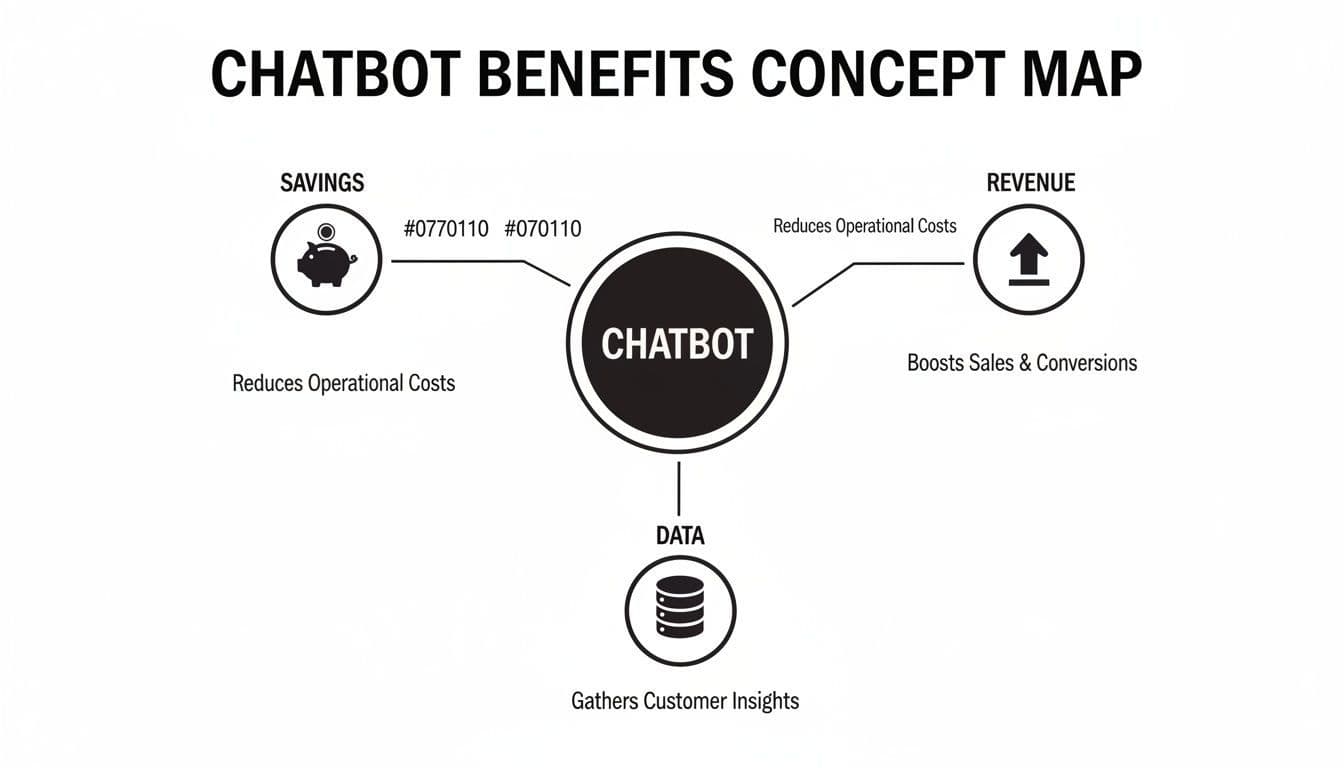
As you can see, a well-built tech stack directly translates into tangible benefits like cost savings, revenue growth, and priceless data insights.
Choosing the right architecture
Not all chatbots are created equal. The right architecture for you depends on what you're trying to achieve. A chatbot development partner will guide you, but it’s smart to know the main options.
A simple rule-based or decision-tree model is perfect for straightforward tasks like answering common FAQs. It’s fast to build and easy on the budget, but it isn't flexible. At the other end, a fully AI-driven chatbot powered by machine learning and LLMs can handle complex, open-ended conversations, adapting its responses on the fly.
Here's a quick breakdown of how these architectures compare.
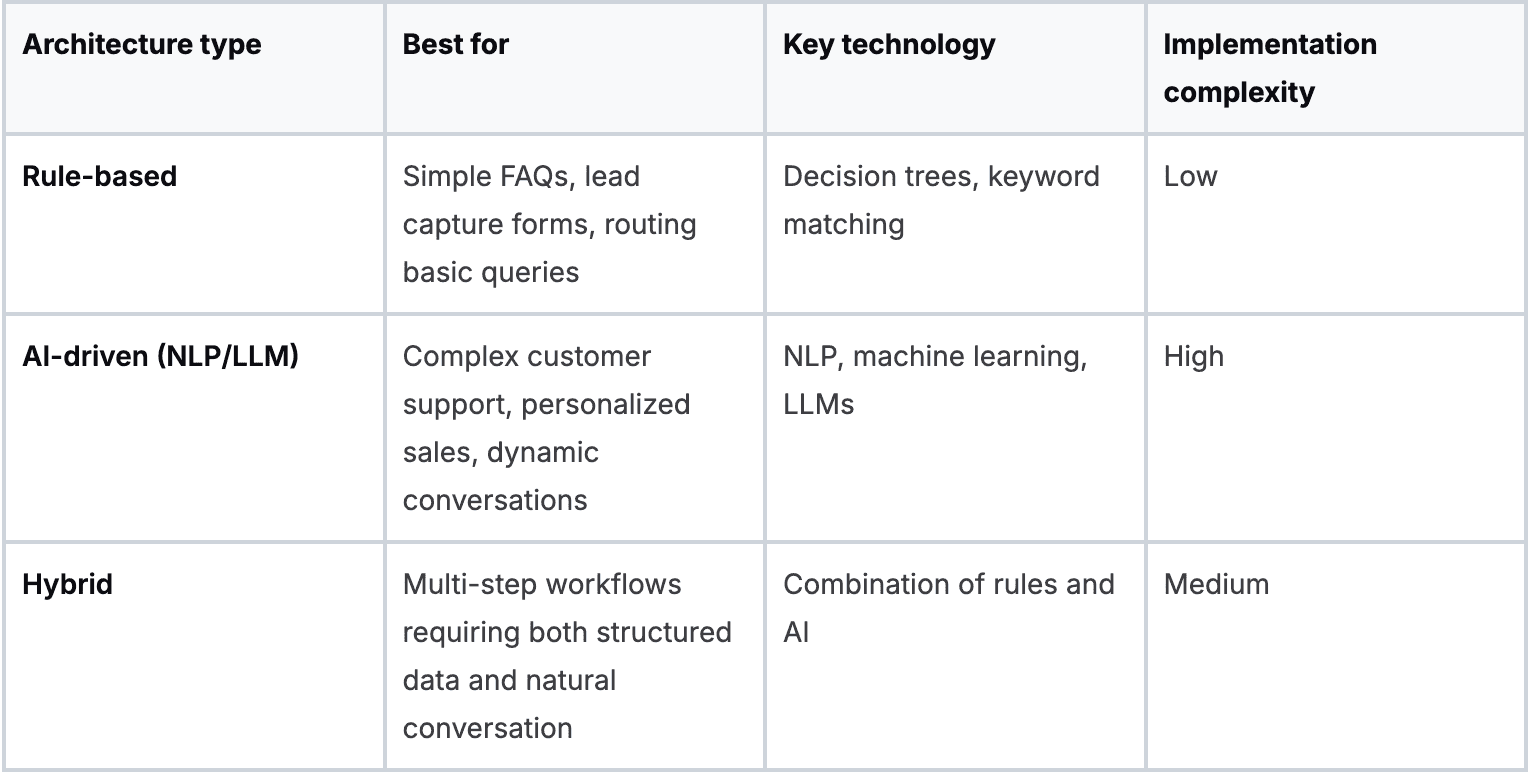
Comparing chatbot architectures
Often, a hybrid model gives you the best of both worlds. It uses rules for predictable parts of a conversation (like asking for an email address) and then switches to AI for more nuanced interactions. This approach gives you a balance of control, cost, and user experience.
The power of integration
A chatbot's magic is unlocked when it connects to your other business systems. This is where the “hands” come in. Using application programming interfaces (APIs), a chatbot can integrate directly with your:
- Customer relationship management (CRM) system to look up a customer's history or create a new lead.
- Enterprise resource planning (ERP) software to check inventory levels or an order's status.
- Payment gateways to process a transaction right inside the chat window.
Without these connections, a chatbot is just an information kiosk. With them, it can take action, solve problems, and get work done on its own. It transforms from a simple Q&A tool into a genuine workhorse for your business.
Your strategic roadmap to chatbot implementation
Taking a chatbot from idea to reality needs a clear plan. A great chatbot doesn't just happen; it's the result of a structured journey from concept to launch. This roadmap breaks that journey down into five practical phases, giving you a project playbook that works even if you don't have a technical background.
Think of this less like a rigid, waterfall process and more like an agile cycle. Each phase builds on the last, with room to learn and adapt. This approach keeps risk low and ensures the final bot solves the right business problem.
Phase 1: Discovery and strategy
This is where it all starts, and it's the most critical phase. This is where you anchor the entire project to real business goals. Rushing this step is the number one reason chatbot projects fail to deliver a meaningful return. Before anyone writes a single line of code, you have to define what "success" looks like.
Start by pinpointing its main job. Is the goal to slash customer support tickets by 30%? Qualify 50% more sales leads? Boost your Net Promoter Score (NPS) by 10 points? Setting specific, measurable Key Performance Indicators (KPIs) is essential.
This phase also involves figuring out your target audience and which systems the chatbot needs to talk to, like your CRM or knowledge base. A solid discovery process is the foundation of any good chatbot development engagement. It's also a smart time to look inward; our guide on conducting an AI readiness assessment can help you spot any gaps.
Phase 2: Design and prototyping
With a clear strategy, the next move is to map out the user experience. This means designing the conversational flows-the different paths a user might take. A good design anticipates user needs and handles mistakes gracefully, so the conversation never hits a dead end.
Here, you’ll also decide on the chatbot’s persona. Should it be professional? Friendly? Witty? The tone has to match your brand voice. Your development partner will then create visual dialogue maps and sample scripts, which act as the blueprint for the build. This prototype lets everyone see and feel the end-user experience before development begins.
Phase 3: Development and integration
This is where the blueprint turns into real software. Developers build out the core logic, set up the AI models, and-most importantly-plug the chatbot into your existing tech stack. This integration is what elevates a simple Q&A bot into a powerhouse automation tool.
Key activities in this phase include:
- Backend coding: Writing the business logic that drives the bot's actions.
- API connections: Securely linking the chatbot to systems like Salesforce, Shopify, or Zendesk.
- UI development: Building the front-end chat widget that users will see on your website or app.
This phase is gaining momentum globally. According to Grand View Research, the Asia-Pacific region is expected to see the highest growth in chatbot adoption, with a projected CAGR of 25.4% through 2030. You can read the full research about the chatbot market to grasp the scale of this trend.
Phase 4: Training and testing
An AI chatbot is only as smart as the data it’s trained on. In this phase, the AI model is fed your company's unique information-FAQs, product manuals, and old customer support chats. This is how the bot learns to give answers that are not just accurate, but also relevant.
Once the initial training is done, the real testing begins. This is about more than just finding bugs; it’s about quality assurance for the conversation itself. Testers will intentionally try to "break" the bot. They'll ask weird questions, use slang, and go off-topic. This process, known as User Acceptance Testing (UAT), is crucial for making sure the bot can handle real-world chaos.
Phase 5: Deployment and monitoring
After the chatbot passes all its tests, it’s ready for prime time. Deployment should be strategic. A common approach is to start with a small pilot group of users or launch it on a specific webpage. This lets you monitor its performance in a controlled environment.
But launching the bot isn’t the finish line. A chatbot is a living system that needs constant attention. You’ll keep a close eye on the KPIs you set in Phase 1, comb through conversation logs to find weak spots, and use that intel to retrain the AI model. This loop of monitoring, learning, and refining ensures your chatbot delivers more value over time.
How to choose the right development partner
Picking a partner for your chatbot project is the single most important decision you'll make. Get it right, and you fast-track your path to ROI. Get it wrong, and you're left with a clunky, expensive tool that frustrates your customers and your team.
This decision goes beyond a simple tech checklist. You need a partner who gets your business, not just your tech stack. What separates a successful project from an expensive failure is their ability to translate your business goals into a functional chatbot.
Evaluating technical expertise and industry relevance
First, you have to vet their technical chops. Any partner worth considering must have proven, hands-on experience with the AI technologies that matter for your project. This means a solid grasp of NLP, LLMs, and-most importantly-the messy reality of complex system integrations.
Their portfolio should be full of examples where they've connected a chatbot to existing business tools. Can they hook it into your CRM like Salesforce? Your e-commerce platform like Shopify? Your own custom-built internal software? If they can't, your chatbot will just be an isolated gimmick.
Just as critical is their experience in your industry. Have they walked in your shoes before? A partner who has already built bots for other SaaS companies will instantly understand the nuances of user onboarding or subscription management. That domain knowledge slashes the learning curve and gets you to a better solution, faster.
As you start your search, take a look at what specialized providers offer to get a feel for the market. For instance, browsing illumichat's main services can give you a solid baseline to help frame your own requirements.
Questions every founder should ask a potential partner
You need to cut through slick sales pitches with direct, evidence-based questions. Don't let them get away with vague promises. Demand proof.
Here’s a checklist to guide your conversations:
- Show me a case study with real ROI. What were the numbers? Don't settle for anecdotes. Ask: How much did you cut support ticket volume? By what percentage did you lift lead conversion rates?
- How do you handle data security and industry compliance? This is a deal-breaker if you handle sensitive customer data. Get specific about their protocols for GDPR, HIPAA, or whatever regulations apply to your business.
- Walk me through your project management and communication process. You're looking for a partner with a transparent, agile process. How often will you communicate? What are the key milestones? How do you handle scope changes?
- What's your plan for post-launch support and optimization? A chatbot isn't a "set it and forget it" project. A great partner will have a clear strategy for monitoring performance and continuously training the AI to make it smarter over time.
- What are the most common AI implementation challenges you've seen? This question tests their experience and honesty. A seasoned partner will openly talk about past hurdles and how they got over them-a topic we cover in our guide to overcoming AI implementation challenges.
Finding the right partner for your chatbot development services is a balancing act between technical skill, business savvy, and cultural fit. Use this checklist to structure your vetting process and find a firm that will be a strategic ally, not just a vendor.
Measuring success and proving chatbot ROI
A chatbot is a business investment. And like any investment, it needs to deliver a clear return. To justify spending on chatbot development services, you have to look past flimsy metrics like "total conversations" and zero in on real business outcomes.
The trick is to connect your chatbot's performance to the KPIs your leadership team already cares about. Success isn't about how busy your bot is-it's about how much value it drives. That means measuring its impact across three core areas: slashing operational costs, boosting revenue, and making customers happier.
Focusing on cost reduction metrics
One of the first places you'll see a chatbot pay for itself is in operational efficiency. The goal is to automate repetitive tasks that bog down your team, freeing up your human agents for high-value conversations.
The cost savings are direct and easy to calculate. Start by tracking these two metrics:
- Support ticket deflection rate: What percentage of customer questions does the bot handle from start to finish? A 25% deflection rate is a solid benchmark, meaning one out of every four tickets is handled automatically.
- Cost-per-interaction: Figure out the cost for a human to handle one interaction (salary, tools, and time). Now, compare that to the cost of a bot interaction. The difference is your direct savings on every query the bot resolves.
Here's a quick calculation: if your chatbot fields 2,000 queries a month that would otherwise cost your team $5 each, you're looking at $10,000 in savings. Every month. For more ideas, check out our guide on achieving AI cost reduction.
Tracking revenue growth and lead generation
A smart chatbot is more than a support tool; it's a sales and marketing machine that never sleeps. It can engage visitors, qualify leads, book demos, and guide users toward a purchase.
To prove it, you need to monitor:
- Lead conversion rate: Of all the conversations your bot has, how many end with a qualified lead? This could be an email capture, a demo request, or a scheduled call. A 5% conversion rate from bot interactions is a strong place to start.
- Sales influenced by the bot: For e-commerce, this is huge. Use tracking to attribute sales that were directly assisted by the chatbot, whether through product recommendations or checkout support.
The influence of chatbot development services is exploding. According to Statista, the global chatbot market is projected to reach nearly $4 billion by 2027. Discover more insights about these chatbot statistics.
Gauging customer satisfaction and experience
Finally, your chatbot must make the customer's life easier. Instant answers and fast resolutions are what build loyalty.
Keep a close eye on these experience metrics:
- Customer satisfaction (CSAT) score: At the end of a chat, ask a simple question: "Did I solve your problem?" This gives you a direct pulse on how helpful people find your bot.
- First-contact resolution (FCR): What percentage of issues are solved in a single interaction? A high FCR means your bot is effective and customers aren't getting stuck in frustrating loops.
- Average resolution time: How long does it take the bot to solve a problem compared to a human agent? Shaving minutes off this time adds up to a much smoother experience.
The one thing to do next
You now have a solid playbook for using chatbot development services to get measurable results. Success isn't about launching a bot and hoping for the best. It’s about having a clear strategy, picking the right tech, and finding a partner who gets what you're trying to achieve. The goal is to solve specific business problems and track the outcomes that matter. Do that, and you'll change your customer experience, make your teams more efficient, and see a real impact on your bottom line.
Here’s the best way to get started: find one high-impact, low-complexity use case inside your business. Don't try to boil the ocean. Pick a nagging, repetitive pain point-like answering the same ten support questions over and over-and start there. This focused approach gets you a quick win, helps you collect real-world data, and keeps the initial risk low. A successful pilot project becomes your internal case study for why this technology is worth investing in.
Ready to find that first quick win? We at N² labs can help you build a chatbot strategy that drives real business results.
FAQ
It depends on complexity. A simple, rule-based FAQ bot might run $5,000 to $15,000. An AI-powered bot using NLP that integrates with your CRM is typically in the $20,000 to $50,000 range. For a true enterprise-grade, generative AI chatbot with deep integrations and custom training, the investment can easily top $100,000. Key cost drivers are the tech stack, number of integrations, and conversational intelligence required.
The timeline is tied to scope. A simple proof-of-concept or FAQ bot can be up and running in 4-8 weeks. A more standard business chatbot with a few system integrations and advanced conversational flows usually takes 3-6 months from kickoff to launch. Complex enterprise projects with custom AI models and heavy security requirements should be planned for 6-12 months or more.
A business chatbot is built for a specific job, like processing e-commerce returns or qualifying sales leads. Its purpose is narrow and tied directly to your company's goals. A virtual assistant, like Siri or Alexa, is a generalist designed to handle a wide range of consumer tasks. For your company, you are almost certainly looking for chatbot development services to build a specialized business chatbot, even if it uses similar AI technology.
A great chatbot is trained, not just built. The process starts with a deep-dive discovery to understand your goals, customer profiles, brand voice, and internal workflows. Then, the AI model is trained on your proprietary data, such as past customer support transcripts, internal knowledge base articles, and product manuals. This ensures the chatbot learns to speak your language and provide answers that are accurate, on-brand, and genuinely helpful.