Written by: Igor
Published: December 2025
Feeling like you're drowning in data but starving for insights? You have numbers flowing in from your CRM, product analytics, and marketing platforms, but turning that raw data into clear, profitable decisions is a huge challenge. This is the exact problem big data consulting is built to solve. This guide explains what it is, what to expect, and how to hire a partner who delivers real ROI.
Key takeaways
- Strategy first, tech second: The best consulting starts with business goals, not a list of tools. A clear plan tied to KPIs like churn reduction or LTV growth is non-negotiable.
- Data maturity matters: Honestly assess where you are-from data-aware to data-driven-to find the right partner and solve the right problems.
- Focus on business outcomes: Judge a potential partner on their industry experience and ability to connect technical work to measurable ROI, not just their technical skills.
- Budget for impact: Expect project costs from $50k to $150k+ for foundational work. Tie every dollar to a specific business case.
- The biggest risks are not technical: A vague business objective, poor data quality, and low user adoption are the most common reasons data projects fail.
What is big data consulting, really?
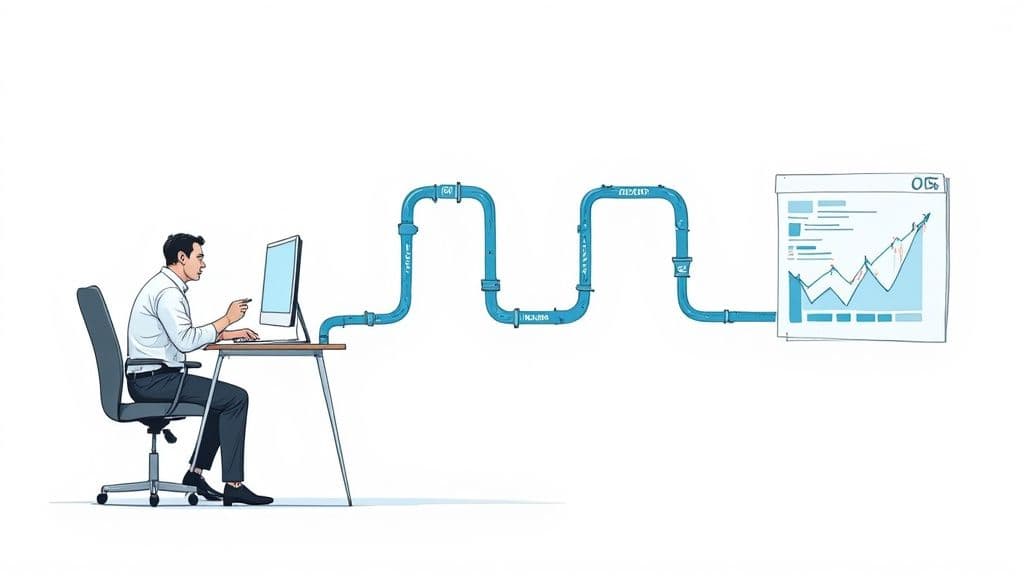
Big data consulting provides strategic guidance and technical execution to help businesses collect, manage, analyze, and profit from their massive datasets. It isn't about just buying new software. It's about building a complete system that turns the information you already have into a measurable competitive edge.
A good consultant acts as a strategic partner. They don't just recommend tools. They work with you to build a roadmap that transforms your disconnected data streams into a single, powerful strategic asset. The goal is always tied to tangible business outcomes, not just technical milestones.
Moving from collecting data to using it
Having data isn't enough. The real value is unlocked when you use it to answer critical business questions and drive growth. That's why effective consulting focuses on creating a system-a well-oiled data pipeline-that reliably delivers insights to the right people at the right time.
This usually involves a few key steps:
- Define clear business goals: What do you want to achieve? Maybe it's reducing customer churn by 15% or boosting marketing ROI. It has to be a real business target.
- Design the right architecture: This is about building a scalable and secure foundation to store and process your data, whether that’s a modern data warehouse or a flexible data lake.
- Clean and organize the data: You have to implement processes to make sure your data is accurate, consistent, and trustworthy. This is often the most critical-and time-consuming-step. Garbage in, garbage out.
- Deliver actionable insights: Finally, it's about creating the dashboards, reports, and predictive models that your teams can use to make smarter decisions.
The market for this expertise is growing for a reason. As of 2024, the big data consulting market size was estimated at USD 6.38 billion. Projections show it nearly doubling to USD 13.97 billion by 2030, according to Fortune Business Insights. You can read the full research on the big data consulting market to see the industry trends. This growth points to a clear need: companies need expert help to get a real return on their data investments.
Ultimately, a good consultant bridges the gap between your technical capabilities and your strategic ambitions. They bring the framework, expertise, and execution power to make your data finally start working for you.
A look inside big data consulting services
When you hire a big data consultant, you should expect a clear menu of services that directly tackle your business problems. Think of it like building a custom home. You start with a blueprint, lay the foundation, build the structure, and finally, add the smart systems that make it a functional home. Big data consulting follows a similar, logical path.
Data strategy and architecture design
Everything starts with a plan. A consultant's first job is to understand your goals and translate them into a technical roadmap. This isn't about chasing tech fads. It's about tying every decision to a business outcome, like boosting customer lifetime value by 10% or cutting supply chain costs.
This strategy phase typically covers:
- Goal definition: Pinpointing the exact business problems you want data to solve. Is it customer churn? Inefficient operations? Missed sales opportunities?
- KPI identification: Defining the key performance indicators (KPIs) that will tell you if you're winning.
- Technology stack selection: Choosing the right tools-from databases to cloud platforms-that fit your budget, scale, and existing infrastructure.
This initial blueprint is the most critical part of the engagement. A report from Deloitte found that companies with a clear data strategy are far more likely to see a real return on their investment. Without one, you risk building expensive systems that solve the wrong problems.
Data engineering and ETL pipelines
Once the strategy is set, the construction begins. This is the world of data engineering-the essential ‘plumbing’ that ensures clean, reliable data flows through your organization. It's the unglamorous work that makes everything else possible.
The core of this service is building ETL (extract, transform, load) pipelines. It’s a three-step process:
- Extract: Pulling raw data from all your different sources-your CRM, marketing platforms, product databases.
- Transform: Cleaning, structuring, and standardizing that messy data to make it consistent and trustworthy. This is where chaos becomes order.
- Load: Moving the now-pristine data into a central repository, like a data warehouse, where it’s ready for analysis.
This step is non-negotiable. Poor data quality is the silent killer of data projects. A good consultant ensures this foundation is rock-solid, so your team isn't making critical decisions based on faulty information.
Advanced analytics and business intelligence
With a clean data pipeline in place, your consultant can start delivering insights. This is where raw numbers are turned into actionable intelligence that your business teams can use every day.
This service usually involves creating:
- Interactive dashboards: Visual tools, often built in platforms like Tableau or Power BI, that let non-technical users explore data, track KPIs in real-time, and spot trends without asking an analyst.
- Business intelligence (BI) reports: Automated reports that answer recurring business questions, like weekly sales performance or monthly customer acquisition costs.
The goal here is simple: empower your people. Instead of waiting days for a custom report, your marketing manager can instantly see which campaigns are driving the most revenue. Your operations leader can identify production bottlenecks before they bring everything to a halt.
AI and machine learning integration
This is where you bring in artificial intelligence (AI) and machine learning (ML) to make your data do more than just explain what happened. Now, it can start predicting what will happen next.
A big data expert can help you build and deploy models for things like:
- Predictive analytics: Forecasting future outcomes, such as which customers are most likely to churn or how much product demand to expect next quarter.
- Process automation: Using ML to automate repetitive, manual tasks, like categorizing thousands of customer support tickets.
- Personalization: Creating custom user experiences, like product recommendation engines.
This service also includes MLOps (machine learning operations). Think of it as DevOps for machine learning-a set of practices for deploying, monitoring, and maintaining ML models in a live production environment. MLOps ensures your models stay accurate and effective over time. If you're wondering where to start, our in-depth guide to AI readiness assessment can help.
How to assess your data maturity level
Before you interview big data consulting firms, you need to take an honest look at where your company stands with its data. Figuring out your current capabilities is the only way to build a realistic roadmap.
This self-assessment helps you pinpoint your biggest gaps and sets you up for a smarter conversation with potential partners.
Without that clarity, you're flying blind. You might pay for a solution that's too complex or hire a partner who solves the wrong problem. The goal is to get from just having data to actually using it to make critical business decisions.
That leap is why the global big data consulting market is set to explode, growing to an estimated USD 33.36 billion by 2034 from USD 9.74 billion in 2024, according to Market.us. You can read more about the big data consulting market trends to see how the landscape is shifting.
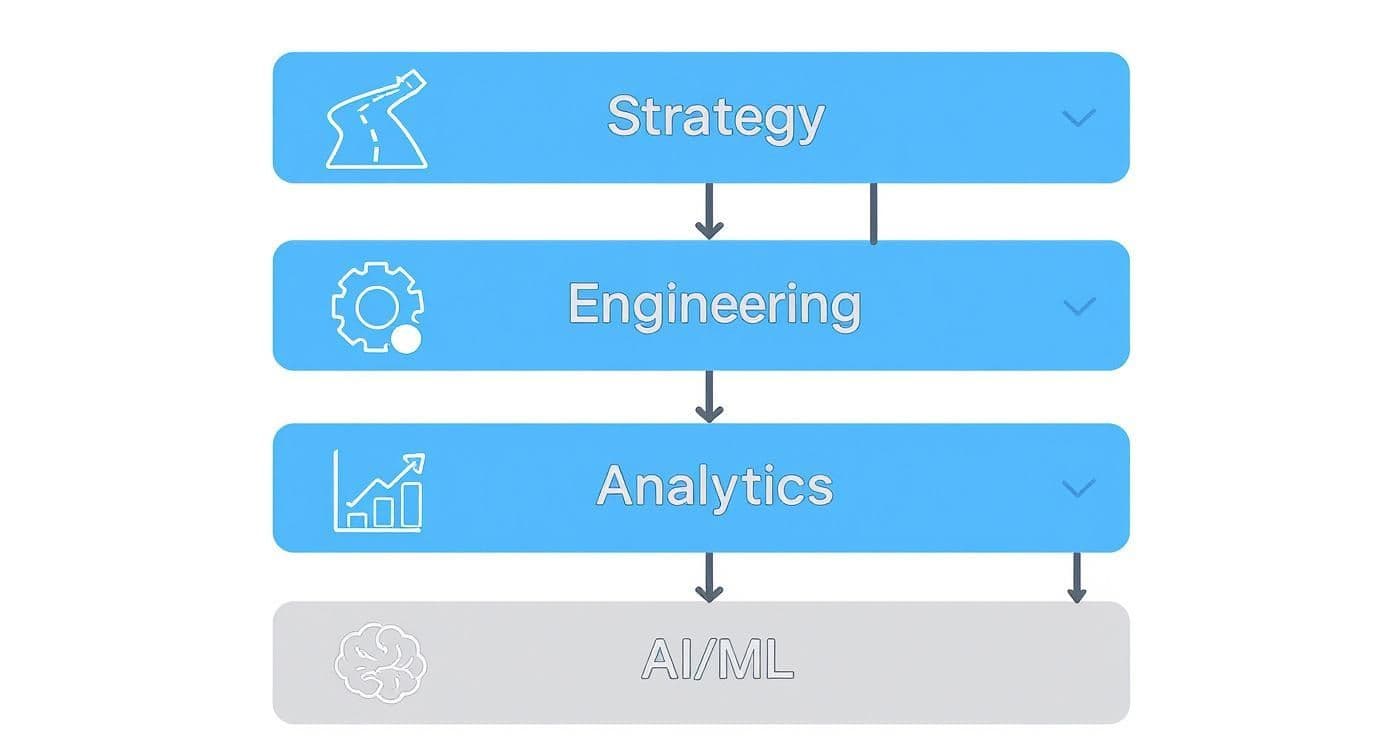
As you can see, you can't just skip to the good stuff. A rock-solid engineering foundation is non-negotiable before you can get real value from analytics or AI.
The stages of data maturity
Most companies land in one of four stages. A full AI readiness assessment will give you a deeper dive, but this quick overview is a great place to start.
Stage 1: data-aware
At this stage, your company is collecting data, but it's all over the place. It's trapped in silos like Google Analytics, your CRM, and disconnected spreadsheets. Reporting is a painful, manual process, usually done reactively.
- Key characteristic: Basic, backward-looking reports.
- Common pain point: It takes forever to get answers to simple questions, and different departments report conflicting numbers for the same metric.
Stage 2: data-proficient
You've made some progress. Your organization has started to centralize its data, maybe in a basic data warehouse. You've got a few automated dashboards tracking your main KPIs.
- Key characteristic: Centralized data and automated KPI dashboards.
- Common pain point: Your business teams are still completely reliant on the data team for any new report or analysis, creating a massive bottleneck.
Stage 3: data-savvy
Now we're talking. Data is a trusted, reliable asset across the company. You've established a "single source of truth" for all your key business metrics. The game-changer here is that business teams are empowered with self-service analytics tools.
- Key characteristic: Self-service analytics and a trusted single source of truth.
- Common pain point: You're great at analyzing what already happened, but you're still guessing when it comes to what's next.
Stage 4: data-driven
This is the top of the mountain. Here, data is woven into your products and strategy. Your organization is using predictive models and machine learning to forecast demand, spot at-risk customers, and automate critical processes.
- Key characteristic: Widespread use of predictive analytics and ML.
- Common pain point: Your new challenge is maintaining, monitoring, and scaling all these AI models in a live production environment (a field known as MLOps).
By figuring out which stage best describes your company, you can go into conversations with a big data consulting partner knowing exactly where you need help.
Choosing the right big data consulting partner
Not all consultants are created equal. Finding the right partner is the single most important decision you'll make in your data journey.
Get it wrong, and you're looking at blown budgets, missed deadlines, and a tangled system nobody knows how to use. The right partner becomes an extension of your team, shortening your path to measurable results. The goal is to find someone laser-focused on business outcomes, not just on selling you billable hours.
Evaluating technical expertise
First, any potential partner has to have deep technical chops that line up with your specific environment. They need to be experts in the technologies that matter to you.
Ask them direct questions about their experience with your current or planned tech stack. If you’re an AWS shop, a consultant who spends all their time in Google Cloud might not be the best fit. A good partner should be able to jump into your existing infrastructure and immediately add value.
They should also have a pragmatic approach. The best partners recommend what’s right for your use case, budget, and team skillset-not just what’s trendy.
Assessing industry and domain experience
Technical skill is a commodity. What’s rare is a partner who pairs that skill with a deep understanding of your industry. Have they solved problems like yours for a company of your size and in your vertical?
A consultant who gets the nuances of e-commerce churn models will be effective on day one. A generalist will spend your money getting up to speed.
Ask for specific case studies.
- Ask for proof: "Can you share a case study with measurable ROI for a company our size in the SaaS space?"
- Probe for details: "What were the biggest unexpected challenges in that project, and how did you navigate them?"
Their answers will quickly reveal if they have real, hands-on experience. Understanding the common AI implementation challenges in your field is a massive advantage.
Understanding engagement models and culture
Finally, you need to understand how they work. Does their process and culture mesh with yours? A mismatch here can create friction.
Some firms prefer fixed-scope projects. This works well for well-defined tasks, like migrating a database. Others offer a more agile, embedded team model. This is often better for complex, exploratory projects like developing a new AI feature.
One of the most telling questions you can ask revolves around what happens after the project is "done."
Crucial questions to ask a potential partner:
- What’s your process for knowledge transfer? We need to own and operate this system ourselves.
- How do you handle scope changes or unexpected roadblocks?
- How will you measure the success of this project, and what specific business metrics will we track?
- Can we speak with one or two of your past clients who had a similar project?
A great big data consulting partner isn't just a vendor; they are a catalyst. They build the systems, transfer the knowledge, and empower your team to become more data-driven long after their contract ends.
Getting a grip on project costs and timelines
How much will this cost, and how long will it take? A good consulting partner breaks the engagement into logical phases with clear costs, timelines, and deliverables from the start.
This structured approach keeps everyone aligned and makes sure the project delivers value instead of spiraling out of control.
A typical project lifecycle
While every project is unique, most follow a predictable path. This phased approach allows for quick wins and ensures the final solution is tuned to your business needs.
- Phase 1: discovery and roadmap (2-4 weeks): A short, intense sprint where the consulting team dives deep into your business, audits your tech stack, and zeros in on the core problem. The main output is a strategic roadmap.
- Phase 2: implementation (3-6 months): This is the build-out phase. Working in agile sprints, the team constructs the data pipelines, sets up the data warehouse, and builds the first analytics dashboards.
- Phase 3: handover and support (ongoing): The job isn't done when the tech is built. A critical final step is knowledge transfer, where consultants train your internal team to own and operate the new system.
Setting a realistic budget
Costs for big data consulting can vary wildly. The demand for these skills is high; one report from Allied Market Research suggests the market could hit $150 billion by 2025. You can discover more insights about the market's rapid growth.
Here are a couple of common ways projects are priced:
- Project-based fees: This is the go-to for well-defined projects. Building a foundational data warehouse or a customer analytics platform might run anywhere from $50,000 to $150,000, depending on complexity.
- Hourly retainers: For more open-ended or strategic advisory work, retainers are common. Rates can range from $150 to $350 per hour per consultant.
The most important thing is to tie every dollar of your budget to a specific, measurable business outcome. A good consultant won't just give you a price; they'll help you build a business case that justifies the investment.
Measuring success with the right KPIs
How do you know if your investment is paying off? The only way is to define clear key performance indicators (KPIs) before a single line of code gets written. Fluffy goals like "become more data-driven" are useless. You need concrete targets.
Here are a few examples of strong, outcome-focused KPIs:
- Reduce customer churn by 15% within six months by building a predictive churn model.
- Increase marketing ROI by 25% by Q4 by optimizing ad spend with a new attribution model.
- Cut operational costs by 10% in the next fiscal year by spotting supply chain inefficiencies.
By establishing these metrics upfront, you create a shared definition of success. It holds your consulting partner accountable for delivering real business value.
Your next step to becoming data-driven
Big data consulting isn't just another tech project. It’s a strategic investment in a durable competitive advantage. The goal is to build an internal capability that turns disorganized data into a source of predictable growth.
Your most important next step? Conduct an honest data maturity assessment.
This single action is the fastest way to get clarity. It shifts the conversation from vague goals to a concrete understanding of your specific needs. By knowing exactly where you stand, you can confidently decide where you need to go next.
We at N² labs can help you translate a data maturity assessment into a practical, ROI-focused roadmap. If you're exploring how to make the leap from data to decisions, our guide on how to implement AI in business offers a clear framework for getting started.
FAQ
A big data consultant helps businesses design strategies and build the technical systems to collect, manage, and analyze large datasets. They are architects who build the data infrastructure (like data warehouses and pipelines) that enables teams to extract valuable insights and make better decisions. Their work is foundational to becoming a data-driven company.
Costs vary based on scope. A short, strategic roadmap project might cost $15,000 - $30,000. A more involved project, like building a foundational data warehouse, typically runs from $50,000 to $150,000+. For ongoing advisory services, hourly rates often range from $150 to $350 per consultant. Always tie the budget to a clear business case and expected ROI.
A data analyst works inside an existing data system to answer specific business questions. They query databases, build reports, and find insights using the tools available. A big data consultant is the architect who designs and builds that system. Consultants build the highway; analysts drive the cars on it.
No. While large enterprises were early adopters, many modern consulting firms specialize in helping startups and mid-market companies. The key is to scope the project correctly-focusing on a single, high-impact area like building a customer data platform or a specific predictive model-to deliver a fast return on investment without an enterprise-level budget.
The biggest risks are rarely technical. They are strategic and people-related. The three most common project killers are: 1) no clear business objective tied to ROI, 2) poor data quality ("garbage in, garbage out"), and 3) low user adoption of the new tools and dashboards. A good consultant helps you identify and manage these risks from day one.