Written by: Igor
Published: December 2025
Your procurement team is under constant pressure to cut costs, mitigate supply chain risks, and do more with less. Sticking with manual methods means you're almost certainly overpaying, missing savings, and getting blindsided by disruptions. This is where integrating artificial intelligence and procurement becomes a core strategy, not just a nice-to-have. It flips the switch from reactive firefighting to proactive, data-driven decision-making.
This guide will show you how to apply AI to your procurement workflow for maximum impact. You'll learn where to start, how to build a business case, and the steps to implement a solution that delivers real ROI.
In this guide
- Why AI is now a must-have for modern procurement teams.
- The highest-impact areas to apply AI in your workflow first.
- How to build a business case that gets executive buy-in.
- A practical, phased roadmap for a successful AI implementation.

Why AI is no longer optional for procurement
In today's volatile market, traditional procurement practices are a liability. Manual data entry, spreadsheet analysis, and periodic supplier reviews are too slow to keep up with rapid market shifts and complex global supply chains. This reactive approach leads to value leakage-money slipping away due to inefficient processes and unforeseen disruptions.
AI changes the game by automating tedious tasks and uncovering insights buried in your data. Instead of spending weeks manually classifying spend, your team can focus on strategic negotiation and building resilient supplier relationships. This shift turns a cost center into a strategic value driver.
The shift from tactical to strategic
With AI, procurement moves beyond just processing purchase orders. It provides the tools to answer the big, strategic questions:
- Are we paying the best price based on real-time market data?
- Which suppliers pose a hidden risk to our operations?
- Where are our biggest opportunities for cost savings next quarter?
By handling the heavy analytical lifting, AI frees up your team's expertise. It’s no surprise that a recent EY survey found 80% of CPOs plan to deploy generative AI, focusing on spend analytics and contract management. This isn't just hype-it’s a clear signal that intelligence is being embedded directly into core procurement workflows.
Where to apply AI in your workflow for maximum impact
Bringing AI into procurement isn't about a massive overhaul. It's about being surgical. Target the specific areas where you can get immediate, measurable returns. Apply AI where it solves your most expensive and time-consuming problems first.
Let's break down the most impactful places to start.
Start with spend analytics
If you don't know exactly where your money is going, you can't control it. Spend analytics is the single best place to start your AI journey. It creates the visibility you need to make smarter decisions everywhere else.
The old way involved manually exporting data into spreadsheets-a slow, error-prone process. AI-powered tools automate this, plugging into your ERP and finance systems. Using machine learning, they automatically classify every dollar with high accuracy, giving you a clean, real-time view of your spending.
Example workflow:
- An AI tool sifts through 50,000 lines of spend data from your ERP.
- It instantly flags that your company uses three different vendors for office supplies across five departments, all at different prices.
- This single insight points you to an opportunity to consolidate spend with one supplier for a 15% volume discount.
Accelerate strategic sourcing
Finding, vetting, and onboarding new suppliers is critical but often slow. AI can compress this timeline from months to days. AI tools scan massive datasets to pinpoint potential suppliers that fit your specific criteria, from quality certifications to sustainability scores.
Once you have a shortlist, AI helps analyze their proposals, comparing terms and scoring their responses. This frees your team to handle final negotiations and build strong partner relationships.
De-risk contract lifecycle management
Contracts are the lifeblood of procurement, but they're also a source of risk and manual work. AI for contract lifecycle management (CLM) turns static legal documents into active, intelligent assets.
An AI-powered CLM platform can automatically:
- Extract key terms: It pulls out critical data like renewal dates and payment terms.
- Flag non-standard clauses: The system compares new contracts against your templates and flags risky language.
- Monitor obligations: It sends automated alerts for upcoming renewals or compliance deadlines.
This means you’ll never get caught off guard by an auto-renewal for a service you don’t need anymore.
Enable predictive supplier risk management
Traditional supplier risk management is reactive. Predictive analytics flips this, letting you anticipate and mitigate risks before they hit your business. According to Gartner, this proactive approach can reduce supply chain disruptions by up to 20%.
AI enables real-time supplier risk monitoring by analyzing billions of data points, combining performance data, market trends, and geopolitical factors. You can learn more about how AI is transforming procurement with these insights. This gives you the breathing room you need to activate a backup plan before a problem occurs.
Building a compelling business case for procurement AI
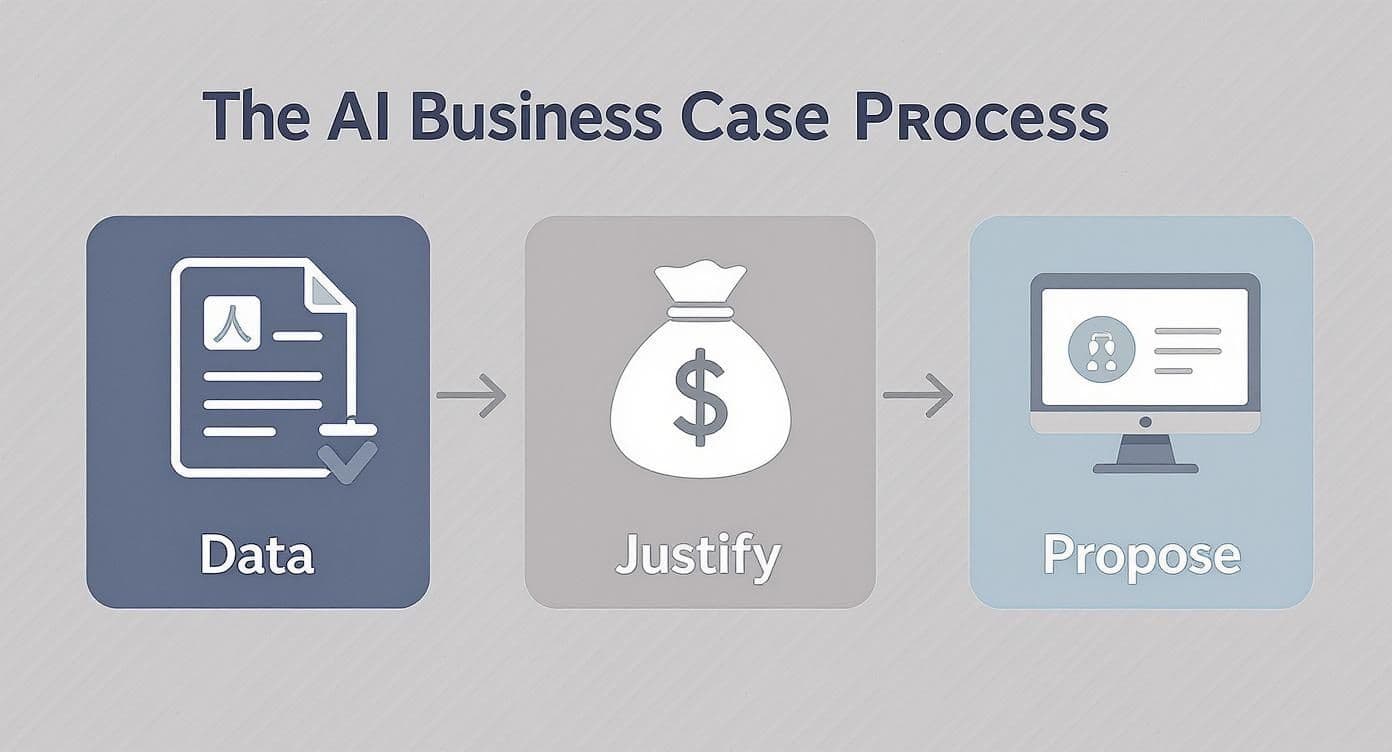
Getting a budget for new tech requires proving a clear, data-backed return on investment. A good business case for procurement AI draws a straight line from the technology to the bottom line. You have to prove this isn't another cost center but a strategic investment that generates real financial wins.
The argument centers on the shift from transactional purchasing to strategic value creation. A McKinsey report found that companies now manage 50% more spend per procurement employee than they did five years ago. AI is the only realistic way to absorb that workload without hiring an army of new people.
Quantifying the return on investment
To get leadership on board, you have to speak their language: numbers. Focus on the three core financial levers AI can pull: cost reduction, efficiency gains, and risk mitigation.
- Cost reduction: "AI can consolidate our tail spend, targeting a 5% to 8% reduction in indirect procurement costs within the first year."
- Efficiency gains: "Automating invoice reconciliation with AI will save 400 hours per quarter, freeing our team for high-value negotiations."
- Risk mitigation: "Proactive AI-powered risk monitoring can help us avoid stockouts, which cost us an estimated $500,000 in lost revenue last year."
Focusing on strategic value
Beyond hard savings, articulate the strategic value AI brings. This elevates the conversation from saving money to making the business more competitive. Modern AI systems promise to boost procurement efficiency by 25% to 40% (McKinsey). This enables your team to operate on a completely different level. Our guide on how to implement AI in business offers a deeper look at building this capability.
Your business case needs to tell a simple story. Start with current pain points, quantify the financial damage, and present AI as the data-driven solution. Show that the cost of doing nothing is far greater than the cost of investment.
Your practical roadmap for implementing procurement AI
Moving from concept to reality isn't about taking a giant leap. A smart roadmap focuses on delivering value quickly, building a solid foundation, and scaling intelligently. This de-risks your AI journey and ensures each step builds on the last.
Before you start, assess where you stand. Is your data a mess? Does your team have the right skills? You can get a deeper understanding by completing an AI readiness assessment for your business.
Phase 1: start with quick wins
The goal is to prove AI's value fast with minimal risk. Pick one specific, high-impact problem and solve it with a targeted AI pilot. Spend analysis is often the perfect place to start. It’s a universal pain point and the potential for a quick ROI is high.
Checklist for phase 1:
- Select a pilot project: Choose a use case like automated spend categorization that can deliver results within 90 days.
- Define success metrics: Set clear KPIs, like "achieve 85% spend classification accuracy" or "identify $100,000 in actionable savings."
- Deploy a targeted tool: Find a vendor that specializes in your chosen area.
- Communicate results: Package the outcomes into a clear report for leadership.
Phase 2: build the foundation
With a successful pilot, it's time to prepare for scale. This phase is about data governance, system integration, and team upskilling. Rushing this step leads to stalled projects and technical debt. You'll shift from a standalone tool to weaving AI into your core operational systems, like your Enterprise Resource Planning (ERP) software.
Phase 3: scale and optimize
Now you're ready to expand. Roll out AI capabilities across more functions, monitor performance, and establish strong guardrails to manage risk. The goal is to embed AI as a core, sustainable capability. This is where the combination of artificial intelligence and procurement delivers compounding returns. As more processes are improved, the data from each one feeds back into the system, making your insights smarter over time.
How to choose the right AI technology and partners
The AI procurement market is noisy. You need a clear framework to cut through the hype and find a solution that fits your business. Choosing the right partner is a high-stakes decision. The best procurement teams see an average 3.2 times ROI on their generative AI investments, according to a recent survey from Deloitte. You can see more insights about these procurement technology trends on Deloitte's website.
Evaluate the technology’s core capabilities
Look under the hood. A slick dashboard means nothing if the engine can’t handle your data. Grill vendors on the technical specifics:
- Data integration: How painful is it to connect to your existing systems?
- Model accuracy: What's the real-world accuracy for tasks like spend classification? Ask for a proof-of-concept with your data.
- Explainability: Can the AI explain why it made a recommendation? A "black box" is a liability.
Assess the partner and total cost of ownership
The tech is only half the battle. You’re starting a long-term relationship. The vendor's expertise and support are just as critical as any feature.
Look past the subscription price and map out the total cost of ownership (TCO). This includes implementation, training, and maintenance. A cheap tool that eats up your team's time is no bargain. This selection process is one of the most common AI implementation challenges that can derail a project.
Finally, ask about their roadmap. Where is the product headed in the next 18-24 months? A good partner is constantly innovating.
The one thing to do next
You’ve seen the potential of weaving artificial intelligence and procurement into your operations. The biggest mistake is waiting for the perfect moment. Don't fall into that trap.
The single most effective next step is to find one specific, nagging problem in your current process. Think small and recurring. Is it manually classifying spend data? Chasing supplier compliance documents? Start there.
Focus all your energy on solving that single, high-value problem with a targeted AI pilot. This minimizes risk, proves value quickly, and builds the momentum you need for bigger projects. A successful pilot is the concrete data you need to build a rock-solid business case for more investment.
We at N² labs can help you pinpoint the highest-impact use case for your business. From there, we’ll build a pilot project that delivers real, measurable results in weeks, not years.
FAQ
Start small with a high-pain pilot project to score a quick, measurable win. For most companies, spend analysis is the perfect place to begin. It's a universal headache where an AI tool can prove its value in less than 90 days by identifying cost-saving opportunities, building the momentum you need for bigger projects.
AI transforms supplier risk management from a reactive, annual review to a proactive, always-on monitoring system. It constantly scans thousands of global data sources-financial filings, shipping data, geopolitical news-to spot early warning signs of trouble. This allows you to mitigate disruptions before they impact your supply chain.
No. While building custom AI models requires data scientists, most modern artificial intelligence and procurement software is designed for business users. These platforms are low-code or no-code with intuitive dashboards. The vendor handles the complex model training, freeing your team to use their expertise to interpret AI insights and make strategic decisions. You can see how some larger organizations are thinking about this in a recent discussion on the impact of AI on outsourcing.
The two biggest risks are poor data quality and model bias. An AI model is only as smart as the data it learns from; "garbage in, garbage out" is the absolute rule. Second, AI can accidentally amplify hidden biases from historical data. Mitigating these risks requires solid data governance and choosing vendors who are transparent about how they train and test their models for fairness and accuracy.