Written by: Igor
Published: November 2025
Jumping into AI without a plan is like navigating a maze blindfolded. A solid AI implementation roadmap isn't about complex jargon; it’s about figuring out if you're ready, finding a high-impact problem to solve, and creating a simple one-page plan to get it done. This guide will walk you through building that plan, turning AI from an expensive experiment into a core driver of your business.
Why your AI pilot program is stuck
Getting an AI project from an exciting pilot to a fully-integrated business function is where most initiatives die. You’re not alone. While 78% of organizations report using AI, a report from McKinsey shows only a fraction manage to scale those projects and see a real return. The problem isn’t the tech-it’s the absence of a clear plan.
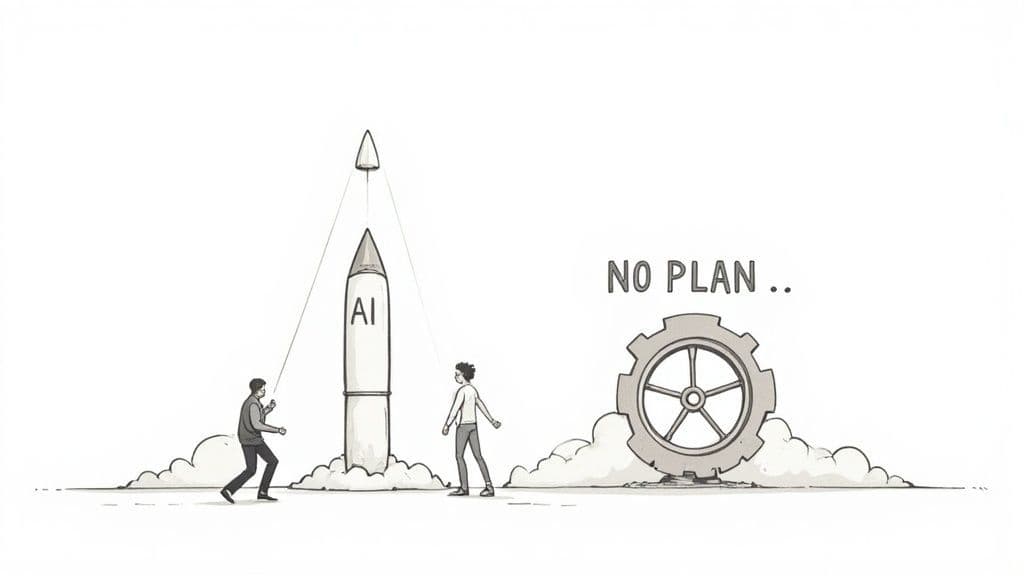
This guide lays out a practical AI implementation roadmap to bridge that gap. We'll walk through the steps for checking your readiness, zeroing in on projects that matter, and building a plan that ensures your AI investments lead to tangible growth. It’s all about turning potential into performance.
The gap between AI adoption and real impact
The hype around AI has created a disconnect between having AI and getting business value from it. This gap is a defining headache for founders and operators.
While most companies are dabbling in AI, very few are generating significant returns. According to McKinsey, while nearly nine out of ten companies use AI, only about a third have scaled beyond the pilot phase. Even more telling? A mere 6% of organizations are considered "high performers" who are truly winning with AI.
These numbers tell a crucial story: just buying AI tools isn't a strategy. Without a structured roadmap, projects get trapped in "pilot purgatory," never delivering on their initial promise.
Common reasons AI initiatives fail to scale
What’s behind this failure to launch? It usually comes down to a few common mistakes made long before a single line of code is written. The issues are rarely technical; they’re almost always about a lack of strategic planning.
Here are the usual suspects:
- Starting with tech, not a business problem: Too many teams pick a shiny new AI model and then hunt for a problem it can solve. This creates solutions that are technically cool but commercially useless.
- Underestimating data readiness: A powerful model is worthless without clean, accessible, and relevant data. Teams often jump into development without a proper data audit, leading to massive delays.
- Lacking clear success metrics: If you don't define what success looks like from day one (e.g., "reduce support ticket response time by 30%"), you can't measure ROI.
- No executive buy-in: AI isn't an IT-only project. It needs a tight partnership between tech, business units, and leadership. Without alignment, projects get stuck in silos.
These are just a few of the most common AI implementation challenges that can kill a project. Tackling them head-on requires a deliberate plan. This guide will give you the framework to build exactly that.
Assessing your business readiness for AI
Jumping into AI development without knowing your starting point is a recipe for disaster. Before a single line of code is written, you need to run an honest check-up on your business.
This isn’t a hyper-technical deep dive. It's a realistic look at your operational strengths and weaknesses across three pillars: your data, your tech, and your people. Getting this right lets you spot weaknesses early and put resources where they’ll make a difference.
How mature is your data?
AI runs on data. Without high-quality, accessible data, even the smartest algorithms are useless. It's no surprise that many AI projects stall because of bad data.
Ask yourself the tough questions:
- Data quality: Is your data clean, consistent, and complete? Or is it a minefield of errors, duplicates, and missing values?
- Data accessibility: Can your tech teams get to the data they need? Or is it locked away in disconnected silos?
- Data governance: Do you have clear rules for who owns the data, who can use it, and how it’s protected?
Evaluating your technical infrastructure
Your current tech stack is the engine that will run your AI initiatives. It needs to be ready for the demanding computational workloads that AI brings.
Be honest about your capabilities. Think about your existing compute power, storage solutions, and how easily a new AI system could plug into your current software. Could your infrastructure handle a successful AI app that suddenly needs to process 10x the data? Answering this now helps you budget for upgrades and avoid performance bottlenecks.
Is your organization aligned?
Technology is only one piece of the puzzle. Your people and processes are just as important. AI projects often fail not because of a technical bug, but because of a lack of organizational buy-in.
Start by gauging a few key areas:
- Executive sponsorship: Does your leadership team get it? They need to provide the budget, resources, and strategic backing.
- Team skillset: Do you have the talent in-house? This means data scientists, machine learning engineers, and MLOps professionals. If not, plan for hiring or partnerships.
- Business process integration: How will AI fit into your existing workflows? Real success comes from deep collaboration between your tech teams and the business units using the tools.
For a more structured way to tackle this, use a comprehensive AI readiness assessment to score yourself across these pillars. This simple exercise provides a clear starting point for your entire roadmap.
How to prioritize high-impact AI use cases
Once you’re ready, the real work begins: focusing on what matters. I’ve seen too many teams get distracted by "AI for AI's sake," leading to projects that are technically fascinating but commercially dead. A successful AI implementation roadmap grounds every decision in tangible business value.
Instead of getting lost in possibilities, you need a simple framework to sift high-value gold from resource-draining distractions. This means evaluating every potential project against two criteria: its business impact and its technical feasibility.
Mapping impact vs. feasibility
A quick way to get a clear picture is with a simple 2x2 matrix. On the vertical axis, plot business impact, from low to high. This isn’t just about revenue; it’s about anything that moves the needle-slashing costs, generating leads, or improving customer retention.
On the horizontal axis is implementation feasibility, also from low to high. This is your reality check. It covers everything from data availability and quality to the project's technical complexity.
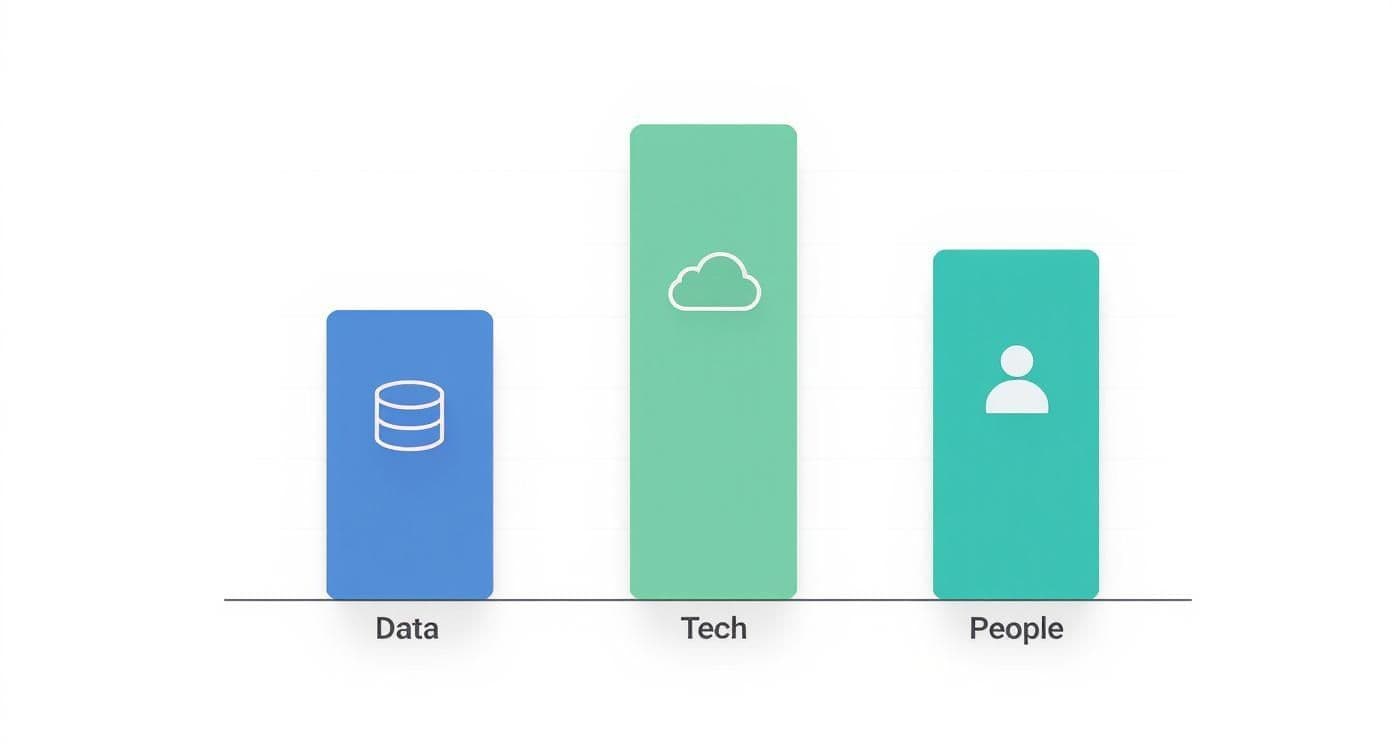
What this visual often drives home is that while the tech stack might be ready, the quality of your data and the skills of your team are the real bottlenecks. When you plot potential AI projects on this matrix, they’ll fall into four distinct categories, bringing instant clarity to your planning.
Identifying your strategic quadrants
Mapping your ideas forces you to sort them into four clear quadrants, each demanding a different strategic approach.
- Quick wins (high impact, high feasibility): These are your no-brainers. They offer significant business value and are straightforward to implement. An example is an AI tool that automates lead scoring using existing CRM data.
- Strategic bets (high impact, low feasibility): These are big, game-changing projects. Think about a fintech startup building its own proprietary fraud detection model. It’s a massive undertaking, but it creates a powerful competitive moat.
- Incremental improvements (low impact, high feasibility): These are "nice-to-haves." An internal chatbot that fields common HR questions fits here. Tackle it when you have spare capacity.
- Time sinks (low impact, low feasibility): Avoid these. They are complex projects with little business upside that drain budgets, time, and team morale.
A study from Harvard Business Review on building the AI-powered organization found that companies excelling with AI are incredibly disciplined about prioritizing projects aligned with their core business strategy. They focus on a handful of high-value use cases instead of spreading efforts thinly.
Real-world prioritization example
Imagine a mid-sized e-commerce company brainstorming AI projects. They have three ideas:
- Automated product descriptions: Use generative AI to create unique descriptions for thousands of SKUs. This is high feasibility and medium impact.
- Personalized recommendation engine: Build a custom model to deliver relevant product recommendations, with the goal of increasing average order value by 15%. This is medium feasibility but high impact.
- Predictive inventory management: Develop a complex forecasting model to predict demand. This is low feasibility but high impact.
Using the matrix, the personalized recommendation engine rises to the top as a strategic bet. The automated descriptions project is a "quick win" to tackle next. The predictive inventory system gets parked as a long-term goal. This clarity turns a wish list into an actionable roadmap.
Building your one-page AI implementation roadmap
You’ve sorted your AI use cases and picked the winners. Now, it’s time to turn that thinking into a plan everyone can use.
Forget dense, 50-page strategy documents. You need a simple, one-page AI implementation roadmap. It gets everyone-from engineers to the C-suite-on the same page.
Think of this one-pager as your north star. It's a living document that spells out the what, why, who, and when for your first high-impact AI project.
The essential components of your one-page plan
Your roadmap must answer a few critical questions clearly. Each section forces you to think through a crucial part of the process, killing ambiguity before you write a single line of code.
Your plan should have these five core components:
- Problem statement: One clear sentence defining the business problem you're solving.
- Success metrics (KPIs): 2-3 specific, measurable numbers that will prove this project was a win.
- Data and tech requirements: A high-level list of the key data sources and tech you'll need.
- Team and resources: Who is needed to make this happen and a ballpark budget.
- Phased timeline: A simple timeline breaking the project into digestible chunks like MVP, V1, and scale.
This structure forces you to tie every technical choice back to a business outcome. For a deeper look, check our guide on how to implement AI in your business.
Practical example: an AI support bot roadmap
Let's make this real. A B2B SaaS company wants to build an AI-powered support bot to handle common customer questions. Here’s what their one-page roadmap could look like:
Problem statement: Our support team spends 60% of its time on repetitive, low-level customer questions, slowing response times.
Success metrics (KPIs):
- Cut initial response time for tier-1 tickets by 50% within 3 months.
- Hit a 40% ticket deflection rate (bot resolves the ticket without human help).
- Keep customer satisfaction (CSAT) score at 90% or higher for bot interactions.
Data and tech requirements:
- Data: 3 years of historical support tickets from Zendesk, knowledge base articles from Confluence.
- Tech: OpenAI API (GPT-4), vector database (e.g., Pinecone), integration with Zendesk and Slack.
Team and resources:
- Team: 1 AI Engineer (lead), 1 backend engineer (integration), 1 product manager (part-time).
- Budget: $50,000 for the initial 3-month MVP development.
Phased timeline:
- MVP (weeks 1-8): Build a bot to answer the top 20 most frequent questions. Internal beta release to the support team for feedback.
- V1 (weeks 9-16): Roll out to 10% of customers. Expand knowledge base to cover 80% of tier-1 issues.
- Scale (post-week 16): Full customer rollout. Integrate with Slack for proactive support.
This is a simple, actionable plan that tells the whole story on one page.
Your roadmap is a living document
Remember that this one-page plan isn't carved in stone. It’s a dynamic guide. The AI space moves incredibly fast, and what looks like the best approach today might be old news in six months.
Review and update your roadmap regularly-at least every quarter. Use it to talk about progress, roadblocks, and new opportunities. This iterative approach lets you adapt to new tech and shifting business needs without losing momentum.
Navigating technical and regulatory hurdles
A brilliant strategy is worthless without solid execution. Once your one-page plan is done, the focus shifts to the real-world challenges of engineering and compliance. This is where your AI implementation roadmap gets serious about technical nuts and bolts.
It’s one thing to build a powerful AI model. It’s another to build one that’s responsible, resilient, and compliant.
Making key technical decisions
First are the technical hurdles. Your engineering team faces critical choices that will impact the cost, scalability, and long-term defensibility of your AI solution.
One of the first big questions is the build-versus-buy dilemma for your core models.
- Proprietary APIs (e.g., OpenAI, Anthropic): Using a third-party API is often the fastest way to get a powerful model into production. The trade-off? You give up control and become dependent on a single vendor.
- Open-source models (e.g., Llama 3, Mistral): Hosting your own open-source model gives you total control, better data privacy, and the freedom to fine-tune it. But it demands a serious investment in MLOps talent and infrastructure.
Beyond the model, you need a robust MLOps framework. Think of this as the operational backbone that keeps your AI systems from falling over. It includes automated deployment, performance monitoring, and data drift detection.
Building a proactive compliance strategy
The tech stack is only half the battle. The regulatory landscape for AI is exploding. Building compliance directly into your roadmap isn't just a nice-to-have; it's essential.
Regulatory frameworks are fundamentally changing how AI gets built. In the last year, U.S. federal agencies rolled out 59 new AI-related regulations-more than double the previous year. Globally, legislative mentions of AI shot up 21.3% across 75 countries, a ninefold increase since 2016, according to the Stanford HAI AI Index Report.
Compliance and ethical considerations can no longer be an afterthought. They have to be baked into your roadmap from day one.
Implementing ethical guardrails and governance
A proactive compliance strategy starts by putting the right guardrails in place to manage risk. This is about building AI that isn't just powerful but also fair, transparent, and secure.
Your roadmap should have explicit line items for these three areas:
- Data privacy and security: Make sure your data handling practices comply with regulations like GDPR and CCPA. This means anonymizing sensitive data and enforcing strict access controls.
- Bias mitigation: If you train a model on biased data, you will get biased outcomes. Your plan must include concrete steps for auditing training data and testing for algorithmic bias.
- Transparency and explainability: For high-stakes applications, you must be able to explain why your model made a certain decision. This is crucial for building user trust.
The one thing to do next
A solid AI implementation roadmap is a living cycle: assess where you are, pick high-impact projects, build something small and focused, then learn from how it performs. The goal is steady progress, not a mythical, perfect launch. Your immediate next move is simple: block out two hours this week to run through the readiness assessment and pick one high-value, high-feasibility project. Starting small is how you build real momentum and unlock the potential AI holds for your business.
We at N² labs can help you build and execute an AI roadmap that actually delivers results.
FAQ
Budget three to six months for a well-scoped AI minimum viable product (MVP). This period allows for proper discovery (4-6 weeks), development (8-12 weeks), and testing (4-6 weeks). Keeping the MVP laser-focused on one core problem is key to getting market feedback fast and proving value.
The biggest mistakes are almost always strategic, not technical. They include leading with technology instead of a business problem, underestimating the data preparation work required (often 80% of the project), and failing to define clear, measurable success metrics from the start.
No, starting lean is smarter for your first AI project. Working with a specialized AI implementation firm or a single, versatile AI engineer is more capital-efficient. This approach lets you validate your AI strategy and get early wins before committing to the large overhead of an in-house team. Once you have a proven success, you'll be in a better position to scale your internal capabilities.
Secure buy-in by tying every part of your roadmap directly to business outcomes. Use the one-page plan format to clearly communicate the problem you're solving, the specific KPIs you'll measure, and the expected ROI. Regular, transparent updates on progress against these metrics will keep leadership engaged and supportive.
The most critical first step is a thorough and honest readiness assessment. Before prioritizing use cases or choosing technology, you must understand your current capabilities across data, tech, and people. Skipping this step is like building a house on a shaky foundation-it leads to failed projects and wasted resources.