Written by: Igor
Published: December 2025
Does your team spend more time buried in repetitive tasks than driving strategic projects? This operational drag prevents you from focusing on what really moves the needle: innovation, customer relationships, and market expansion. The fix is business process automation (BPA), which converts time-sucking manual workflows into efficient, automated systems. This guide will show you how BPA delivers measurable advantages with practical examples, helping you spot your first high-impact automation opportunities.
Key takeaways
- Slash operational costs: Cut down on labor expenses for repetitive tasks and eliminate costly human errors in areas like invoice processing.
- Boost team productivity: Free up your team from manual grunt work like data entry, allowing them to focus on high-value strategic initiatives.
- Improve accuracy and compliance: Ensure flawless execution of rule-based tasks and create perfect, unbreakable audit trails for regulations like GDPR and HIPAA.
- Build an agile business: Scale operations up or down instantly without a corresponding jump in headcount, letting you seize market opportunities faster.
What is business process automation?
Business process automation (BPA) uses technology to handle recurring tasks or processes that people currently do by hand. It's more than just automating a single task-it's about streamlining an entire chain of events from start to finish. Think of it as a digital assembly line. Instead of someone physically walking an invoice from desk to desk, BPA creates a digital path where the document moves automatically based on preset rules.

This isn't niche tech anymore. The global BPA market is projected to grow from $14.21 billion in 2023 to $22.25 billion by 2028, according to a report by Statista. This growth shows that companies everywhere are recognizing its power.
Why automation matters now
The pressure to be efficient has never been higher. Manual processes are the biggest source of friction in any business.
- They're slow: Manual data entry, chasing approvals, and building reports eat up countless hours.
- They're error-prone: Humans make mistakes, and those mistakes lead to expensive rework.
- They're hard to scale: You can't hire ten more people overnight when demand spikes. Manual work doesn't scale on demand.
BPA addresses these problems by creating systems that are fast, accurate, and scalable. By automating the right processes, you're not just getting work done faster-you're building a more resilient company.
1. Dramatically reduce your operational costs
One of the most immediate advantages of business process automation is its impact on your bottom line. Manual processes are expensive. They burn through employee hours and open the door for costly human errors.

When you automate tasks like invoice processing or data entry, you change the cost structure. An automated accounts payable workflow can slash the cost of processing an invoice from several dollars to just a few cents. This isn't about replacing your team. It's about freeing them from manual tasks so they can focus on work that generates revenue.
How to quantify the financial impact
The savings from automation come from two places: cutting labor expenses and eliminating expensive mistakes. Every hour an employee spends on a task a machine could do is a direct operating cost. A misplaced decimal in a financial report or a wrong payment can spiral into thousands of dollars in wasted cash or fines. Automation follows rules with perfect precision, acting as a financial shield.
Research from McKinsey shows that automation can lead to cost savings of 20% to 30% for many business functions. One real-world case saw a payment processing firm cut its budget completion time by an incredible 66%-from six weeks down to just 10 days. For more context, you can dig into workflow automation statistics to see the full picture.
Example: a finance team's month-end close
Let's look at a painfully familiar process: the month-end close.
- The manual way:
- Export data from CRM, ERP, and bank statements into spreadsheets.
- Manually match transactions, line by line.
- Copy and paste data to build financial reports.
- Chase reviews and approvals via email.
This ordeal can tie up a team of three for a full week, burning 120+ work hours.
- The automated way:
- An automation bot uses APIs to pull data from all systems automatically.
- The bot runs preset rules to reconcile transactions, flagging only exceptions for human review.
- It drops the clean data into a report template and sends it to the right people.
With automation, the team cut its closing time from five days to two. That's over 70 hours saved every month, or 840 hours annually, now used for strategic financial modeling. This is one of the clearest advantages of business process automation you can find.
2. Boost team productivity and strategic focus
When your team is buried under repetitive tasks, their real talent is wasted. A key benefit of business process automation is its power to get your people back to doing what you hired them for: solving problems, creating strategies, and talking to customers.

This is also a huge boost for morale. Nobody enjoys spending their day copying and pasting data. When automation takes over that grunt work, employees can tackle more engaging projects, which leads to better retention.
Redirecting efforts toward high-value work
Think about the daily grind in your key departments. A sales team can let automation handle logging lead info and updating the CRM. This frees them up for what brings in money-building relationships and closing deals.
In HR, automating onboarding paperwork means the team can focus on creating a welcoming experience for new hires instead of just chasing signatures. You're not just doing the same work faster; you're enabling your people to take on bigger, more strategic goals. Our guide on building efficient teams has frameworks to help organize this newfound focus.
Mini case study: customer support transformation
Let's look at how automation can change the game for a customer support team. Before, agents spent a huge chunk of their day just sorting tickets.
- The manual workflow: An agent reads every ticket, manually determines its category and urgency, assigns it to the right person, and types out a standard confirmation email. The process was slow and inconsistent.
- The automated workflow:
- Automated routing: A tool now scans incoming tickets using natural language processing (NLP) to identify keywords and sentiment.
- Intelligent assignment: Based on preset rules, the system instantly routes the ticket to the correct team-technical support, billing, or general questions.
- Instantaneous response: The system sends an immediate, personalized acknowledgment to the customer.
The results were dramatic. The team slashed its average first-response time by 70% and freed up agents to handle 40% more complex issues. Agents were happier, customers got better service, and the support department became a strategic asset.
3. Improve accuracy and strengthen compliance
Human error is a fact of life in any manual process. Sometimes, small slips turn into flawed financial reports or serious regulatory fines. A major advantage of business process automation is its precision. It executes every task exactly as programmed, without getting tired or distracted.
This accuracy slashes the risk of mistakes in high-stakes areas like data entry and financial calculations. For regulated industries like finance and healthcare, this precision isn't just a nice-to-have; it's a requirement.
Build an unbreakable audit trail
Keeping up with regulations like the General Data Protection Regulation (GDPR) or the Health Insurance Portability and Accountability Act (HIPAA) is a constant battle. Digging through emails and spreadsheets for an audit is a nightmare.
BPA creates a perfect, digital audit trail. Every action, approval, and data change is automatically logged with a timestamp and user ID. When auditors show up, you can pull a clean, comprehensive report that proves you’ve met every standard. This automated paper trail makes audits less painful and significantly reduces operational risk.
Example: automated compliance check in action
Imagine a financial services firm running a Know Your Customer (KYC) check on every new client. An automated workflow is airtight.
- Initiation: A new client sign-up automatically kicks off the KYC workflow.
- Data collection: A bot gathers required documents via a secure online portal.
- Verification: The bot connects to third-party identity verification services via API to check the information.
- Risk assessment: The system cross-references the client’s details against internal and external watchlists.
- Human review for exceptions: If all checks are clean, the account is approved automatically. If any step fails, the file is routed to a compliance officer for review.
This process ensures no step is ever skipped, creating a compliance framework that is both robust and easy to defend.
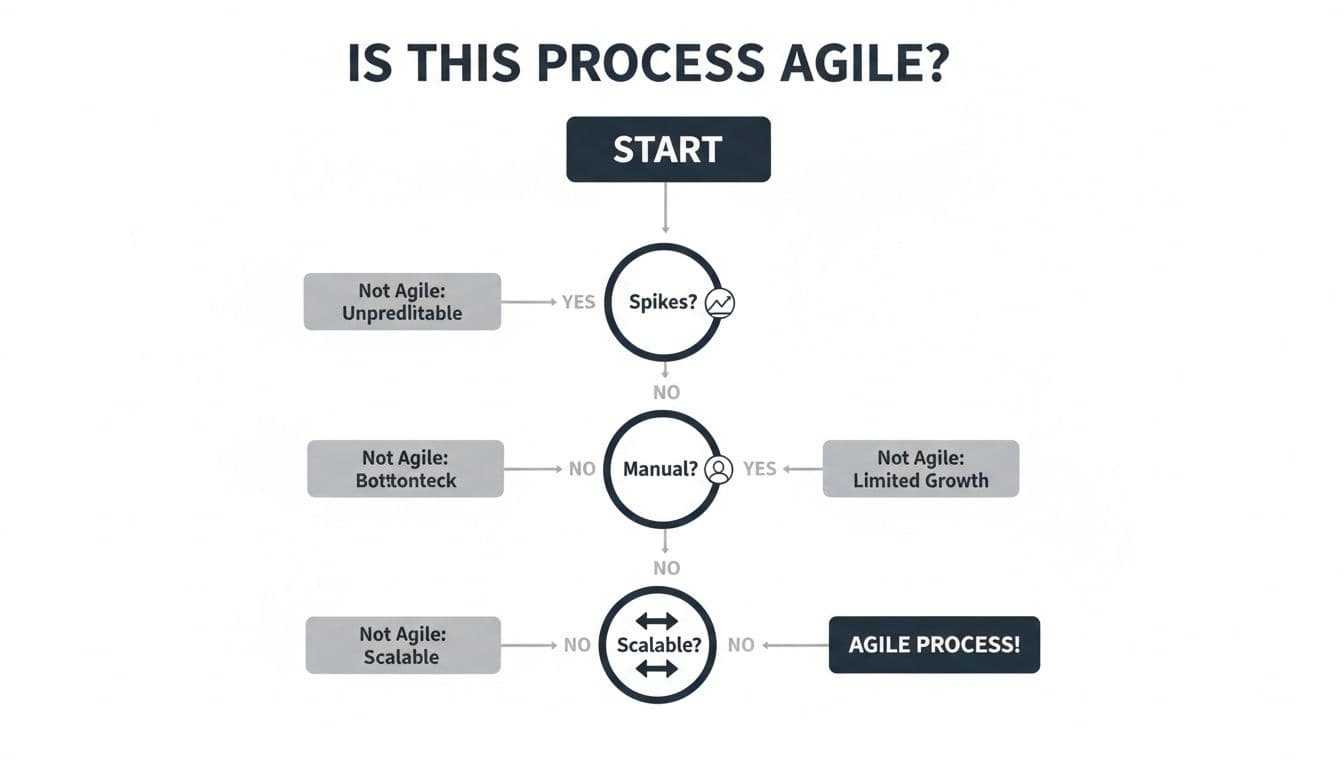
4. Build a more agile and scalable business
In a market that can change instantly, adaptability is a survival skill. Companies relying on manual processes are brittle. When demand spikes, their only move is to throw more people at the problem, which is slow and expensive. This is where the strategic power of business process automation changes the game.
Automation gives your business the elasticity to scale up or down almost instantly. An automated system can handle a 5x jump in customer orders overnight without breaking a sweat. This means you can jump on market opportunities the second they appear.
Decouple your growth from your headcount
True scalability means your growth is no longer tied to your operational costs. Manual work creates a direct link: to double your output, you have to nearly double your team. Automation breaks that chain, letting technology absorb the extra volume.
This is a massive competitive edge. You can chase aggressive growth goals knowing your operational backbone won't crack. Nearly one-third of businesses now lean on workflow automation to sharpen their operations, as shown in these business process automation statistics. It's about building a business model that's ready for anything.
An agile framework for seizing opportunities
Agility is about being able to pivot your strategy without tearing down your systems. You can update the rules in your automation platform in hours, not the weeks it would take to retrain an entire department.
- The opportunity: A competitor messes up their pricing, opening a brief window to grab market share.
- The manual response: Marketing scrambles new campaign materials while sales manually updates prices in the CRM. The opportunity is gone before they're ready.
- The automated response: An automated workflow pushes the new pricing to all systems at once. Another workflow instantly triggers a promo campaign. The business cashes in on the opportunity in real time.
By building this flexibility into your operations, you create a business that can react to market shifts faster than everyone else.
How to find your first automation wins
Knowing the benefits of automation is great, but getting results is where the real work begins. Start by targeting small, high-impact projects. These "quick wins" build momentum and prove the business case. A successful first project builds confidence and unlocks the budget for bigger initiatives.
To find these low-hanging-fruit opportunities, use the ‘Rule of Three’. Look for processes that are repetitive, rule-based, and reliant on digital data.
A practical checklist for finding quick wins
Start hunting for potential candidates across different departments.
- Finance: Invoice processing, expense report approvals, purchase order generation.
- Human resources: Onboarding paperwork, leave request processing, payroll data entry.
- Marketing & sales: Lead data entry into your CRM, social media scheduling, weekly performance reports.
Once you have a list, use a simple matrix to prioritize. Score each process on potential impact (1-5) and implementation effort (1-5). Your first project should be high-impact and low-effort. That’s your golden ticket. For a deeper dive, check out our guide on how to implement AI in business.
Wrapping up
We’ve walked through the core advantages of business process automation, from slashing costs to building a more agile business. BPA isn’t a luxury; it's a fundamental strategy for any founder serious about growth. Don't let manual processes limit your potential.
Your first move doesn't have to be a giant leap. Start by identifying just one repetitive, rule-based process and mapping it out. Understanding its current bottlenecks is the first step toward transforming it. To kick off this journey, our guide on conducting an AI readiness assessment gives you a structured way to do it.
We at N² labs can help you pinpoint these high-impact opportunities and build a robust automation strategy that delivers real results.
FAQ
The top three advantages are significant cost reduction, massive productivity gains, and improved accuracy and compliance. Automation cuts labor costs and eliminates expensive human errors, frees up your team to focus on strategic work, and ensures rule-based tasks are performed flawlessly every time.
Finance, HR, and customer service typically see the quickest wins. These departments are full of high-volume, repetitive tasks like invoice processing (finance), employee onboarding (HR), and support ticket routing (customer service), making them ideal candidates for automation.
Measure both direct and indirect benefits. Direct ROI includes cost savings from reduced labor hours and eliminating errors. Indirect ROI includes metrics like faster process cycle times, higher employee productivity on strategic goals, and improved customer satisfaction scores. For a deeper dive into what can go wrong, it's worth understanding the common AI implementation challenges that can derail your ROI.
Absolutely. Modern, cloud-based automation tools are more accessible and affordable than ever. BPA allows small businesses to operate with the efficiency of a much larger company, enabling them to scale operations without a massive increase in headcount or overhead.
A classic example is automating lead data entry. When a potential customer fills out a form on your website, an automation workflow can instantly take that information, create a new contact in your CRM, assign the lead to a sales representative, and send a welcome email-all without any manual intervention.